
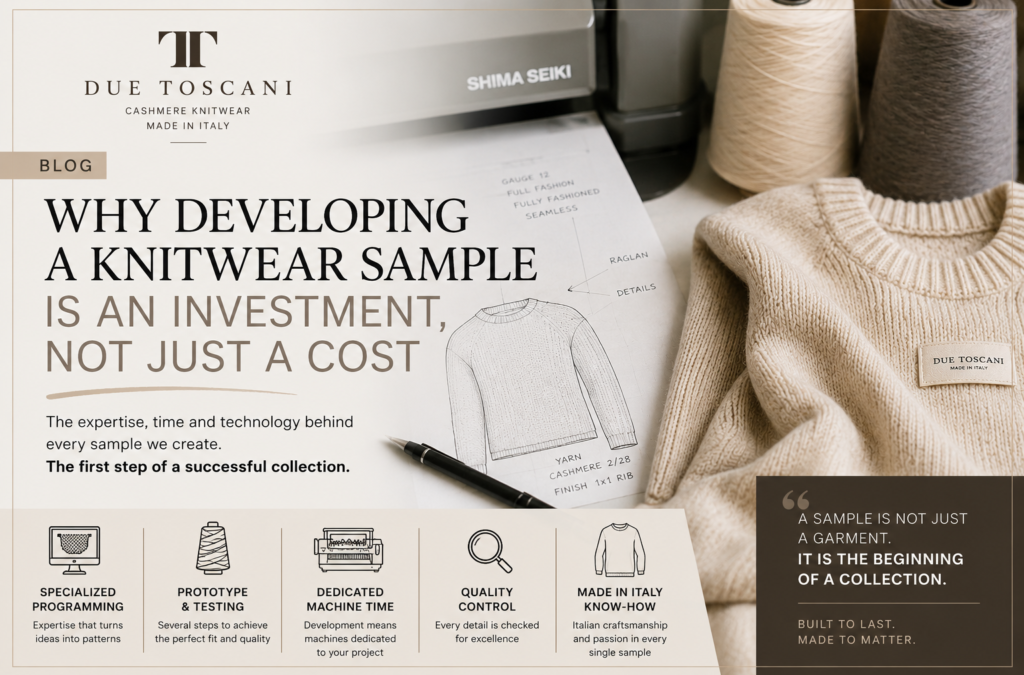
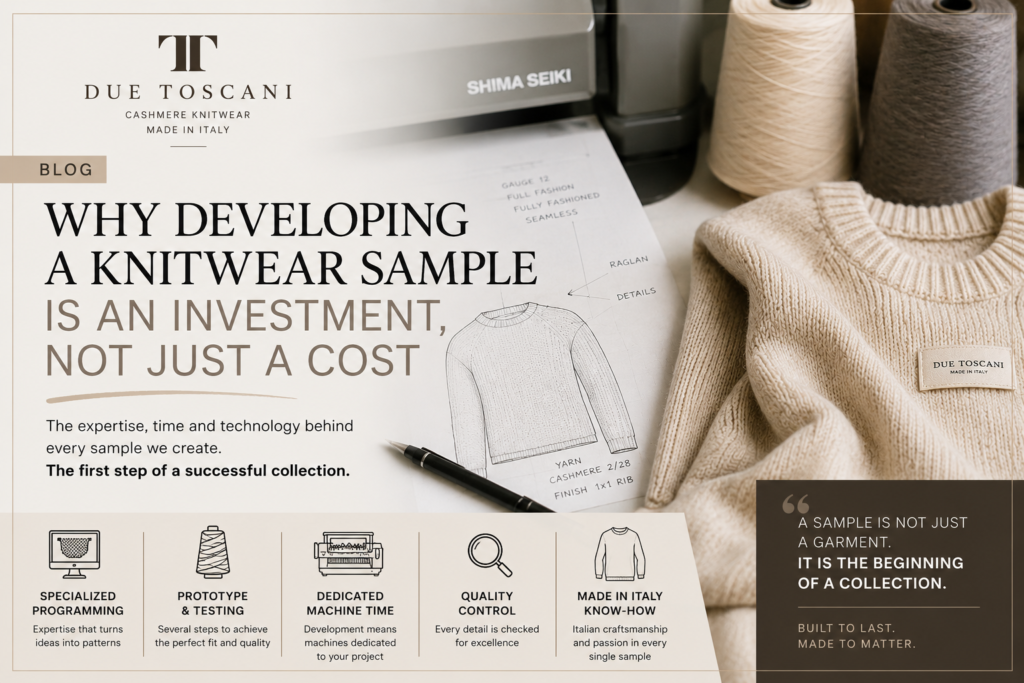
When a customer asks us to create a new knitwear style, the request often sounds very simple:
"Can you make a sample?"
The answer is almost always yes.
However, behind that single garment lies a development process that requires highly specialized expertise, time, advanced technology, and a significant production investment.
For this reason, at Due Toscani we consider every sample to be the first step of a production project, not simply a demonstration piece.
A Sample Begins Long Before the Machine Starts Knitting
Creating an electronic knitwear garment means transforming an idea into a program capable of communicating with a Shima Seiki knitting machine.
Before the machine is even switched on, several technical steps are required:
- Analyzing the design
- Defining the knit structure
- Selecting the yarn and gauge
- Engineering every construction detail
- Developing the knitting program
This work can only be carried out by highly skilled Shima Seiki programmers—professionals who have acquired their expertise through years of training and practical experience.
Every new style represents a completely new engineering project.
The First Sample Is Rarely the Final One
Many people believe that once the program has been created, the machine simply knits the finished garment.
In reality, the first prototype is produced to evaluate how the garment behaves.
During this phase we carefully assess:
- Fit
- Measurements
- Stitch structure
- Yarn tension
- Finishing details
- Yarn consumption
- Performance after washing
It is perfectly normal to modify the knitting program and produce additional prototypes before achieving the desired result.
Sample development is therefore an engineering process, not simply manufacturing.
The Knitting Machine Is Dedicated to Sample Development
While a prototype is being developed, the knitting machine is dedicated exclusively to that project.
This means it cannot be used to manufacture garments for existing customer orders.
Sample development therefore occupies valuable production capacity that could otherwise be used for regular manufacturing.
This is another important cost that often remains invisible to those outside the industry.
The Value of Specialized Expertise
Programming Shima Seiki knitting machines is one of the most specialized skills in the knitwear industry.
Every program requires technical knowledge, creativity and many hours of work.
Depending on the complexity of the style, developing the knitting program alone represents a significant investment. In addition, there are the costs of:
- Programmer's time
- Knitting technician
- Machine setup and operation
- Yarn consumption
- Quality control
- Linking and finishing
- Washing and final inspection
The real value of developing a knitwear sample is therefore much higher than the cost of producing a single garment.
Why We Charge for Sample Development
At Due Toscani, we charge a €200 contribution for developing a new sample.
This amount is largely symbolic and covers only a portion of the actual costs involved.
Our objective is not to sell samples, but to dedicate our time, expertise and production capacity to projects with a genuine intention of moving into production.
This approach allows us to provide every client with the highest level of attention while maintaining the quality standards that define our work.
Building Long-Term Partnerships
When we develop a sample, our goal is not simply to deliver a prototype.
Our goal is to lay the foundation for a successful production project.
We believe that the relationship between manufacturer and customer should be based on mutual trust, transparency and a shared vision.
For this reason, we are always pleased to invest our expertise in projects that have a real opportunity to become long-term collaborations.
Due Toscani: We Develop Products, Not Just Samples
Every collection we produce is born in the textile district of Prato, Italy—one of the world's leading centers for high-quality knitwear manufacturing.
Every sample embodies design expertise, technical engineering, Italian craftsmanship and years of manufacturing experience.
This invisible work is what transforms a simple prototype into a product ready for commercial production.
If you are looking for an Italian manufacturer to develop your collection in virgin cashmere, recycled cashmere, merino wool or other premium yarns, Due Toscani will be pleased to guide you from the initial concept through to full-scale production.