
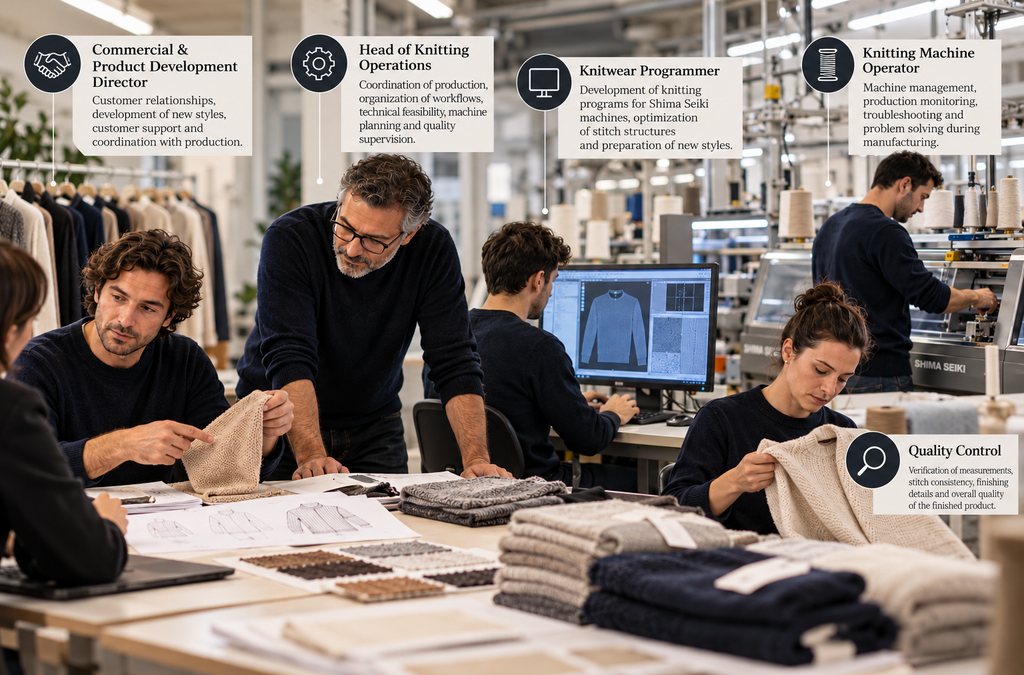
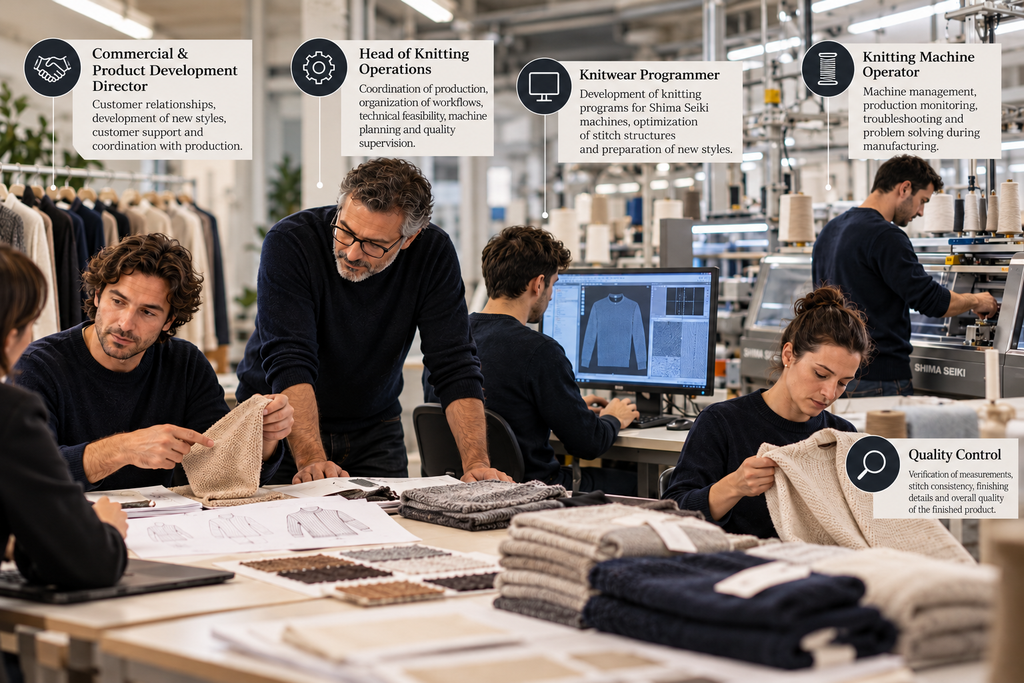
Behind Every Knitwear Garment, There Are People, Not Just Machines
From the customer's initial idea to the finished product: discover the professionals behind Made in Italy knitwear manufacturing.
When we talk about knitwear manufacturing, we often think about machines, yarns, and knitting techniques. Today, modern computerized knitting machines such as Shima Seiki allow manufacturers to create highly sophisticated garments, with structures, details, and techniques that would have been difficult to imagine just a few decades ago.
But even the most advanced machine cannot create a collection on its own.
Behind every sweater, cardigan, scarf, or accessory is a team of professionals with different skills and responsibilities. Some work directly with the machines, others develop knitting programs, while others coordinate production or manage customer relationships.
Let's discover who these professionals are and what they do.
1. Head of Knitting Operations: The Person Who Runs the Workshop
The Head of Knitting Operations is one of the key figures in a knitwear manufacturing company.
This professional oversees daily production activities, organizes machine workloads, plans manufacturing processes, and supervises the production team.
In Italian artisan workshops and small to medium-sized manufacturing companies, this role is often performed by one of the business owners.
The job involves much more than simply assigning work to a machine. It requires extensive knowledge of yarns, stitch structures, knitting gauges, machine capabilities, and the technical challenges that may arise during production.
Key responsibilities include:
- Organizing production and allocating work across knitting machines.
- Coordinating programmers and machine operators.
- Evaluating the technical feasibility of new designs.
- Optimizing production times, processes, and machine utilization.
- Solving manufacturing problems.
- Supervising production quality.
This role combines practical experience, organizational skills, and in-depth technical knowledge.
Because even with the most advanced knitting technology, experience still makes the difference.
2. Knitwear Programmer: Turning a Design into Machine Instructions
A computerized knitting machine does not produce a garment simply by pressing a button.
Before production can begin, someone must tell the machine exactly how to create the garment.
That is the job of the Knitwear Programmer.
Using specialized software, such as the systems developed by Shima Seiki, the programmer translates a garment's technical specifications into instructions that the knitting machine can execute.
This requires a thorough understanding of knitted structures, yarn behavior, shaping techniques, garment construction, and machine capabilities.
The programmer's responsibilities include developing and modifying knitting programs, optimizing manufacturing processes, and working closely with the production manager during the development of new styles.
For particularly complex constructions, including seamless and integral knitting, programming requires an exceptionally high level of expertise.
It is a profession that combines textile knowledge, logical thinking, precision, and problem-solving skills.
3. Knitting Machine Operator: Managing the Machines During Production
Once the knitting program has been developed and tested, the garment moves into production.
The Knitting Machine Operator is responsible for monitoring and operating the knitting machines throughout the manufacturing process.
Their duties include preparing the machines, loading the correct yarns, monitoring production, and responding to any problems that may occur.
Operators must be able to recognize defects, yarn breakages, irregular stitches, and other issues that could affect the quality of the finished garment.
An experienced operator is much more than someone who watches a machine.
They are a skilled professional capable of identifying problems that an untrained eye might easily miss.
4. Commercial & Product Development Director: Connecting Customers with Production
Another essential role in a knitwear manufacturing company is one that does not necessarily involve working directly with the machines.
The Commercial & Product Development Director manages commercial development and helps coordinate product development from the customer's and the market's perspective.
In manufacturing companies that also produce garments for other brands, this professional acts as the connection between customer expectations and the workshop's manufacturing capabilities.
They listen to ideas, evaluate projects, understand the customer's objectives, and collaborate with production managers to turn those requests into products that can actually be manufactured.
Their responsibilities include:
- Managing commercial relationships with customers, boutiques, and fashion brands.
- Providing customer support before, during, and after orders.
- Collecting requests for customization and new product development.
- Contributing to the creation of new catalogue collections.
- Discussing technical feasibility with production managers.
- Identifying suitable materials, product features, and manufacturing solutions.
- Coordinating communication between customers and the workshop throughout development and production.
In some companies, this professional is also a business partner or shareholder, even without being directly involved in the daily management of knitting machines.
Their market knowledge and direct contact with customers bring valuable information into the workshop: which styles are in demand, which features customers appreciate most, which problems need to be solved, and which new opportunities are worth exploring.
A successful product also begins with understanding the people who will sell it and the people who will wear it.
5. Quality Control: Ensuring the Finished Product Meets Expectations
Before a garment reaches the customer, it must be carefully inspected.
Quality Control involves a series of checks covering measurements, stitch consistency, seams, finishing details, and the overall appearance of the product.
However, quality control should never be considered just the final stage of manufacturing.
Quality is built throughout the entire production process: from yarn selection and programming to machine knitting, washing, finishing, and packaging.
In smaller manufacturing companies, quality control responsibilities may be shared among several professionals, each checking the results of their particular stage of production.
6. Collaboration: Turning an Idea into a Finished Product
Imagine a customer who wants to develop a new cashmere sweater for their own brand.
The project might begin with a photograph, a drawing, a physical sample, or simply a description of the desired garment.
The commercial manager collects the necessary information, clarifies the customer's expectations, and discusses the project with the production manager.
The production manager evaluates the technical possibilities, garment construction, and manufacturing requirements.
The knitwear programmer develops the machine program, while the operators help produce the first sample.
The sample is then inspected, adjusted if necessary, and submitted to the customer for approval.
Only after this stage does the project move into production, followed by quality checks and finishing operations.
Every professional contributes a different set of skills to this process.
The commercial manager understands the customer's needs. The production manager understands the workshop's capabilities. The programmer translates the design into machine instructions. The operators manufacture the garment. Quality control verifies the result.
None of these skills is sufficient on its own.
7. Modern Technology, Italian Expertise
Italian knitwear manufacturing has undergone an extraordinary technological transformation.
Computerized knitting machines have changed the way garments are designed and manufactured, making increasingly precise and complex constructions possible.
But technology has not eliminated the importance of people. It has transformed the skills required.
Today, a modern knitwear workshop needs both traditional knitting expertise and advanced capabilities in programming, production management, product development, and customer relations.
In the textile district of Prato, Tuscany, where we operate, these skills represent a valuable heritage built through generations of experience and continuously updated through new technologies.
The Due Toscani Approach
At Due Toscani, we believe that the quality of a garment comes from collaboration between all these professionals.
We work closely with production workshops, programmers, and the people who operate knitting machines every day, connecting their technical expertise with our customers' requirements.
Our direct relationships with boutiques, retailers, and private label brands allow us to actively contribute to the development of new styles, both for our own collections and for customized projects.
Not every idea can be manufactured immediately, and not every request is compatible with production schedules, minimum quantities, or technical requirements.
An important part of our work is explaining these possibilities and limitations clearly, while offering practical solutions.
Because producing high-quality knitwear is not simply about owning modern machines or purchasing excellent yarns.
It is about bringing together the right people, with the right skills, who know how to work as a team.
And that remains one of the most important values of authentic Made in Italy manufacturing.
Due Toscani — Made in Italy knitwear and accessories. Virgin cashmere, recycled cashmere, and premium yarns. Manufacturing for boutiques, retailers, and private label brands.