
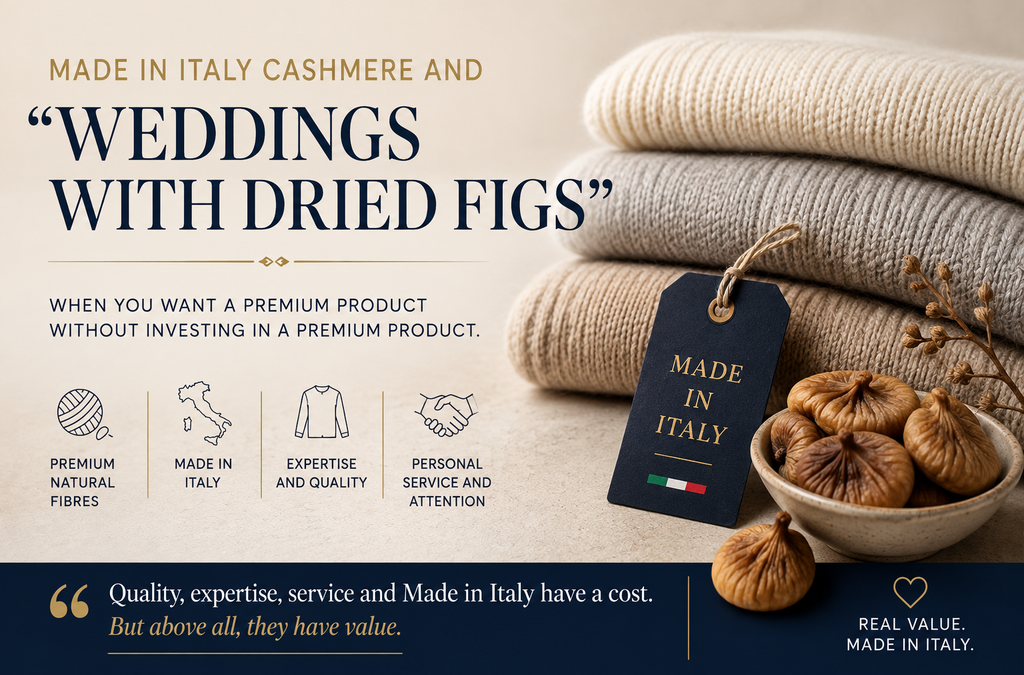
When you want a premium product without investing in a premium product
There is an old Italian expression that perfectly describes a situation we sometimes encounter in our business:
“Voler fare le nozze con i fichi secchi.”
Literally, it means:
“Wanting to have a wedding with dried figs.”
It comes from the idea of wanting to organise an important, elegant wedding celebration while offering your guests nothing more than a handful of dried figs.
In other words, wanting something ambitious, prestigious and expensive while being unwilling to invest the resources necessary to achieve it.
The closest English idea might be wanting champagne on a beer budget, although the Italian expression is perhaps even more colourful.
And in the world of fashion and knitwear, we see our own version of “weddings with dried figs” more often than you might imagine.
A company is looking for an Italian manufacturer.
They want cashmere, extra-fine merino wool or other premium natural fibres.
They want genuine Made in Italy production.
They want small quantities.
They want attention to detail, flexibility, advice and direct communication with the manufacturer.
They may also want custom designs, private-label production, prototypes, modifications and assistance in developing an entire collection.
All perfectly reasonable requests.
Then comes one final requirement:
“But the price needs to be very low.”
Sometimes, the company is not even willing to invest in the development of the samples.
And this is where we have a contradiction.
Not because Italian manufacturers do not want to be competitive.
But because you cannot ask for a premium product while removing all the costs that make that product premium.
A sweater is not simply a sweater
In a photograph, two sweaters may look relatively similar.
One may be made from synthetic fibres and manufactured in tens or hundreds of thousands of units in a highly industrialised supply chain designed primarily around price.
The other may be knitted in Italy from cashmere or extra-fine merino wool, produced in relatively small quantities and made by specialised workers within a local manufacturing district.
Both are sweaters.
But from a manufacturing and economic perspective, they are two completely different products.
It is like comparing a mass-produced car with a vehicle made in small series by specialised manufacturers.
Their basic function may be similar.
The product is not.
And neither is the cost structure behind it.
What is really behind a Made in Italy garment?
When you purchase an Italian knitted garment, you are not simply paying for yarn and a few minutes of machine time.
There is an entire chain of expertise behind that garment.
The yarn has to be selected.
The design has to be interpreted and transformed into something that can actually be knitted.
The knitting machine has to be programmed.
Tests have to be carried out.
The individual parts — or the complete garment in the case of seamless technology — have to be knitted.
Depending on the construction, there may be linking, assembly and finishing.
Then come washing and fulling, measurement checks, finishing and quality control.
And behind all these processes are people who have spent years, sometimes decades, learning how to do this work properly.
Made in Italy is not simply a label sewn inside a sweater.
It is a manufacturing ecosystem.
It is knowledge.
It is experience.
And all of that has value.
“Can you make a sample first?”
Of course.
In fact, when we develop a new style for a customer, the sample is an essential part of the process.
But there is a common misunderstanding that needs to be addressed.
A sample is not a free sweater supplied by the manufacturer.
Before the first prototype exists, somebody has to study the design.
The knitting machine has to be programmed.
The construction has to be tested.
Yarn has to be used.
The garment has to be knitted, finished, washed and checked.
And very often it has to be corrected and produced again.
When 100 pieces of the same style are manufactured, much of this initial development work is spread across the entire production run.
When you make one prototype, the development work still has to be done.
That is why the first sample can appear expensive when compared with the eventual unit price of the production order.
You are not simply paying for one sweater.
You are paying for the development of a product.
Who should take the risk?
This becomes particularly important when we work with new and emerging brands.
We completely understand the need to control the initial investment.
A new brand does not yet know how much it will sell.
It wants to test the market.
It wants to protect its cash flow.
It wants to minimise risk.
That is perfectly understandable.
But reducing your own risk cannot simply mean transferring that risk to the manufacturer.
If a company asks a manufacturer to develop its designs for free, produce samples at no cost, manufacture very small quantities and at the same time offer prices comparable with large-scale industrial production, someone still has to finance all that work.
And that someone becomes the manufacturer.
That is not a sustainable partnership.
A healthy business relationship has to make economic sense for both sides.
Small quantities? Yes — but with a different strategy
None of this means that a small brand necessarily needs to invest tens of thousands of euros before selling its first garment.
There are other ways to start.
For example, a new brand or retailer can begin with products that have already been developed and are available from stock.
It can test different materials, colours and styles.
It can start with a carefully selected range rather than immediately developing an entire custom collection.
It can understand what its customers actually want.
And once the market has been tested, it can begin investing in exclusive designs and private-label development.
This is a strategy we often recommend ourselves:
Test the market first. Build the collection afterwards.
It reduces the customer's risk without asking the manufacturer to finance the project.
Looking for a better price is not the problem
Negotiation is part of business.
Comparing manufacturers is sensible.
Optimising costs is good management.
There is absolutely nothing wrong with any of that.
The problem begins when prices are compared between products that belong to completely different categories.
If your primary purchasing criterion is the lowest possible price, there are global manufacturing supply chains that are extremely efficient at providing exactly that.
There is nothing inherently wrong with choosing them.
It is a business model.
But if you are looking for cashmere and premium natural fibres, genuine Italian manufacturing, relatively small quantities, custom development, flexibility, direct assistance and a high level of workmanship, you cannot realistically expect the price of a mass-produced synthetic garment.
The comparison itself is wrong.
It is not simply a question of whether one manufacturer is expensive and another is cheap.
It is a question of what you are actually buying.
Before asking about price, ask another question
Naturally, every buyer needs to know:
“How much does it cost?”
But there is another question that should come first:
“What exactly am I receiving for that price?”
What fibre is being used?
Where is the yarn produced?
Where is the garment actually manufactured?
What quantities are being produced?
What level of workmanship is involved?
Who develops the product?
What kind of assistance will I receive?
Can I communicate directly with the manufacturer?
Can the manufacturer help me develop my own designs in the future?
And finally:
What is genuine Made in Italy production worth to my brand and to my customers?
Only after answering these questions does it make sense to compare two prices.
Because price and value are not the same thing.
So, can you have a wedding with dried figs?
Of course you can.
But perhaps it will not be the wedding you imagined.
We believe in Italian manufacturing.
We believe in cashmere, premium natural fibres and the extraordinary manufacturing knowledge that exists within the Italian textile districts.
We also believe in small companies, independent retailers and new brands.
Some of today's small projects can become tomorrow's successful businesses, and we are happy to grow alongside them.
But we believe even more strongly in transparent and sustainable partnerships.
We can work together to reduce the initial investment.
We can start with products that have already been developed.
We can build a collection gradually.
We can choose yarns, constructions and processes that make sense for the available budget.
We can find many different solutions.
What we cannot do is promise premium fibres, Italian manufacturing, custom development, small quantities, personal assistance and premium workmanship at the price of a mass-produced synthetic garment.
Because quality has a cost.
Expertise has a cost.
Service has a cost.
Made in Italy has a cost.
But more importantly:
they have value.
And price and value are two very different things.
So when you are planning your next premium collection, remember the old Italian saying:
You can organise the wedding you want.
Just don't expect to pay for it with dried figs.