

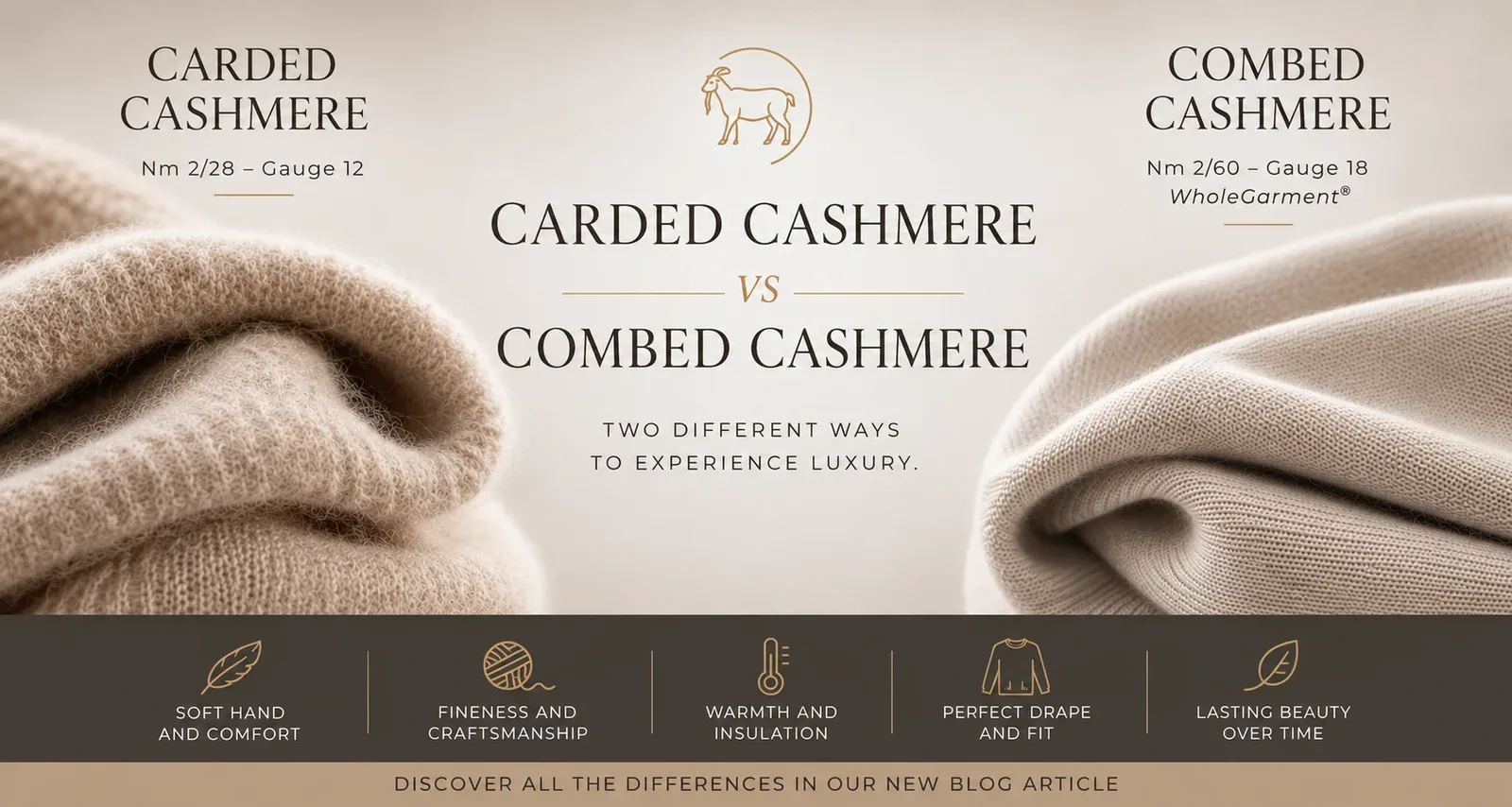
Carded cashmere is like a very soft wool blanket: it envelops, traps air, and transmits warmth and softness.
Combed cashmere is like a heavy silk fabric: fluid, clean, elegant, with a perfectly smooth surface.
When people think about cashmere knitwear, they often assume that one cashmere sweater is much like another. In reality, nothing could be further from the truth.
There are two main families of cashmere yarns used in knitwear: carded cashmere and combed cashmere.
Both can be made from the finest quality cashmere fibers, both can be entirely Made in Italy, and both can represent true luxury. Yet the final garment offers a completely different experience.
To better understand the difference, let's compare two women's sweaters produced by Due Toscani:
- a sweater knitted in 100% carded cashmere Nm 2/28 on a 12-gauge knitting machine;
- a sweater knitted in 100% combed cashmere Nm 2/60 on an 18-gauge Shima Seiki WholeGarment® machine, produced seamlessly.
Both are made from pure cashmere.
Both are manufactured in Italy.
Yet they almost seem to belong to two different worlds.
Carded Cashmere: Softness, Warmth and Volume
The very first sensation you experience when touching a sweater made from carded cashmere is softness.
During the carding process, the fibers are opened and arranged in a less uniform way than in combed yarns, allowing part of the fibers to naturally rise to the surface.
The result is a garment that feels:
- softer;
- fuller;
- slightly fuzzy;
- warmer to the touch.
Its surface is not perfectly smooth.
And that is precisely its beauty.
The delicate halo surrounding the yarn creates the comforting softness that most people instinctively associate with premium cashmere.
Carded yarn also traps a larger amount of air between the fibers.
Since air is nature's best thermal insulator, this structure allows the garment to retain heat extremely well.
That is why a carded cashmere sweater immediately feels warm and cozy, even when it is surprisingly lightweight.
Combed Cashmere: Precision, Elegance and Refinement
Combed cashmere follows a completely different philosophy.
Before spinning, the fibers are carefully combed and aligned in the same direction.
This produces a much more regular, compact and uniform yarn.
A sweater knitted in Nm 2/60 cashmere on an 18-gauge machine has characteristics that are immediately recognizable:
- perfectly smooth surface;
- silky, dry hand feel;
- elegant drape;
- exceptionally well-defined stitch structure;
- uniform weight distribution.
It doesn't feel like a soft cloud.
Instead, it feels like an exceptionally refined textile.
Many customers describe it as wearing a "second skin."
The Way the Garment Drapes Is Completely Different
This is perhaps the biggest difference—although it is difficult to appreciate in photographs.
A carded cashmere sweater has more body.
It maintains its structure and shape more naturally.
A combed cashmere sweater, on the other hand, follows the body's movements effortlessly.
It drapes gracefully over the shoulders and adapts naturally to the silhouette.
For this reason, combed cashmere is widely used in contemporary luxury collections where elegance, fluidity and refined tailoring are essential.
Gauge Makes a Huge Difference
A 12-gauge knitting machine produces a richer, fuller knit with a more visible stitch structure.
The fabric feels substantial and textured, making it ideal for autumn and winter garments.
An 18-gauge machine, by contrast, creates an exceptionally fine knit.
The stitches become almost invisible.
The surface appears smooth, continuous and incredibly elegant.
When this construction is combined with WholeGarment® seamless technology, comfort reaches another level.
Without side seams or linking, the garment adapts naturally to the body and offers an almost imperceptible wearing experience.
Which One Feels Softer?
This is probably the question we hear most often.
The answer depends on what we mean by "soft."
Carded cashmere feels softer the moment you touch it.
Its loft immediately creates a sensation of warmth and comfort.
Combed cashmere, instead, initially feels smoother and drier.
But once worn, it surprises with its extraordinary delicacy against the skin.
They are simply two different kinds of softness.
One is cloud-like softness.
The other is silky softness.
Which One Is Warmer?
For garments of comparable weight, carded cashmere generally provides greater thermal insulation because its loft traps more air between the fibers.
Combed cashmere, on the other hand, focuses on lightness, elegance and year-round comfort.
It performs exceptionally well indoors, under jackets and in environments where refined layering is preferred.
Neither is objectively better.
They simply offer two different interpretations of luxury.
Carded Cashmere vs Combed Cashmere
| Feature | Carded Cashmere (Nm 2/28 – Gauge 12) | Combed Cashmere (Nm 2/60 – Gauge 18 WholeGarment®) |
|---|---|---|
| Appearance | Soft, slightly fuzzy, voluminous | Smooth, clean, refined |
| Hand Feel | Plush and enveloping | Silky, dry and ultra-fine |
| Touch Sensation | Cloud-like softness | Second-skin comfort |
| Volume | Fuller | Slimmer |
| Fabric Thickness | More substantial | Extremely fine |
| Perceived Weight | Light for its volume | Compact for its thickness |
| Warmth | Excellent thanks to greater air retention | Excellent, though slightly less insulating at equal weight |
| Drape | More structured | Fluid and elegant |
| Elastic Recovery | Softer and more relaxed | Stable and precise |
| Stitch Definition | Softer, less defined | Extremely sharp and refined |
| Fit | Cozy and enveloping | Elegant and naturally body-following |
| Comfort | Immediate feeling of warmth | Lasting comfort throughout the day |
| Overall Style | Casual luxury | Contemporary luxury |
| Best Use | Winter sweaters, cardigans, turtlenecks | Fine sweaters, polos, lightweight crew necks, garments worn under jackets |
| Typical Manufacturing Technology | 7–12 gauge knitting machines | 16–18 gauge WholeGarment® seamless knitting machines |
A Difference You Don't Just See… You Feel
If we had to describe these two types of cashmere in just a few words, we would say this.
Carded Cashmere
✔ You immediately want to wrap yourself in it.
✔ It feels warm from the very first touch.
✔ It offers instant softness.
✔ It has a rich, natural and textured appearance.
✔ It creates an immediate sense of comfort.
Combed Cashmere
✔ It truly reveals itself once you wear it.
✔ It glides effortlessly over the body.
✔ It is exceptionally elegant.
✔ Its surface is perfectly smooth.
✔ It is so comfortable that you almost forget you're wearing it.
An Easy Way to Understand the Difference
A simple comparison often explains it better than any technical description.
Carded cashmere is like a luxurious blanket.
It wraps around you.
It keeps you warm.
It gives you an immediate feeling of comfort.
Combed cashmere is like a bespoke shirt made from the world's finest fiber.
It is lightweight.
It drapes beautifully.
It is effortlessly elegant.
A Matter of Personal Preference
Another important difference concerns how the garment evolves over time.
Because carded cashmere naturally has more free fibers on its surface, it may develop a light pilling during the first period of use. This is perfectly normal for high-quality carded yarns and usually stabilizes after the first wears and proper washing.
Combed cashmere, thanks to its longer, parallel fibers, generally has a smoother and more stable surface, with a lower tendency to pill and a more uniform appearance over time.
Neither characteristic should be considered a defect.
They are simply the natural result of two different spinning technologies.
Two Interpretations of the Same Extraordinary Fiber
Carded cashmere represents the warmest, softest and most enveloping expression of this extraordinary natural fiber.
Combed cashmere expresses its most refined, technical and elegant side.
At Due Toscani, we choose both because they meet different expectations.
Some customers seek the comforting embrace of a warm winter sweater.
Others are looking for an exceptionally refined knit that feels light, elegant and perfectly tailored.
In both cases, the true protagonist remains the same:
high-quality cashmere, expertly crafted in Italy through a combination of traditional craftsmanship and state-of-the-art knitting technology.