
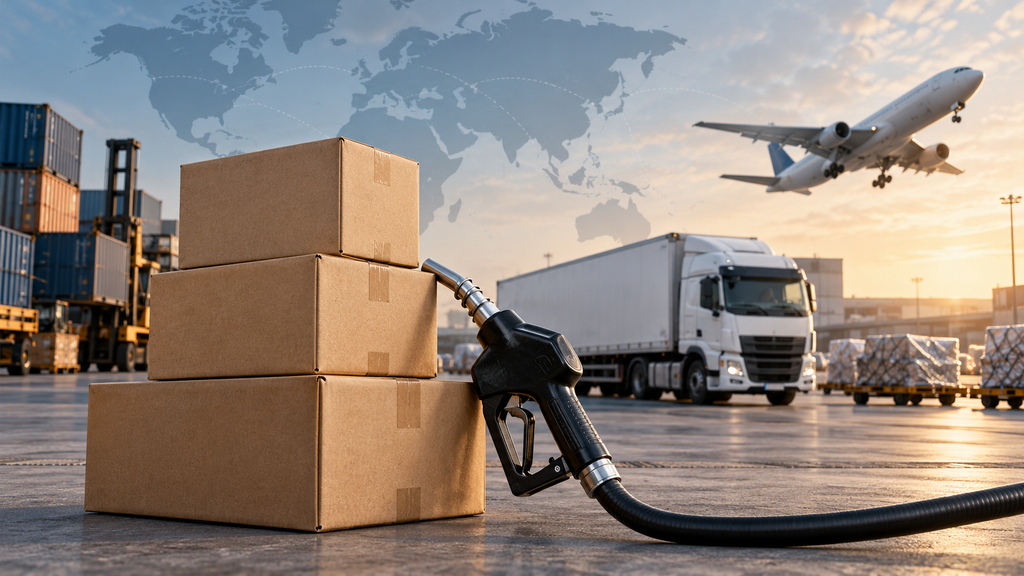
When you buy a product, the shipping cost may seem straightforward: one parcel, one address and one price. In reality, every delivery relies on a network of collections, transfers, sorting centres and final distribution. Each stage requires energy and, often, fuel.
This is why shipping prices can change even when the product, parcel weight and destination remain the same. For shipments outside the EU, particularly those travelling by air, these fluctuations can be especially noticeable.
What Is a Fuel Surcharge?
Many carriers apply a fuel surcharge: a variable charge added to the transportation rate.
Its purpose is to adjust shipping prices in response to changes in fuel costs. Road services may use diesel prices as a reference, while air services generally refer to aviation fuel.
The percentage and frequency of updates depend on the carrier and service. FedEx, for example, states that its international fuel surcharge is updated weekly using an aviation fuel price index. There is therefore no single percentage that applies to every shipment.
One point deserves clarification: a 10% increase in fuel prices does not automatically mean a 10% increase in the shipping price. The actual impact depends on the carrier’s surcharge tables, the base transportation rate and the charges to which the surcharge applies.
How Much Can It Affect the Final Price?
Let’s consider a purely illustrative example, unrelated to any carrier’s current rates.
If the base transportation rate is €40:
| Item | With a 20% Surcharge | With a 30% Surcharge |
|---|---|---|
| Transportation rate | €40 | €40 |
| Fuel surcharge | €8 | €12 |
| Total for these two items | €48 | €52 |
The parcel is identical, but the cost increases by €4.
The actual calculation can be more complex. Some carriers also apply the fuel surcharge to certain additional charges, such as remote area delivery or oversized parcel surcharges. It is therefore important to check the service conditions as well as the base rate.
Why Is the Impact Often Greater on Shipments Outside the EU?
Crossing a customs border does not, in itself, increase fuel consumption. What matters is the distance, the mode of transport, the carrier’s network and the delivery speed required.
A shipment from Italy to Switzerland may travel just a few hundred kilometres by road. A delivery to the United States or Japan may involve road transfers, air transport and further distribution within the destination country.
For many distant destinations outside the EU, air transport is a significant component of express shipping. Changes in aviation fuel prices can therefore affect the surcharge applied.
Moreover, when the base transportation rate is higher, the same percentage results in a larger additional charge in euros. A 25% surcharge adds €5 to a €20 transportation rate, but €20 to an €80 rate.
This helps explain why a change may have a relatively modest impact on a nearby delivery and a much more noticeable effect on an intercontinental shipment.
Fuel Surcharges and Customs Charges Are Different Costs
For shipments outside the EU, it is important to distinguish between the different charges:
- Transportation: the service required to move the goods to their destination.
- Fuel surcharge: the carrier’s adjustment for fuel costs.
- Other logistics surcharges: possible additional charges relating to the delivery location, parcel dimensions or service requested.
- Import and customs clearance charges: any applicable duties, taxes and handling fees, which depend on the destination country and the goods being shipped.
A fuel surcharge is not a customs duty. An increase in the transportation price does not necessarily mean that customs charges have also increased.
When comparing two quotations, check that they include the same items. An apparently lower rate may exclude surcharges added later.
Why Can the Cost Change Between Ordering and Dispatch?
Days or weeks may pass between requesting a quotation and dispatching the goods. If the carrier’s surcharges change during that period, the final shipping cost may also change.
This is particularly relevant for orders that require preparation or production time. It is useful to know how long a quotation remains valid and to confirm the shipping cost once the number of parcels, their weight and dimensions, and the delivery address have been established.
How to Reduce the Impact of Shipping Costs
Neither the seller nor the buyer controls fuel prices, but certain choices can help manage the overall cost:
- Combine purchases, where possible, to spread shipping costs across more products.
- Use appropriately sized packaging, avoiding unnecessary volume.
- Consider less urgent services, when they meet the required delivery timeframe.
- Compare complete quotations, including all applicable surcharges.
- Look at the shipping cost per item, as well as the total.
For knitwear and accessories, for example, a small trial order may carry a higher shipping cost per item than a larger order. Combining purchases may reduce that cost, although any savings should be checked against the carrier’s weight bands and the service selected.
Shipping costs depend on specific, changing conditions. Understanding the role of fuel helps you assess a quotation and explains why delivering the same product to the same country can cost different amounts at different times.