
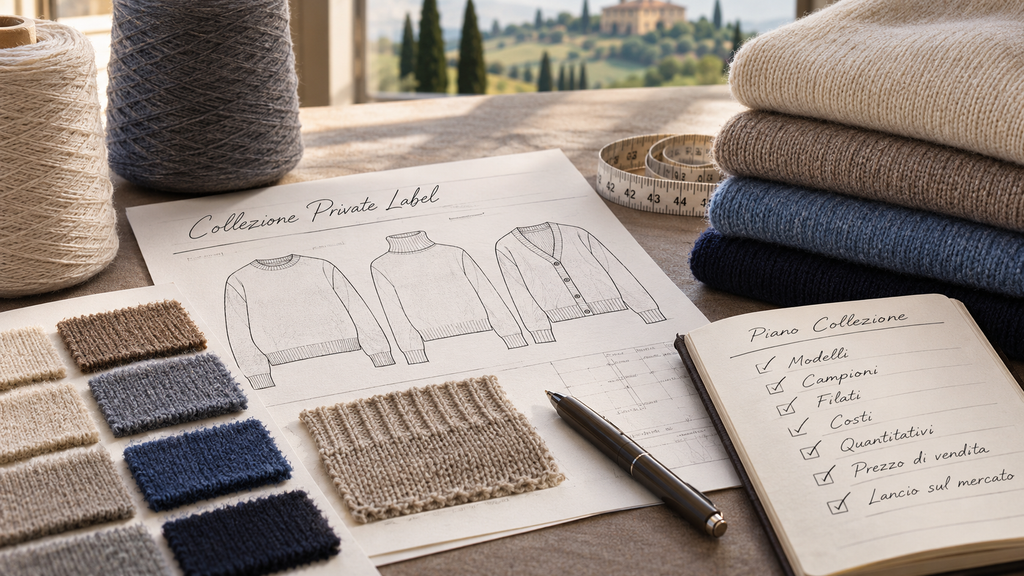
Creating your own knitwear brand is an exciting project. However, turning an idea into a collection ready for sale requires careful planning, investment and technical expertise. Here's what you need to know before getting started.
Having an Idea Doesn't Mean Having a Collection
Every year, new fashion brands enter the market. Some begin with a clearly defined business plan, others with a passion for fashion, and others simply with the desire to create something unique.
Often, everything starts with a photograph, a sketch, a garment seen in a boutique or an existing design that someone would like to reinterpret.
But having an idea is only the first step.
Developing a knitwear collection, particularly when working with cashmere, extra-fine merino wool and other premium yarns, involves much more than selecting a few designs.
You need to consider fit, yarn composition, knitting gauges, sizing, colours, production costs, minimum order quantities and, most importantly, the price at which your products can realistically be sold.
The first question should not be how much it costs to manufacture a sweater, but who will buy it, why they should choose it and how much they are willing to pay.
Every successful collection should begin with these answers.
1. Define Your Market Before Developing Your Products
One of the most common mistakes made by people entering the private label market is selecting products before identifying their target customers.
A cashmere sweater can appeal to very different markets.
It might be positioned as a luxury product, an everyday essential for independent boutiques, an item for an online store or a niche product with distinctive characteristics.
Each market has different expectations.
Before investing in product development, you should define:
- Your target customer.
- Your brand positioning.
- Your intended retail price.
- Your sales channels: e-commerce, boutiques, distributors or direct sales.
- The countries where you intend to sell.
- The capital available for development, production and marketing.
An excellent product offered to the wrong market, or at an unsustainable price, may remain unsold.
And unsold inventory, regardless of its quality, represents capital tied up in stock.
2. A Collection Doesn't Need Dozens of Designs
Another common misconception is that launching a fashion brand requires a large collection.
For a new brand, the opposite is often true.
A carefully planned collection of three, four or five designs can be commercially more effective than twenty products without a clear identity.
Imagine a small knitwear collection consisting of:
- A unisex crewneck sweater.
- A turtleneck sweater.
- A cardigan.
- A scarf.
- A matching beanie.
These five products can already form a coherent collection, especially when developed using coordinated yarns and colours.
Colour selection is equally important.
Every additional colour increases the number of product variations and may increase the inventory you need to manage.
A few carefully selected designs, a limited colour palette and a recognisable identity are often more valuable than a large assortment that consumes resources before sales even begin.
3. Why Investing in Samples Is Essential
Let's address one of the most important, and frequently misunderstood, aspects of developing a private label collection: sampling.
A sample is not simply a sweater manufactured as a single piece.
It is the result of a technical development process.
When a customer presents an original design, the manufacturer must analyse it and transform it into a product that can be consistently reproduced.
In knitwear manufacturing, this process may include:
- Analysing the sketch or reference garment.
- Selecting the appropriate yarn and knitting gauge.
- Studying measurements and fit.
- Programming the knitting machines.
- Producing the first prototype.
- Checking measurements, yarn consumption and construction.
- Making necessary adjustments and optimisations.
- Finalising the design for production.
All these activities require time, skilled personnel, machinery and materials.
Producing a single prototype may involve resources that would otherwise be dedicated to regular manufacturing.
This is why sample development has a cost.
A sample is not a complimentary promotional item. It is an investment required to transform an idea into a marketable and reproducible product.
Samples Help Prevent Expensive Mistakes
Imagine producing one hundred sweaters without properly checking their fit.
If the garments have incorrect proportions, the financial loss could be considerably greater than the original sampling cost.
The same applies to yarn selection, garment behaviour after washing, sleeve length or knitting construction.
Investing in samples reduces the risk of costly production errors.
Naturally, the prototype should be inspected and approved before proceeding with the final production order.
4. Developing New Designs or Starting From an Existing Collection?
There are two main approaches to creating a private label knitwear collection.
Starting With the Manufacturer's Existing Designs
This is often the simplest, fastest and most affordable option.
The manufacturer already has developed and tested designs that are ready for production.
Customers can select the styles that best suit their market and, depending on the manufacturer's available options, personalise them with their own labels, choose colours and materials or request limited modifications.
The main advantage is that much of the technical development has already been completed.
Initial costs are generally lower, and development risks are reduced.
This approach is particularly suitable for entrepreneurs who want to launch a collection without immediately investing in entirely new product development.
Developing Completely New Designs
The second option is to create garments based on the customer's own sketches, technical specifications, photographs or reference samples.
This approach offers greater opportunities for differentiation but requires a higher initial investment.
Each design must be studied, programmed, sampled and tested.
Furthermore, not every idea can be manufactured using every yarn or knitting machine.
The manufacturer's technical expertise therefore becomes essential.
An original collection can provide a significant competitive advantage, but it must be developed with both technical feasibility and commercial positioning in mind.
5. How Much Does It Cost to Develop a Private Label Collection?
There is no single figure that applies to every project.
Costs depend on the number of designs, manufacturing complexity, yarn selection, production quantities and requested customisations.
However, it is important to distinguish between three main investment categories.
A. Development Costs
These include design analysis, programming, prototyping and any necessary adjustments.
They are initial development expenses and should not be confused with the manufacturing cost of each garment.
B. Production Costs
These include yarns, knitting, finishing, quality control and the other processes required to manufacture the finished product.
The unit cost also depends on production quantities and garment complexity.
C. Commercial Costs
These are frequently overlooked.
Once the collection has been manufactured, it needs to be sold.
Professional photography, website development, packaging, communication, shipping, sales commissions and marketing are all expenses that should be considered from the beginning.
Having a finished collection sitting in a warehouse is not enough.
You need a clear strategy for bringing it to market.
6. A Practical Example: Budgeting for a Small Collection
Let's consider a purely illustrative example.
Imagine developing four original knitwear designs, with an initial production run of fifty garments per design.
| Expense | Estimated investment |
|---|---|
| Development of 4 designs at €350 each | €1,400 |
| Production of 200 garments at €65 each | €13,000 |
| Labels and packaging | €400 |
| Photography and content creation | €800 |
| Website and sales materials | €600 |
| Total estimated investment | €16,200 |
These figures are illustrative, excluding VAT, and do not constitute a quotation. They do not include every possible marketing, logistics, additional development or business management expense.
This example highlights an important point.
The development of four original designs represents €1,400 out of a total investment of €16,200.
In this scenario, less than 9% of the initial investment is allocated to technical product development.
Trying to save money during this phase, while potentially compromising the quality of the entire production run, may therefore be a poor business decision.
How Much Do You Need to Sell to Recover Your Investment?
Suppose the 200 garments are sold directly to consumers at an average retail price of €150, including Italian VAT.
The theoretical total revenue would be €30,000 including VAT, equivalent to approximately €24,590 excluding Italian VAT at 22%.
However, this amount is not your profit.
You must deduct your costs and account for any additional expenses not included in the initial budget, such as commissions, returns, shipping, advertising and business operations.
Furthermore, selling every garment is never guaranteed.
A sustainable business plan should also consider the possibility that part of the collection may remain unsold for some time.
Your selling price should not simply be calculated by adding a percentage to the manufacturing cost. It must support the entire commercial operation.
7. Minimum Order Quantities: Why Do They Exist?
People entering private label manufacturing for the first time often want to produce just a few garments per design, colour and size.
This is understandable: they want to minimise financial risk.
However, knitwear manufacturing involves preparation, programming, machine setup and production organisation costs.
Manufacturing five sweaters does not have the same unit cost as producing fifty or one hundred.
Minimum order quantities allow manufacturers to distribute these costs across an economically viable number of garments.
For customers, the challenge is therefore to organise their assortment correctly.
For example, an order of fifty sweaters divided across five sizes and four colours does not necessarily mean fifty pieces of every variation.
Instead, the total quantity can be distributed according to the manufacturer's commercial conditions.
This flexibility can help emerging brands build their first collection without accumulating excessive inventory.
8. Your Manufacturer Should Be More Than Just a Supplier
When developing a collection, choosing a manufacturing partner solely because they offer the lowest price can be a mistake.
An experienced manufacturer should help customers understand which knitting techniques are appropriate, which yarns to use, how to improve garment fit and how to make production more efficient.
In some cases, a small modification to a garment's construction can reduce yarn consumption or simplify manufacturing without compromising its appearance.
In other cases, an incorrect technical decision can unnecessarily increase production costs.
Manufacturing expertise is therefore an important part of the value customers receive.
You are not simply paying for a sweater. You are also paying for the knowledge and expertise required to manufacture it correctly.
9. When Should You Start Developing Your Collection?
Timing is another essential consideration.
Knitwear is a highly seasonal industry, and manufacturers need to plan their production capacity well in advance.
Brands planning to introduce an autumn/winter collection should begin developing their designs several months before the intended selling season.
Waiting until September to start developing a collection intended for the same winter may leave insufficient time for sampling, modifications, production and distribution.
It is important to distinguish between the date when you want to sell your products and the date when development must begin.
Proper planning improves efficiency, reduces last-minute emergencies and allows for better decisions.
10. The Real Risk Is Not Investing in Samples. It's Investing Without a Plan.
Some aspiring fashion entrepreneurs consider sampling costs an unnecessary expense.
But the real problem is not spending a few hundred euros to develop a product correctly.
The greater risk is investing thousands of euros in a collection without clearly defining the target market, selling price, distribution channels and capital required to support the business.
A properly developed sample allows you to evaluate an idea.
A carefully planned collection allows you to create a coherent product offering.
A commercial strategy allows you to turn that collection into sales.
These are three different but closely connected stages.
How We Work at Due Toscani
At Due Toscani, we manufacture knitwear and accessories in Tuscany, Italy, using virgin cashmere, recycled cashmere, extra-fine merino wool and other premium yarns.
We work with boutiques, retailers and fashion brands interested in developing private label collections.
We offer two main approaches.
1. Starting With Our Existing Collection
Customers can select styles from the Due Toscani catalogue and personalise them according to the available options, including the application of their own brand labels.
This is particularly suitable for businesses that want to start with products that have already been developed.
2. Developing Original Designs
We can study and manufacture new garments based on customer specifications and references, within the technical capabilities of our knitting processes.
Our standard development fee is €350 per design, covering technical analysis, programming, prototype creation and the optimisation included in our development service.
Our standard minimum production quantity for private label manufacturing is 50 pieces per design, with the possibility of dividing the order across colours and sizes according to our commercial terms.
For customers who prefer to start with smaller quantities, our Stock Service offers ready-made products that can also be purchased individually.
Our manufacturing experience allows us to support customers not only during production but also in the technical decisions necessary to develop a collection consistent with their business objectives.
Conclusion: A Collection Is an Investment, Not an Improvised Experiment
Creating a fashion brand is more accessible today than ever before.
However, building a sustainable and competitive brand requires preparation.
Success does not necessarily depend on the number of designs or the amount of money invested.
It depends on making the right decisions, at the right time, with reliable partners.
Starting with a focused product range, investing appropriately in sampling, understanding production costs and planning your commercial strategy are essential steps.
Because the real objective is not simply to manufacture a collection. It is to create a collection that has a market and can actually be sold.
Ready to Develop Your Private Label Knitwear Collection?
Discover our catalogue, customisation options and manufacturing conditions.
Due Toscani – Knitwear Made in Tuscany, Italy
For private label enquiries and manufacturing projects, contact: