
One of the questions we receive most frequently from new clients and brands is:
“How much does it cost to produce a cashmere sweater?”
Or:
“I would like to produce a 100% extrafine merino wool knitted sweatshirt weighing approximately 250–350 grams. What would the price be?”
These are perfectly understandable questions. The problem is that, with this information alone, it is impossible to calculate even an approximate production price, let alone an accurate one.
In knitwear manufacturing, the cost of a garment does not depend solely on the yarn used and its weight. Two sweaters made from the same yarn, with the same weight and apparently very similar, can have significantly different production costs.
Let’s see why.
The yarn is only the starting point
Naturally, the yarn affects the price.
Virgin cashmere, recycled cashmere, extrafine merino wool, merino/silk and other fibres all have different costs. Even within the same fibre composition, there can be significant differences depending on quality, yarn count, supplier and technical characteristics.
Knowing the composition and approximate garment weight therefore allows us to make an initial assessment.
But it is still not enough to determine the actual cost.
Even the type of neckline changes the price
Let’s take a simple 100% extrafine merino wool sweater as an example.
It could be:
- crew neck;
- V-neck;
- turtleneck;
- mock neck;
- polo;
- zip polo;
- button-neck sweater.
We could use exactly the same yarn and produce garments with a very similar final weight.
And yet, their production costs would be different.
Why?
Because the number of components, machine time, programming, assembly operations, finishing and the time required to complete the garment all change.
A turtleneck is not constructed in the same way as a crew neck. A polo requires operations that a crew neck does not. A zip introduces additional materials and manufacturing steps.
Every detail has an industrial cost.
Garment construction is fundamental
It is not enough to simply tell us that you want a “crewneck” or a “sweater”.
We need to know how it is constructed.
For example:
What kind of fit should it have? Regular, slim, oversized, boxy?
What type of sleeve? Set-in, raglan, dropped shoulder?
What are the measurements?
What is the garment length?
How should the cuffs and hem be constructed?
Are there side slits, ribs, special trims or other details?
Even a few centimetres of difference in measurements can change yarn consumption and production time.
For this reason, a photograph can be useful to understand the aesthetic concept, but a technical sheet or a physical reference sample is far more useful when preparing an accurate quotation.
The stitch and construction can completely change the cost
Another fundamental variable is the type of knitting structure.
Stockinette, rib, fisherman’s rib, cables or jacquard structures do not require the same production time.
Some structures can be knitted relatively quickly, while others require considerably more machine time.
And in industrial production, machine time has a cost.
The same applies to machine gauge, the number of yarn ends used and the density of the knitted fabric.
Simply saying “100% merino wool, 300 grams” therefore tells us very little about how long that garment will take to manufacture.
The actual garment weight is known after development
Another common issue concerns weight.
A client may provide a target, for example:
“I would like a sweater weighing between 250 and 350 grams.”
This is useful information, but it is a design target, not necessarily the final yarn consumption.
When developing the garment, we need to establish the yarn count, number of yarn ends, tensions, density, measurements and knitting structures. Based on these factors, we also determine which machine to use, as each machine has a specific gauge and range of applications.
Only after developing and producing the prototype can we determine more accurately how much yarn is actually required for that garment.
And actual yarn consumption is one of the fundamental elements used to calculate the price.
Then there is production time
Two garments weighing 300 grams may use a similar quantity of raw material but require completely different machine times.
If the first garment takes 20 minutes to knit and the second takes 50 minutes, they clearly cannot have the same production cost.
We must also consider all the other stages:
machine programming, knitting, assembly, linking or sewing when required, washing and finishing, pressing, quality control, application of labels and hangtags, embroidery or other customisations, and packaging.
The final price is the result of all these operations combined.
Why is the sample so important?
This is why, when we develop a new style for a client, the sample is not simply something that shows what the finished product will look like.
It is a genuine industrial product-development stage.
Starting from the client’s drawing, technical sheet or reference garment, we need to develop the machine program, determine the most appropriate construction, produce the first prototype, check measurements and fit, and assess the knitting structure and the behaviour of the yarn.
During this process, we can obtain essential production data such as:
actual yarn consumption + machine time + assembly and finishing time + additional operations = actual production cost.
The prototype therefore allows the client to see and touch the product, but it also allows the manufacturer to prepare an accurate and sustainable production quotation.
“But can you at least give me an indicative price?”
In some cases, yes.
If the requested garment is very similar to something we have already produced, we can use our experience and previous production data to provide an indicative price range.
However, it is important to distinguish between an estimate and a final quotation.
Saying that “a merino sweater costs X” without knowing its construction, measurements and knitting details may seem quick and easy, but it can create problems later.
We prefer to be transparent from the beginning.
What do we need for an initial evaluation?
The more information we receive, the more accurate we can be.
Ideally, the client should provide:
- a photograph, drawing or rendering of the style;
- a technical sheet, if available;
- measurements or size chart;
- desired fibre composition;
- knitting structure;
- desired fit;
- details of neckline, cuffs and hem;
- any zips, buttons, embroidery or other customisations;
- expected quantity;
- number of colours;
- a physical reference sample, if available.
You do not need to have everything perfectly defined before contacting us.
We can also assist clients during product development.
However, it is important to understand that the more generic the request, the more indicative the price will necessarily be.
A knitted garment is not a commodity
This is perhaps the most important concept.
A Made in Italy knitted garment is not simply a certain quantity of cashmere or merino wool transformed into a sweater.
Behind every garment there is design, programming, technology, experience, machine time, manual work, finishing and quality control.
It is the combination of all these elements that determines its cost.
This is why two products that appear identical in a commercial description — for example, “unisex 100% extrafine merino wool sweater, 300 grams” — may actually be very different products with equally different prices.
Do you want to create your own brand? There are two different paths
Anyone who wants to sell knitwear under their own brand first needs to understand what kind of project they want to develop.
The first option is to start with styles already developed by the manufacturer.
In this case, the manufacturer has already carried out the development work: the garment exists, has been programmed, sampled, tested and produced. The client can select products from the manufacturer’s catalogue and, depending on the available options, customise them with their own labels, hangtags, embroidery, logo or other branding elements.
This is the simplest solution for those who want to create their own collection without immediately taking on the full development costs of entirely new styles.
The second option is completely different:
developing and manufacturing your own styles.
In this case, you are no longer simply purchasing an existing product and customising it. You are creating a new product.
And creating a new product requires an investment.
You need to decide which styles you genuinely intend to develop, define their characteristics, measurements, fit, yarns, knitting structures and details, and then invest in producing the samples.
It is not realistic to ask a manufacturer to develop numerous different styles and then decide afterwards which ones you might eventually put into production.
Every sample requires work: style analysis, programming, trials, yarn, machine time, assembly, washing, finishing, quality control and, very often, further adjustments.
A sample is not simply a garment purchased in advance. It is part of the investment required to develop your own product.
Before starting a truly customised private-label collection, a brand therefore needs to make a choice: identify the styles it wants to invest in and start with those.
This is the fundamental difference between choosing an already developed product and putting your brand on it and actually creating your own product.
We will explore this subject in a dedicated article, because understanding why sampling has a cost and why it should be considered an investment rather than an unnecessary expense is essential for anyone seriously planning to build their own knitwear collection.
From the project to the price
When a brand contacts us to develop a new product, our objective is not simply to reply with a number.
We first need to understand what actually has to be manufactured.
We can start from an idea, a photograph, a drawing, a technical sheet or an existing garment. Together with the client, we analyse materials, construction, knitting structures and details, and then develop the prototype.
At that point, we can calculate actual yarn consumption, production time and all the operations required.
And transform an idea into something much more concrete:
an industrially producible product, a real sample and a real price.
Because in professional knitwear manufacturing, the price is not guessed.
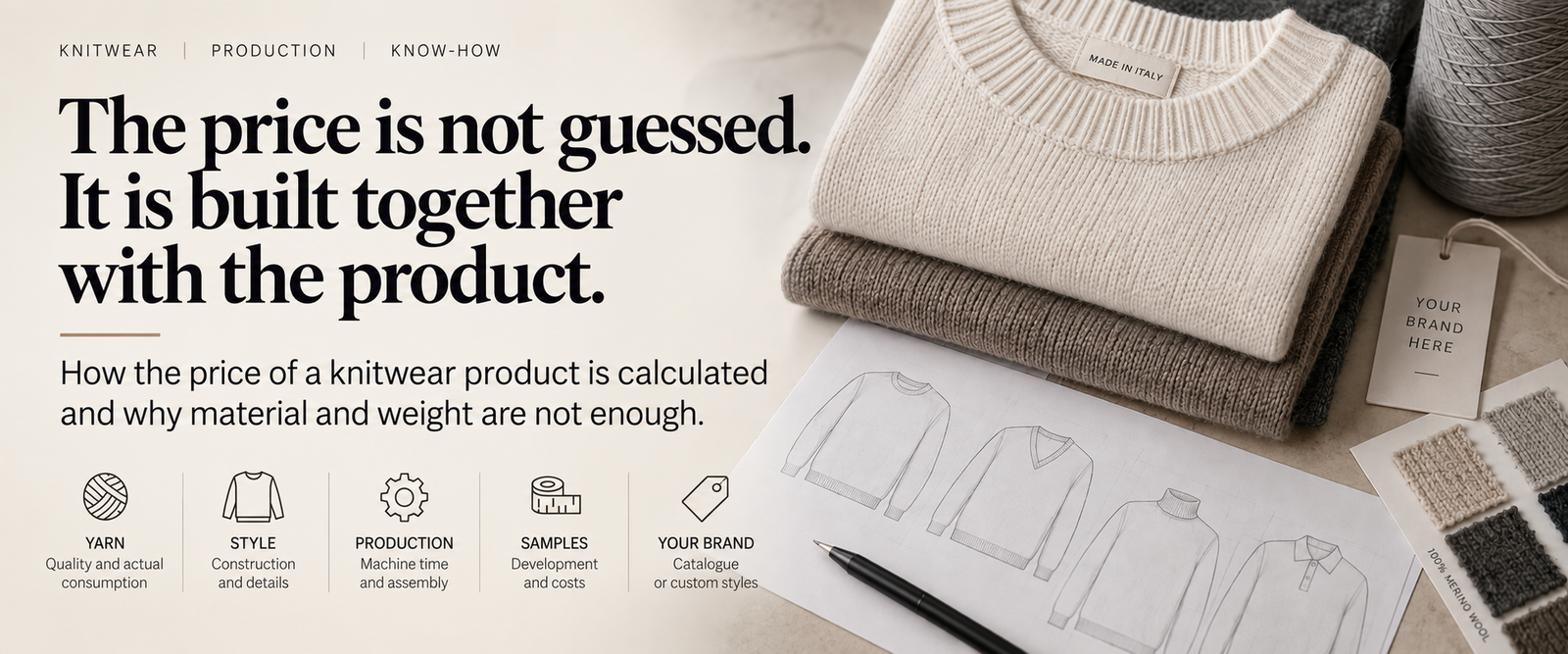
It is built together with the product.