
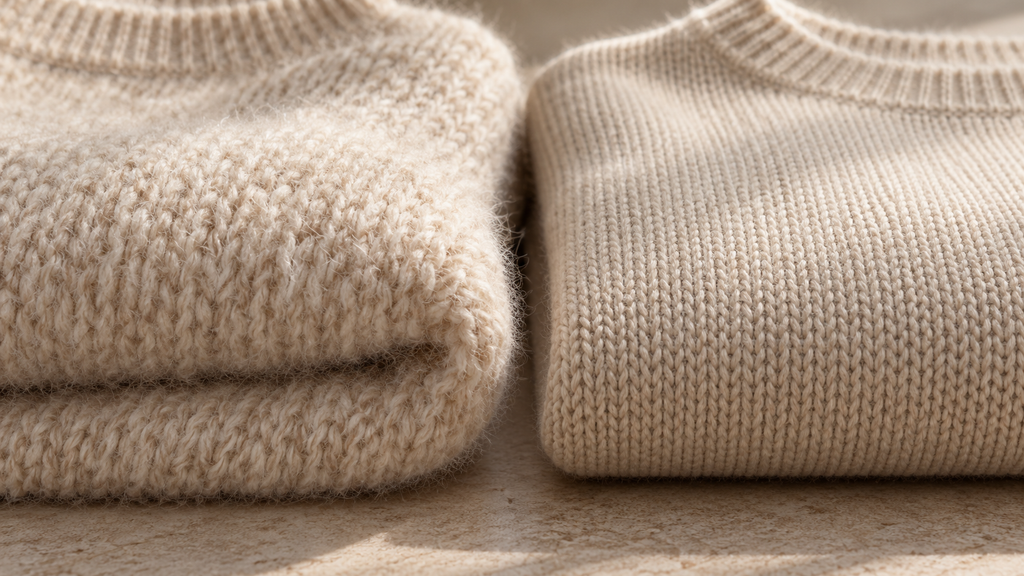
Two sweaters can have exactly the same fibre composition — for example, 100% Merino wool or 100% cashmere — yet feel completely different. One is soft, fluffy and enveloping; the other is smooth, fine and compact. One looks distinctly wintery; the other slips comfortably under a jacket.
This difference may come down to the yarn: woollen-spun or worsted-spun, known in Italian as cardato and pettinato.
You do not need to understand every stage of spinning to choose well. What matters is knowing how these two approaches affect the feel, appearance, thickness and behaviour of a garment during wear.
The first point to clarify is that woollen-spun and worsted-spun are not two quality grades. They are different ways of working with fibres to achieve different results.
The Difference You Can See and Feel
In woollen-spun yarn, the fibres are less parallel, and the yarn tends to have an airier, fuller structure. In worsted-spun yarn, the fibres are more closely aligned, and some shorter fibres are removed during preparation. The result tends to be more even and compact.
In a finished garment, this generally translates into the following differences:
| Characteristic | Woollen-Spun | Worsted-Spun |
|---|---|---|
| Appearance | Fluffier, with a visible fibre halo | Smoother, more even and defined |
| Feel | Soft, full and enveloping | Smooth, fluid, with a drier handle |
| Bulk | Generally greater | Generally more restrained |
| Stitch definition | Softer outlines | Crisper stitches and details |
| Typical uses | Sweaters and accessories with a cosy appearance | Fine knitwear, polo shirts and layering pieces |
These are tendencies, not absolute rules. Fibre choice, yarn, stitch structure and finishing can significantly change the result. IWTO also distinguishes generally bulkier woollen-spun knitwear from worsted-spun knitwear, which is suitable for very fine, lightweight garments.
Handle: Softness Can Mean Different Things
Handle describes the combination of sensations you experience when touching a garment: softness, smoothness, fullness, elasticity and substance.
A woollen-spun sweater can feel almost cloudlike. Squeeze it between your fingers and you notice its loft and cushioning softness. Its slightly fuzzy surface contributes to that impression.
A worsted-spun sweater can be equally soft, but in a different way. It often feels smoother, more fluid and less fluffy. Textile professionals sometimes describe this as a “dry handle”. This does not mean rough: it means less downy and less fuzzy.
For a retailer, this distinction matters. A customer who associates quality exclusively with a very soft, fluffy feel may underestimate an excellent worsted-spun garment. Someone looking for a clean, smooth surface may mistake the natural halo of woollen-spun knitwear for a fault.
The useful question is: which kind of softness do you enjoy wearing?
Fibre Length and Fineness Are Different Things
When discussing fibres, “long” and “fine” are often confused.
- Length describes how long an individual fibre is.
- Fineness describes how thin it is — its diameter.
A long fibre is not necessarily finer. A fine fibre is not necessarily long.
Worsted spinning generally uses fibres long enough to produce a regular yarn. Woollen spinning can also accommodate shorter fibres, but this does not mean it necessarily uses waste or poor-quality raw materials.
A woollen-spun yarn can be made from high-quality virgin cashmere. Furthermore, “woollen-spun” and “recycled” are not synonyms: the first describes the processing system; the second describes the origin of the raw material.
For a customer, knowing only that a garment is woollen-spun or worsted-spun is therefore not enough to determine its value.
Which One Feels Itchier?
You cannot answer this simply by looking at the spinning system.
Prickliness depends strongly on fibre diameter and the presence of coarser fibres protruding from the surface. Fine fibres bend more easily against the skin and tend to feel more comfortable.
Consequently, woollen-spun knitwear made from very fine Merino can feel more comfortable than worsted-spun knitwear made from coarser wool.
Personal sensitivity matters too. A sweater that feels pleasant over a shirt may not feel equally comfortable against a bare neck.
If you intend to wear a garment directly against your skin, try it against the areas it will touch. If you are a retailer, avoid promising that a product “will not itch” simply because it is worsted-spun or labelled Merino.
Thickness and Weight: A Bulky Sweater Is Not Necessarily Heavy
These two characteristics are often confused:
Thickness is the space the garment occupies. Weight is the amount of material it contains.
A sweater can be thick and lightweight because its structure contains plenty of air. Another can be thinner yet substantial because the knit is dense.
Woollen-spun yarn tends to create loft, while worsted-spun yarn lends itself to flatter surfaces. However, you cannot assume that the former always weighs more or that the latter is always lightweight.
The finished weight also depends on size, fit, length, stitch structure and the amount of yarn used.
This is why judging quality by weight is misleading. A heavier garment is not automatically more luxurious. Even when comparing how much material two garments contain, you must also account for their dimensions and construction.
Which One Is Warmer?
Warmth does not depend solely on the grams of wool or cashmere in a garment. The air held within its structure also contributes to insulation.
A lofty, airy structure can provide warmth without excessive weight. This is one reason bulk is valued in winter knitwear. Woolmark highlights the relationship between trapped air, yarn structure and insulation.
Woollen-spun yarn is therefore often chosen for enveloping garments with a cosy appearance. Worsted-spun yarn is particularly useful when you want less bulk and prefer to dress in layers.
However, “woollen-spun means warm, worsted-spun means cool” is an oversimplification. A thick worsted-spun sweater can be warmer than a thin woollen-spun one. An open knit can also let air through, even when it looks bulky.
Consider the whole garment and how you will use it: in a heated office, outdoors, under a jacket or over a shirt.
Pilling: Does Woollen-Spun Knitwear Develop More Bobbles?
Pilling is the formation of small balls of fibre on a garment’s surface, particularly in areas exposed to friction.
Under comparable conditions, soft, fuzzy woollen-spun knitwear may be more prone to pilling than compact worsted-spun knitwear. A greater presence of surface fibres and shorter fibres can encourage the process.
However, the spinning system alone cannot predict how a sweater will perform. Fibre length, yarn twist, knit density, finishing and friction during wear all matter. Woolmark identifies longer fibres, suitable twist and a more closely constructed fabric as factors that can help reduce pilling.
For the customer, this means:
- Worsted-spun knitwear can still pill.
- A few bobbles do not, on their own, prove that a garment is poor quality.
- Heavy, persistent pilling accompanied by rapid deterioration deserves attention.
For a retailer, the right approach is to explain the product and its care requirements realistically, rather than promise that it will never pill.
A Fibre Halo and Pilling Are Not the Same Thing
A slightly fuzzy surface can be an intentional characteristic of woollen-spun knitwear.
A halo is a fine layer of surface fibres; pilling consists of small clumps of tangled fibres. A garment can have a beautiful, fluffy surface without being covered in bobbles.
Finishing treatments also help create that soft, fuller appearance. Woolmark explains that finishing woollen-spun products can allow the yarn to bloom and bring some fibres towards the surface.
Close-up photographs therefore need to be interpreted carefully: visible fuzz does not automatically indicate a defect.
Which Holds Its Shape and Appearance Better?
Compact worsted-spun knitwear tends to have a neater surface and clearer stitch definition. Woollen-spun knitwear places greater emphasis on softness and loft.
Shape retention, however, depends on the whole garment: construction, knit density, weight, ribbing, washing, drying and storage.
It would be misleading to promise that a worsted-spun sweater will never stretch or that a woollen-spun one will inevitably lose its shape.
Both need care appropriate to their labels. In particular, hanging a heavy knitted garment while wet can distort it, regardless of the spinning system.
Why Can Worsted-Spun Knitwear Cost More?
Fibre selection and the additional preparation stages required for combing can affect costs. However, this distinction alone cannot explain the price.
High-quality woollen-spun cashmere can cost considerably more than worsted-spun Merino. Even with the same fibre composition, raw material quality, yarn quantity, manufacturing and finishing can differ.
It is therefore mistaken to assume that a thin garment should be inexpensive or that a fluffier garment must be more valuable.
How to Choose in Store
If you want a soft, full and enveloping feel, woollen-spun knitwear may be closer to your expectations.
If you prefer a smooth, understated surface with less bulk, worsted-spun knitwear may suit you better.
For a retailer, offering both helps meet different needs. Someone looking for a substantial winter sweater is not necessarily seeking the same product as someone who wants a fine knit to wear under a jacket.
Before choosing, look at the surface, feel the garment and try it on. Consider its bulk, how it drapes and how it feels against your skin.
Good woollen-spun knitwear should deliver the qualities of good woollen-spun knitwear; good worsted-spun knitwear should do the same for its own characteristics. Quality lies in how well the raw material, construction, comfort and long-term performance work together. The right choice depends on what you want to wear.