
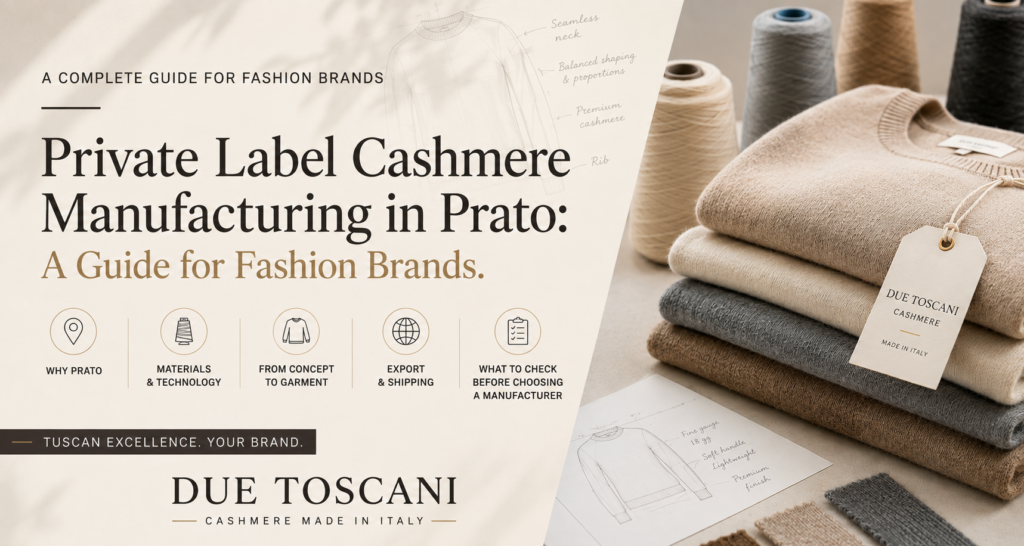
For a fashion brand looking to develop its own cashmere knitwear collection, choosing the right manufacturer is one of the most important decisions to make. It is not simply about finding someone capable of producing a sweater: it means finding a partner who can transform an idea, sketch, technical specification or existing sample into a product that can be manufactured consistently, while keeping quality, fit, costs and lead times under control.
Prato has been one of Italy’s leading textile and manufacturing districts for decades and offers an ecosystem particularly well suited to private label knitwear production.
Due Toscani, a company specialising in the production of cashmere knitwear and accessories, operates within this manufacturing district and provides a useful example of how Made in Italy private label production works in practice.
Why Manufacture Cashmere in Prato?
When people think of Prato, they often think primarily of fabrics and textiles. In reality, the district includes an extremely extensive network of specialised companies: spinning mills, knitwear manufacturers, programmers, dye houses, finishing and washing facilities, ironing specialists, garment makers, embroidery companies, label manufacturers, packaging suppliers and many other specialised businesses.
This means that many of the skills required to transform yarn into a finished garment are concentrated within the same geographical area.
For a fashion brand, this represents an important advantage.
Producing a knitted garment is not simply a matter of knitting yarn on a machine. Behind an apparently simple sweater there may be programming, tension tests, prototyping, garment assembly, washing, fulling, drying, pressing, label application and quality control.
Due Toscani works within the Tuscan textile district, coordinating these different areas of expertise, with the aim of providing customers with a single point of contact for the development and production of their collections.
What Does a Private Label Manufacturer Actually Do?
Private label does not simply mean attaching a customer's label to an existing product.
There are, of course, different levels of customisation. A brand may start with a style already developed by the manufacturer and modify its colour, yarn, measurements or details. Alternatively, it may want to develop an entirely new garment.
At Due Toscani, for example, customers can work either from styles already available in the company's collections or develop completely customised products.
The starting point can be:
- a technical specification or tech pack;
- a sketch;
- a photograph;
- a rendering;
- a physical sample;
- an existing garment to be reinterpreted;
- or simply an idea accompanied by measurements and style indications.
The more accurate the initial information, the easier it will be to transform the project into a successful prototype.
From an Idea to a Sweater: The Production Process
One of the aspects that often surprises brands approaching knitwear production for the first time is the complexity involved in prototyping.
A new garment must first be interpreted from a technical point of view.
With electronic knitting machines, a specific machine programme must be created. This is not simply a graphic file: the programme determines the garment construction, decreases, increases, knitting structures, stitches, tensions and many other parameters.
Due Toscani uses Shima Seiki technology, both for traditional knitwear production and for integral/seamless knitting. Programming therefore requires skilled technicians with specific experience and training on these machines.
Once the programme has been created, the first garment is knitted. In some cases, it can be advisable to produce an initial test using a less expensive trial yarn, allowing the construction and programme to be checked before using a more valuable cashmere yarn.
The prototype then goes through the other required stages: assembly when necessary, finishing, washing or fulling, drying, pressing and quality control.
Only after these stages can the result be properly evaluated.
The sample may require adjustments to the fit, measurements, length, proportions or construction. Once the final prototype has been approved, the style can move into production.
A Sample Is Not Yet Production
This is an important concept, especially for new fashion brands.
A prototype is a product development tool.
Its purpose is to create the final product that can subsequently be replicated in production. For this reason, producing a single sample can have an apparently high cost compared with the unit price of the same garment during a production run.
Development costs include programming, machine preparation, yarn, machine time, garment assembly, finishing, pressing and quality control, as well as any modifications that may be necessary.
Due Toscani therefore considers sampling to be a genuine product development phase, rather than simply the production of a single sweater.
MOQ: How Many Pieces Do You Need to Produce?
MOQ – Minimum Order Quantity – is the minimum production quantity required by a manufacturer to make a production run economically sustainable.
In Italian knitwear manufacturing, the MOQ depends on several factors, including the style, yarn, colours, complexity of the knitting process and production organisation.
Due Toscani also works with relatively small brands and businesses and, for private label production, the usual reference MOQ is 50 pieces, although this should always be evaluated according to the specific project.
It is important to discuss MOQ from the very beginning because developing many different styles with only a few pieces per style can make the economics of a collection very different from a production concentrated on fewer styles and larger quantities.
For a new fashion brand, it can therefore be much more effective to begin with a carefully designed capsule collection rather than immediately developing a very large range.
Which Materials Should You Choose?
Cashmere does not necessarily mean one single type of yarn.
One of the first decisions concerns the choice between virgin cashmere and recycled cashmere. There is not necessarily one material that is universally “better” than the other: they are two different products with different characteristics, aesthetics, costs and market positioning.
Due Toscani manufactures garments in both high-quality virgin cashmere and recycled cashmere, as well as extra-fine merino wool and premium blends such as merino/silk.
Another fundamental distinction is between woollen-spun and worsted-spun yarns.
Woollen-spun cashmere can provide a softer, fuller, warmer and more traditional hand, while worsted-spun yarn can be used to create garments that are generally finer, lighter and cleaner in appearance.
Machine gauge also has a major impact on the final result.
Due Toscani works with different gauges and can develop both fuller, heavier knitwear and extremely fine garments, including worsted knitwear produced on 18-gauge WholeGarment machines, particularly suitable for premium and luxury collections.
The choice should therefore begin with the result the brand wants to achieve, rather than simply with the name of the fibre.
Seamless Knitwear and WholeGarment Technology
Another option for brands looking to develop particularly refined products is integral garment construction.
With Shima Seiki WholeGarment technology, certain types of garments can be knitted without traditional side seams.
The result can provide greater comfort, cleaner construction and a distinctive fit.
Due Toscani also uses this technology for private label production, particularly for projects where lightness, comfort and construction quality are important elements of the product's positioning.
Labels, Customisation and Packaging
A private label production should reach the customer ready to be marketed.
For this reason, even elements that may initially appear secondary should be defined from the beginning: brand labels, composition and care labels, size labels, hangtags, packaging and packing requirements.
Due Toscani can manage productions intended to be sold directly under the customer's own brand, coordinating the agreed customisation during the development process.
The brand should, however, provide logos, artwork, company information and all other details required for label production in good time.
Export and Shipping
Working with an Italian manufacturer does not mean that the customer has to be based in Italy.
Due Toscani works with international B2B customers and can manufacture collections intended for both European and non-EU markets.
Before placing an order, it is important to clarify:
- delivery address and destination country;
- shipping method;
- transport costs;
- required documentation;
- customer's VAT status;
- any customs procedures;
- import duties and charges in the destination country.
For non-EU shipments in particular, the brand should check the regulations applicable in its own market in advance.
The manufacturer can prepare the commercial documentation required for shipment, while customs duties, local taxes and import procedures depend on the destination country and the commercial terms agreed between the parties.
How to Prepare a Good Brief for Your Manufacturer
A well-prepared brief can significantly reduce development time, misunderstandings and costs.
Before contacting Due Toscani – or any other knitwear manufacturer – it is useful to prepare at least the following information:
- Product type – crew neck, cardigan, turtleneck, polo, dress, scarf, beanie, etc.
- Men's, women's or unisex.
- Preferred material – virgin cashmere, recycled cashmere, merino wool, merino/silk, etc.
- Desired weight and hand feel – lightweight, medium, heavy, soft, compact, dry, etc.
- Measurements or size chart.
- Expected quantities.
- Number of colours.
- Target market and product price positioning.
- Photographs, sketches, tech packs or reference samples.
- Approximate date by which the production should be available.
It is not essential for the customer to know the machine gauge or exact yarn count.
That is part of the manufacturer's expertise.
For example, a customer might simply tell Due Toscani: “We would like a very lightweight women's crew neck, clean and soft, seamless and with a luxury feel.”
The manufacturer can then evaluate the most appropriate yarn, yarn count, machine gauge and construction.
What Should You Check Before Choosing a Cashmere Manufacturer?
Price is important, but it should not be the only criterion.
Before entrusting a collection to a manufacturer, it is advisable to understand where the garments are actually produced, which technologies are used and who is responsible for product development.
It is also useful to check:
- specific experience in knitwear manufacturing;
- ability to develop new styles from scratch;
- availability of specialised programmers;
- types of knitting machines used;
- origin and quality of the yarns;
- sampling capabilities;
- MOQ requirements;
- production lead times;
- quality control procedures;
- private label capabilities;
- export experience;
- clarity and reliability of communication.
Another fundamental question is: who will be my point of contact throughout the project?
For a small or medium-sized brand, having direct communication with someone who genuinely understands production can be far more important than it may initially seem.
This is one of the principles behind Due Toscani's B2B service: a direct relationship between the fashion brand and the manufacturer, without turning the development of a collection into a long chain of intermediaries.
Visiting the Manufacturer Can Make a Difference
Whenever possible, it can be extremely useful to visit the manufacturer in person, particularly for an important project.
Seeing the machines, yarns, samples and production processes makes it much easier to understand what can actually be achieved.
For brands that cannot immediately travel to Italy, an initial video call with Due Toscani can be enough to discuss the project, review references, talk about materials, quantities and objectives, and determine whether the right conditions exist to move forward with development.
Due Toscani: Private Label Knitwear Manufacturing in the Prato Textile District
Choosing Prato means working within a region that has built its identity around textiles and manufacturing.
Due Toscani produces Made in Italy knitwear and accessories in virgin cashmere, recycled cashmere, extra-fine merino wool and other premium fibres, developing both its own collections and private label productions for boutiques, retailers and fashion brands.
Thanks to Shima Seiki technology, the ability to work with different machine gauges and collaboration with a network of specialised companies within the local textile district, projects can be followed from yarn selection through to the finished garment.
For a fashion brand that already has a tech pack, a physical sample or simply a few reference images, the first step does not necessarily have to be an order.
It can simply be a conversation.
Reviewing the style, material, expected quantities and brand positioning together makes it possible to understand how the garment can be produced, which technology and yarn are most appropriate, and what the approximate costs will be.
And that is where good private label manufacturing should begin: not with the knitting machine, but with a clear understanding of the product the brand wants to create.
Related reading
- Sourcing Recycled Cashmere: A Buyer’s Guide
- Recycled Cashmere: How Our Regenerated Yarn Is Created
- Why International Brands Choose Italian Cashmere Production
- Request our catalogue
Frequently asked questions
What is private-label cashmere manufacturing?
It means a manufacturer develops and produces cashmere knitwear that you sell under your own brand — from a tech pack, sketch, photo or existing sample through to the finished garment.
What is the minimum order quantity (MOQ)?
For private-label production the usual reference MOQ is 50 pieces per style, always evaluated according to the specific project.
Which materials can Due Toscani work with?
Virgin cashmere, recycled cashmere, extra-fine merino wool and premium blends such as merino/silk, in different gauges including 18-gauge WholeGarment for premium collections.
Do you produce for international brands?
Yes. Due Toscani works with international B2B customers and can manufacture collections for both EU and non-EU markets.
Trackbacks/Pingbacks