
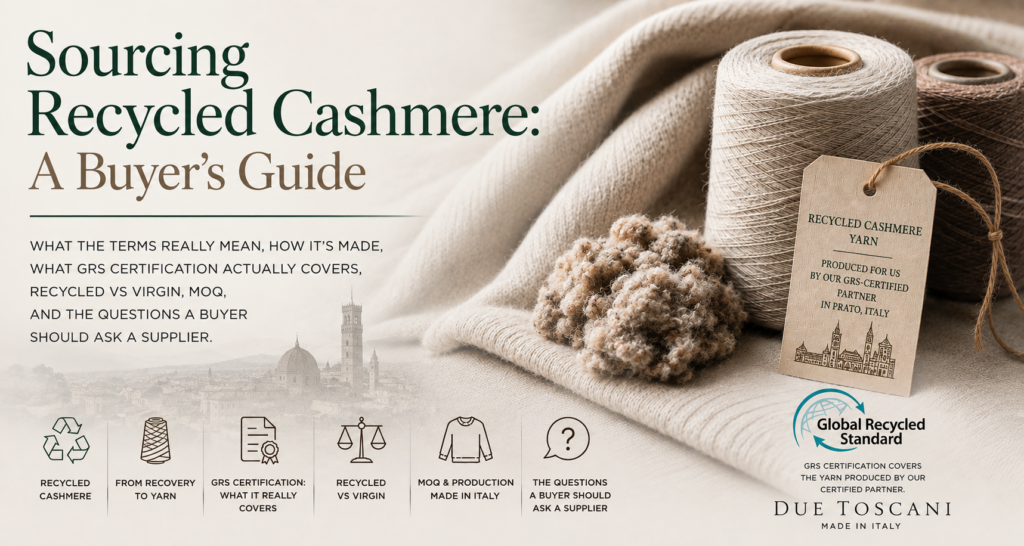
Recycled cashmere has become an increasingly interesting raw material for brands, boutiques, and fashion companies looking to combine the quality of cashmere with an approach focused on recovering and giving new value to existing resources.
But sourcing recycled cashmere is not simply a matter of asking a supplier: “Do you offer recycled cashmere?”
A professional buyer should be asking many more questions.
Where does the fibre come from? How is it recovered? Where is it turned into yarn? What is the actual percentage of cashmere? Is the yarn certified? What does GRS certification really mean? Does the certification apply only to the yarn or also to the finished garment? What are the minimum order quantities?
In the Prato textile district, textile fibre recovery has been part of the local industrial culture for generations. Due Toscani operates within this district and manufactures Made in Italy knitwear and accessories using, among other materials, recycled cashmere yarn that we have produced by a specialised GRS-certified partner in Prato.
However, it is important to clarify one fundamental point from the outset: the GRS certification applies to the recycled cashmere yarn that we have produced by our GRS-certified partner. Due Toscani and the subsequent knitwear production supply chain are not GRS certified. Consequently, we do not present or market our finished knitwear and accessories as GRS-certified products.
This distinction is important not only to describe our products correctly, but also to understand what a buyer should actually verify when a supplier talks about certified recycled cashmere.
What Does “Recycled Cashmere” Really Mean?
The first point to clarify is the meaning of the word recycled.
In the textile industry, buyers frequently encounter terms such as:
- recycled cashmere;
- regenerated cashmere;
- reclaimed cashmere;
- pre-consumer recycled;
- post-consumer recycled.
These terms are not necessarily perfect synonyms.
Recovered material can come from different waste streams. Pre-consumer material is recovered before a product reaches the consumer, while post-consumer material comes from products that have already been used and are subsequently collected for recycling.
For this reason, the simple description “recycled cashmere” does not tell the whole story of the material.
A buyer should understand not only whether the cashmere is recycled, but also how it is recovered, processed, traced, and spun into yarn again.
How Is Recycled Cashmere Yarn Made?
Producing high-quality recycled cashmere yarn is considerably more complex than it may appear.
The process begins with the selection of the material to be recovered. This is a crucial stage because the quality of the incoming material will inevitably influence the quality of the finished yarn.
The selected material is prepared and mechanically processed to return it to a fibrous state. Fabrics and knitted garments are progressively opened and pulled apart until usable fibres can be recovered.
This process, however, has an important technical consequence: recovered fibres tend to be shorter than virgin fibres.
This is one of the main characteristics that differentiates recycled cashmere from virgin cashmere.
Producing a quality yarn therefore requires experience in raw-material selection, a deep understanding of fibres, and the ability to correctly manage spinning, yarn count, twist, and the subsequent knitting process.
This is also one of the reasons why Prato is historically one of the world's most important textile recycling districts. For generations, the area has developed an industrial supply chain specialised in sorting, recovering, and regenerating textile fibres.
Due Toscani's Recycled Cashmere
For Due Toscani, recycled cashmere is not simply a yarn selected from a supplier's catalogue.
We have our recycled cashmere yarn produced by a specialised GRS-certified partner in the Prato textile district.
This is an important distinction.
Our direct relationship with the company producing the yarn allows us to have a much closer understanding of the material we subsequently use to manufacture knitwear and accessories for both our own collections and our private-label customers.
We therefore understand not only the finished product, but also how the yarn behaves during production. This is particularly important with recycled cashmere, where the characteristics of the recovered fibre require experience and appropriate manufacturing parameters.
The garments are subsequently manufactured entirely in Italy through our production network, and we directly follow the different stages, from yarn selection and development through to the finished garment.
For a brand, this means working with a manufacturer that understands both the raw material and the processes required to transform it into knitwear.
What Does GRS Certification Really Mean?
One common mistake is to consider GRS – Global Recycled Standard as a generic certification stating that a product is simply “eco-friendly” or “sustainable”.
The concept is much more specific.
GRS is a voluntary international standard that includes verification of recycled content and its traceability throughout the supply chain, together with specific requirements established by the standard relating to social, environmental, and chemical practices.
One of its fundamental concepts is the chain of custody.
This means that simply using a certified raw material does not automatically allow every product manufactured from that material to be declared GRS certified.
And this brings us to one of the most important distinctions a buyer needs to understand.
A GRS-Certified Yarn Does Not Automatically Make a Sweater GRS Certified
Suppose a manufacturer uses a GRS-certified recycled cashmere yarn.
That yarn can be covered by the documentation provided within the yarn manufacturer's certified supply chain.
The yarn must then be transformed into a finished knitted garment.
Depending on the style, this process can involve numerous stages:
programming, knitting, linking or assembly, washing and finishing treatments, drying, pressing, quality control, and final finishing.
In order to maintain certification and the corresponding traceability through to the finished product, the relevant organisations and stages within the chain of custody must fall within the certification system required by the standard.
Therefore, the certification of the raw material cannot simply be transferred to the finished sweater.
There is a substantial difference between saying:
“This garment is made using GRS-certified recycled cashmere yarn.”
and saying:
“This garment is GRS certified.”
These are two very different statements, and a buyer should always ask the supplier which one actually applies.
The Due Toscani Case: Certified Yarn, Non-Certified Finished Garment
Due Toscani provides a practical example of this distinction.
We have our recycled cashmere yarn produced by a specialised GRS-certified partner in Prato, and the certification applies to the yarn manufactured by our partner within its certified supply chain.
The subsequent transformation of the yarn into knitwear and accessories takes place through Due Toscani's production network.
Due Toscani is not currently GRS certified, and some of the companies performing subsequent manufacturing processes within our production supply chain are not GRS certified.
For this reason, we do not declare or market our knitwear and accessories as GRS-certified finished products.
We believe it is important to communicate this distinction to our customers with complete transparency.
For Due Toscani, at least for the time being, obtaining certification for our company alone would have limited practical value if all the relevant external manufacturing stages required to produce the finished garment could not also be included within the certified chain.
Our approach is therefore straightforward:
we highlight the GRS certification of the recycled cashmere yarn that we have produced by our certified partner, but we do not extend that certification claim to the finished knitwear and accessories.
One Essential Question to Ask Any Supplier
When a manufacturer claims to use certified recycled cashmere, a buyer should ask one very precise question:
“Is the yarn you use GRS certified, or is the finished product you are selling me also GRS certified?”
The difference is fundamental.
If the supplier claims that the finished garment is also certified, the buyer should ask which certification applies and what documentation can be provided to support that claim.
The presence of a certified raw material within a production process should not be confused with certification of the entire finished product.
A serious supplier should be able to clearly explain to the buyer where the certified supply chain begins and where it ends.
GRS Does Not Automatically Mean “100% Recycled”
Another common misunderstanding concerns the percentage of recycled material.
The presence of GRS certification does not necessarily mean that a material consists of 100% recycled fibre.
For this reason, when purchasing yarn or finished garments, do not simply ask:
“Is it GRS certified?”
Also ask:
“What is the exact fibre composition of the yarn?”
A yarn may contain recycled cashmere together with other fibres. Buyers should therefore know precisely the composition and percentage of each component.
This is important regardless of certification.
What GRS Certification Does NOT Mean
GRS should not be interpreted as a universal certification covering every possible environmental characteristic of a product.
A serious certification system is primarily a tool for verification, control, and traceability according to defined requirements, rather than a marketing slogan.
Terms such as:
GRS certified, recycled, sustainable, responsible, or circular
should therefore be used accurately.
For a B2B buyer, it is important to look beyond the marketing claim and ask:
What exactly is certified? Who holds the certification? How far through the supply chain does the certification extend? Is the finished product actually certified?
Recycled Cashmere or Virgin Cashmere: Which Is Better?
Due Toscani's answer is very simple:
both.
They are two different materials, and we do not believe that one should automatically be considered superior to the other.
Virgin cashmere starts with new and generally longer fibres. It can offer exceptional softness, consistency, strength, and lightness and remains a fundamental raw material for high-end knitwear.
Recycled cashmere, on the other hand, starts with existing cashmere that is recovered and given a new life.
After the recovery process, the fibre has different characteristics and requires specific processing. The result can be an extremely pleasant, soft, high-quality garment, but it does not necessarily need to imitate a garment made from virgin cashmere in every respect.
They are two products with different characteristics and different stories.
For Due Toscani, therefore, the right question is not:
“Which one is better?”
but:
“Which material is best suited to the product, price point, and market positioning we want to achieve?”
The Price of Recycled Cashmere
There is another common misconception:
recycled means inexpensive.
Not necessarily.
Producing a quality recycled yarn requires collection, sorting, processing, fibre recovery, spinning, and quality control.
When a certified supply chain is involved, procedures, controls, documentation, and certification-related costs must also be considered.
The quality of the recovered raw material, fibre composition, yarn count, colour, quantities, and type of processing all influence the final cost.
For this reason, comparing two offers simply on the basis of the yarn price per kilogram — or the final price of a sweater — can be misleading.
First, a buyer needs to understand what is actually being compared.
MOQ: How Much Do You Need to Order?
MOQ – Minimum Order Quantity is one of the most important issues for small brands and new collections.
However, it is important to distinguish between at least two different levels:
yarn MOQ and finished garment production MOQ.
Producing a custom yarn colour may require different minimum quantities compared with using an existing colour.
Similarly, developing a completely new style involves different costs and production requirements compared with selecting a style that has already been developed.
For this reason, a buyer should provide the manufacturer with the following information from the beginning:
- expected quantity;
- number of styles;
- number of colours;
- size range;
- desired fibre composition;
- target price range;
- destination market;
- any certification requirements;
- need for custom colours.
At Due Toscani, we work both with our own collections and with private-label production, including the development of styles supplied or designed directly by our customers.
Understanding the project before discussing MOQ alone often makes it possible to identify a much more efficient production solution.
Questions a Buyer Should Ask a Recycled Cashmere Supplier
Before choosing a recycled cashmere knitwear manufacturer, we recommend asking at least the following questions:
- What is the exact fibre composition of the yarn?
- What percentage is actually recycled cashmere?
- Is the recycled material pre-consumer, post-consumer, or a combination of both?
- Where is the raw material recovered and processed?
- Where is the yarn produced?
- Is the yarn GRS certified?
- Who actually holds the GRS certification?
- Does the certification apply to the yarn or also to the finished product?
- How far through the supply chain is the certification maintained?
- Can you provide the relevant documentation for the supply?
- Which yarn counts and knitting gauges are available?
- Which colours are already available?
- Can custom colours be developed, and what is the MOQ?
- What is the MOQ per style and colour for knitwear production?
- Does the manufacturer have specific experience working with recycled cashmere?
- Where are knitting, assembly, washing/finishing, and pressing carried out?
- Can a prototype be developed before production?
- What are the sampling and production lead times?
- Can you provide private-label production with the customer's own labels and packaging?
- What documentation will accompany the finished product?
The answers to these questions tell a buyer far more than price alone.
Traceability Before Marketing
Recycled cashmere represents an important opportunity for the fashion industry, but the increasing attention given to sustainability and recycling also makes accuracy in product claims more important than ever.
Terms such as recycled, sustainable, circular, and responsible should not be used simply as marketing tools.
For a B2B buyer, the priority should be understanding the actual supply chain behind the product.
Who produced the yarn? Where was it produced? What material was used? What is its composition? Who holds the certification? Which part of the supply chain is certified? Does the certification extend to the finished product, or does it stop at the raw material or yarn stage?
These questions are far more important than any slogan.
This is also why Due Toscani prefers to state exactly what we can document:
we have our recycled cashmere yarn produced by a GRS-certified partner in Prato, but we do not claim that our knitwear and accessories are GRS certified because Due Toscani and the subsequent production supply chain are not entirely GRS certified.
For us, transparency towards the buyer comes before the marketing claim.
Due Toscani: Recycled Cashmere and Knitwear Manufacturing in Prato, Italy
For Due Toscani, working with recycled cashmere means combining a tradition deeply rooted in the Prato textile district with the requirements of today's international fashion brands.
We have our recycled cashmere yarn produced by a specialised GRS-certified partner in Prato and use this yarn to manufacture Made in Italy knitwear and accessories.
We can work with styles from our own collections or develop private-label productions, starting from an existing garment, a technical specification, a photograph, a physical sample, or a customer's original design.
This gives buyers access to a manufacturing partner that understands both the finished product and the behaviour of the raw material used to create it.
Most importantly, it allows the buyer to understand precisely what is certified and what is not.
Because sourcing recycled cashmere should not simply mean purchasing a yarn or a sweater.
It means understanding the raw material, the manufacturing process, and the supply chain behind the product.
And in Prato, the recovery and transformation of textile fibres is not a recent trend: it is part of a manufacturing culture built over generations.
Related reading
- Private-Label Cashmere Manufacturing in Prato: A Guide for Fashion Brands
- Virgin or Recycled Cashmere: Which Is Better?
- Recycled Cashmere: How Our Regenerated Yarn Is Created
- Request our catalogue
Frequently asked questions
Is Due Toscani's recycled cashmere GRS-certified?
The recycled cashmere yarn is produced by a GRS-certified partner in Prato. Due Toscani's finished knitwear is not GRS-certified, so we do not market the garments as GRS-certified products.
Does a GRS-certified yarn make the finished sweater GRS-certified?
No. Certification follows a chain of custody. A certified yarn does not automatically make the finished garment certified unless every manufacturing stage is within the certified system.
Does GRS certification mean 100% recycled?
No. GRS verifies recycled content and traceability, but the material is not necessarily 100% recycled. Always ask for the exact fibre composition.
What should a buyer ask a recycled cashmere supplier?
Ask for the exact fibre composition, the recycled percentage, where the yarn is produced, who holds the GRS certificate, and whether it covers only the yarn or also the finished product.
Trackbacks/Pingbacks