
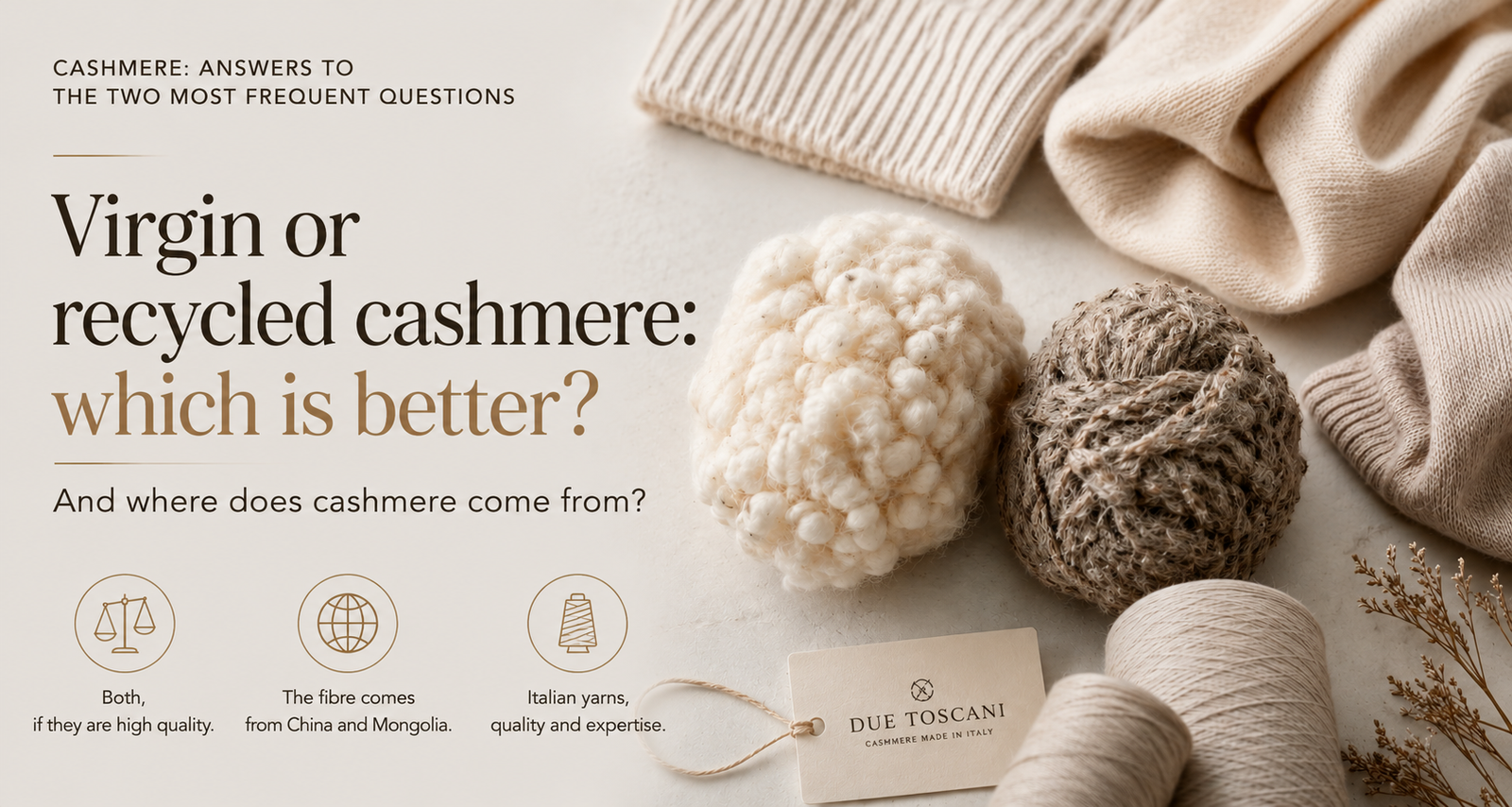
There are two questions we have been receiving very frequently lately from customers, buyers, retailers and brands contacting us to develop their own collections:
1. Which is better: virgin cashmere or recycled cashmere?
2. Where does cashmere come from?
These are two very interesting questions because they give us the opportunity to clarify some aspects of cashmere that are still often misunderstood.
Let’s start with the first one.
Which Is Better: Virgin or Recycled Cashmere?
Our answer is simple:
Both.
High-quality virgin cashmere and high-quality recycled cashmere are both excellent materials.
They are different.
They have different origins, are obtained through different processes and can have different characteristics, both to the touch and in the finished garment.
But different does not mean better or worse.
The real distinction should not simply be between virgin cashmere and recycled cashmere.
It should be between high-quality cashmere and poor-quality cashmere.
Not All Virgin Cashmere Is the Same
Virgin cashmere is produced from the fibre obtained from the undercoat of cashmere goats.
It is an extraordinarily fine, soft and insulating fibre which, when it is of good quality and properly processed, can be used to create exceptional yarns and knitwear.
But there is one very important thing to remember:
the words “100% cashmere” indicate the composition, not the quality.
Two sweaters can both have “100% cashmere” written on their labels and yet be completely different.
The quality of the fibre depends on several factors, including fineness, length, uniformity and the selection of the raw material.
And then there is everything that happens afterwards.
The quality of the spinning, dyeing, yarn count, number of plies, machine gauge, knit construction and finishing process all contribute to the final result.
This is why there are exceptionally high-quality virgin cashmeres as well as much more commercial-quality virgin cashmeres.
Simply saying “it is virgin cashmere” is not enough to determine the quality of a garment.
What About Recycled Cashmere?
The same principle applies to recycled cashmere.
Once again, everything starts with the quality of the raw material and how carefully it is selected.
Recycled cashmere is obtained by recovering cashmere-containing materials, carefully sorting them and processing them back into fibre.
That fibre can then be used to produce a new yarn and, subsequently, a new garment.
The quality of the final result depends on the quality of the original material, the sorting process, the knowledge of the fibres and the way in which the entire recycling and spinning process is carried out.
High-quality recycled cashmere can be extremely soft, warm, pleasant to the touch and beautiful to wear.
It will have different characteristics from virgin cashmere, but that does not automatically make it inferior.
It is simply another way of using cashmere.
Recycled Cashmere Is Not “Second-Class Cashmere”
This is probably one of the points we care about most.
Automatically considering recycled cashmere to be a cheaper or lower-quality version of virgin cashmere is an oversimplification.
There is excellent recycled cashmere, just as there is mediocre virgin cashmere.
Once again, everything depends on the raw material and how it is processed.
Recycled cashmere also introduces another important element: the ability to recover a precious fibre and give it a new life.
And when we talk about recovering textile fibres, we inevitably talk about Prato.
In Prato, Textile Recycling Is Not a Recent Trend
Today, there is a great deal of discussion about the circular economy, raw material recovery and sustainability.
In the textile district of Prato, these practices have existed for generations.
The sorting of garments and textile waste, separation by composition and colour, fibre recovery and transformation into new raw material are all part of the industrial history of our area.
Behind these processes are skills that cannot simply be acquired by purchasing a machine.
They require experience, knowledge of fibres and the ability to recognise and correctly select different materials.
For this reason, recycled cashmere is not simply an alternative to virgin cashmere for us.
It also represents part of the textile culture we come from.
So, Virgin or Recycled Cashmere?
Both.
We use both and we believe in both.
We may choose virgin cashmere when we are looking for certain characteristics and recycled cashmere when we are looking for others.
We may prefer the feel of one or the other.
We may choose according to the garment, the project, the price point, the positioning of the collection or the philosophy of the brand.
But there is no rule saying that virgin automatically means “better” and recycled automatically means “worse”.
For us, the fundamental question remains:
Is it good cashmere?
Second Question: Where Does Cashmere Come From?
This is another question we are asked very frequently.
And here we need to distinguish between at least three things:
the origin of the fibre, where the yarn is produced, and where the garment is manufactured.
These are three different things.
Where Does Cashmere Fibre Come From?
Cashmere fibre comes from the undercoat of cashmere goats.
These animals live mainly in areas of Asia characterised by particularly harsh climatic conditions.
The main cashmere-producing regions are located in China and Mongolia, as well as other areas of Central Asia.
To protect themselves from extremely cold winters, cashmere goats develop a very fine, soft and insulating undercoat beneath their longer, coarser outer hair.
It is this exceptionally fine fibre that we are interested in.
After collection, the raw material must be sorted, cleaned and separated from the coarser hairs. Only part of the material collected will therefore become the cashmere fibre used to produce yarn.
So Does Italian Cashmere Exist?
It depends on what we mean by the expression.
If we are talking about the origin of the fibre, the cashmere used by the Italian textile industry comes mainly from Asia.
But this certainly does not mean that there cannot be cashmere yarn produced in Italy or, of course, cashmere knitwear Made in Italy.
And this is where confusion often arises.
The origin of the raw material is one thing.
Where and how that raw material is transformed is another.
From Asian Fibre to Italian Yarn
Cashmere fibre originating from Mongolia or China can be purchased, selected and subsequently transformed in Italy by an Italian spinning mill.
Spinning is a fundamental part of the process.
Having access to good fibre is not enough to automatically produce an exceptional yarn.
It requires knowledge of the raw material, experience, technology, selection expertise, preparation, blending, spinning, dyeing and quality control.
Italy is home to some of the world’s most prestigious and specialised cashmere spinning mills.
And these are the companies we rely on for our virgin cashmere production.
The Virgin Cashmere Yarns We Use
For our virgin cashmere knitwear, we use yarns produced in Italy by some of the finest Italian spinning mills.
The yarn is selected according to the garment we need to produce.
There is no single yarn that is ideal for everything.
A substantial sweater knitted on a particular gauge, an extremely lightweight garment produced on a high-gauge machine, a scarf, a shawl or a seamless garment may all require yarns with different characteristics.
For us, choosing the yarn therefore means starting with the result we want to achieve.
And What About Our Recycled Cashmere?
In the case of recycled cashmere, our involvement with the yarn is even more direct.
The recycled cashmere yarn we use is produced by us in collaboration with a specialised partner in the Prato textile district.
This allows us to be directly involved in the selection of the raw material and in the production of the yarn that will subsequently be used in our collections and in the garments we manufacture for our customers.
And it is significant that this takes place in Prato.
Because here, fibre regeneration is not simply a manufacturing technique.
It is part of our industrial history.
And Finally, There Is the Knitwear
At this point, we have the fibre and we have the yarn.
But one fundamental step is still missing: transforming that yarn into a knitted garment.
This is where our work begins.
The choice of machine gauge, programming, stitch construction, tensions, knitting, linking and assembly where required, finishing, washing, fulling, pressing and final quality control can all have a profound effect on the final result.
The same yarn, worked in two different ways, can produce two garments with completely different looks and handles.
This is why the quality of a cashmere sweater cannot be explained simply by reading the composition on its label.
Behind a good garment lies an entire supply chain.
Fibre, Yarn and Knitwear: Three Different Origins
We can therefore summarise the journey very simply.
Cashmere fibre originates mainly in Asia.
The virgin cashmere yarns we use are produced in Italy by some of the finest Italian spinning mills.
Our recycled cashmere yarn is produced by us in collaboration with a specialised partner in Prato.
Our knitwear is manufactured in Italy.
These are different stages of the same story.
And it is important to understand them because when we purchase or develop a cashmere product, we are not simply purchasing a fibre.
We are purchasing the result of a long chain of skills and expertise.
So, in the End, Which Cashmere Is Better?
Let’s return to the question we started with.
Virgin cashmere or recycled cashmere?
Both.
As long as the raw material is good.
As long as the yarn is well made.
As long as the right manufacturing process is chosen.
And as long as the people transforming that yarn into knitwear really know what they are doing.
Because the quality of cashmere does not come from a single word written on a label.
It comes from the raw material, knowledge and experience of all the people who transform it.