
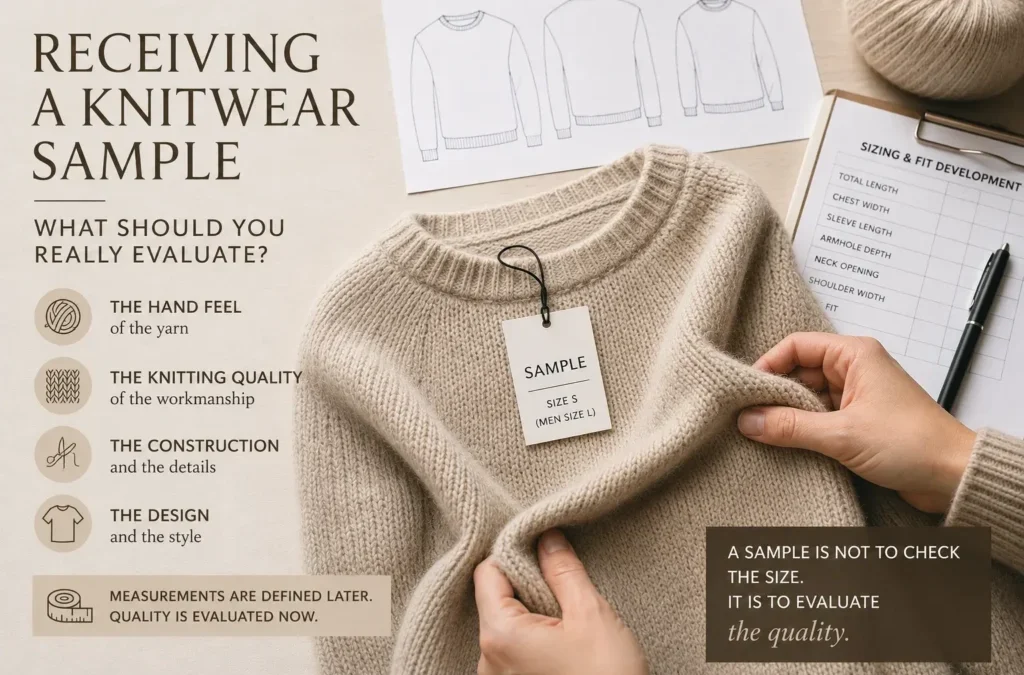
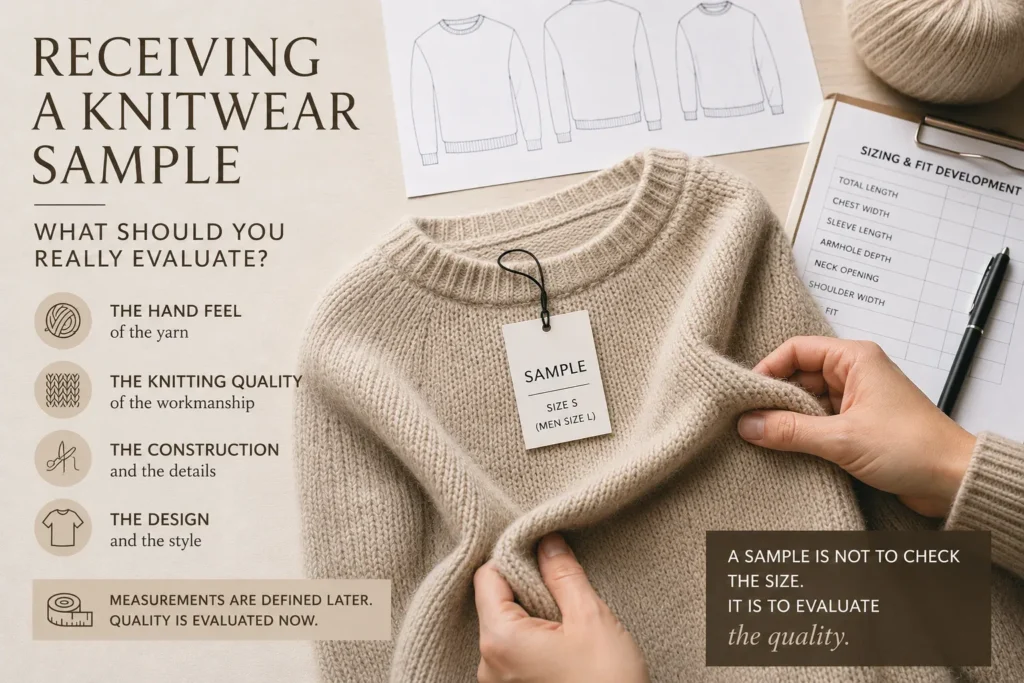
A knitwear sample isn't used to check the fit. It's used to verify the product's quality. The fit can be customized later.
Many of our new customers are developing their very first knitwear collection.
It's perfectly normal that, when they receive their first sample, their first comment is something like:
"It's a bit too small."
or
"I expected it to be a little longer."
Our answer is almost always the same:
No problem. We can adjust it exactly the way you want.
This is one of the biggest misunderstandings for brands that are new to knitwear manufacturing.
A Sample Is Not the Final Product
The purpose of the first sample is not to deliver the perfect fit.
Its purpose is to verify that the product has been developed correctly.
For this reason, samples are normally produced in standard reference sizes:
- Women's: Size S
- Men's: Size L
These are simply industry-standard sample sizes used as a starting point.
They are not the final sizing of your collection.
Fit Is Developed Together
One of the greatest advantages of knitwear manufacturing is its flexibility.
Unlike ready-made garments, almost every measurement can be customized.
We can modify virtually every aspect of the garment, including:
- overall body length;
- sleeve length;
- chest width;
- shoulder width;
- neck opening;
- turtleneck height;
- armhole depth;
- bottom width;
- body shape;
- slim, regular or oversized fit;
- and virtually any other measurement required.
In other words:
There is no single "correct" fit.
Every brand has its own identity, target customer and style.
Our job as a manufacturer is to transform your vision into a garment that reflects your brand.
What Should You Evaluate When You Receive a Sample?
When you receive your first sample, we recommend focusing on the aspects that truly determine the quality of the garment rather than its measurements.
1. The Hand Feel
How does the yarn feel?
Is it soft?
Does it feel compact or fluffy?
Does it provide the level of comfort you were expecting?
For cashmere and fine wool garments, the hand feel is one of the most important characteristics.
2. The Knitting Quality
Take a close look at the fabric.
Is the stitch definition clean?
Is the knitting tension even throughout the garment?
Does the fabric drape nicely?
Are the stitches regular and consistent?
These details reveal the overall manufacturing quality far more than the garment measurements.
3. The Garment Construction
Carefully inspect how the garment has been assembled.
Are the side seams perfectly straight?
Are the shoulders symmetrical?
Are the linking and finishing clean and accurate?
Does every part align correctly?
Unfortunately, not every knitwear manufacturer pays the same attention to these details.
It is not uncommon to find garments with twisted side seams, uneven shoulders or poorly assembled panels.
A well-made garment immediately reflects the quality of the manufacturer behind it.
4. The Design
Does the style match what you had in mind?
Are the proportions balanced?
Is the ribbing height correct?
Does the neckline have the look you wanted?
Do the finishing details meet your expectations?
These are exactly the elements that should be evaluated during the first sampling stage.
What About Measurements?
Measurements are usually finalized only after the sample has been approved.
This is a separate phase of product development.
Once the quality, construction and overall design have been approved, we can refine every measurement to achieve the desired fit.
At this stage we define:
- body length;
- chest width;
- sleeve length;
- fit;
- grading;
- size specifications;
- and any aesthetic adjustments.
Only then does the garment become the final production version.
Every Brand Has Its Own Fit
Think about your favorite fashion brands.
Some garments have a very slim silhouette.
Others offer a relaxed fit.
Some collections are intentionally oversized.
None of these approaches is right or wrong.
They simply reflect different brand identities.
Our role as a knitwear manufacturer is to create the fit that best represents yours.
The Advantage of Custom Knitwear Manufacturing
One of the greatest advantages of producing knitwear in Italy is the level of customization available.
You don't have to adapt your brand to an existing garment.
Instead, the garment is developed around your vision.
Every measurement can be adjusted until the fit is exactly what you are looking for.
For this reason, there is no need to worry if the first sample is slightly shorter, longer, wider or slimmer than expected.
That is simply part of the normal product development process.
Our Advice
When you receive your first sample, don't ask yourself only:
"Does it fit perfectly?"
Instead, ask yourself:
- Does the yarn feel right?
- Is the hand feel what I was looking for?
- Does the garment communicate quality?
- Is the construction clean and accurate?
- Does the design represent my brand?
If the answer is yes, then you are already very close to your final product.
Measurements can always be adjusted.
Manufacturing quality is what truly makes the difference.