
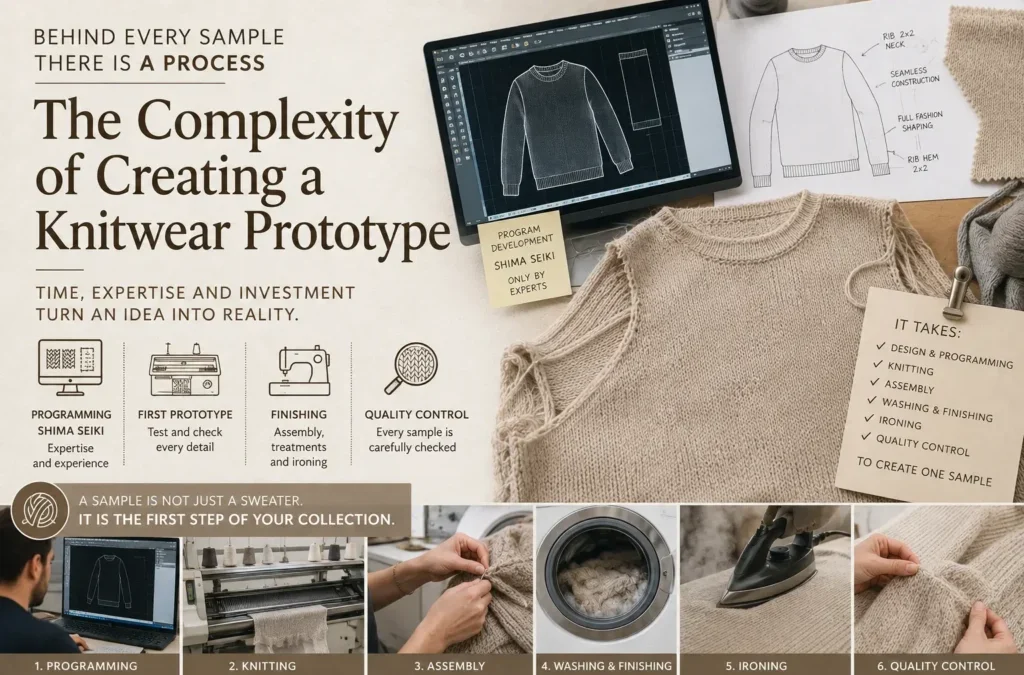
"Can you make us a sample?"
It is one of the questions we receive most frequently.
Many people imagine that producing a sample simply means loading yarn onto a knitting machine and waiting for a sweater to come out.
The reality is very different.
When developing a new knitwear style, the garment does not yet exist.
It has to be designed, programmed, tested, refined and perfected before it can go into production.
A sample is not just a sweater.
It is the beginning of an entirely new product.
Every Sample Starts with an Idea
A new knitwear sample can begin in many different ways.
A customer may provide:
- a photograph;
- a fashion sketch;
- a technical specification sheet (tech pack);
- an existing garment;
- or simply an idea to develop.
Regardless of the starting point, that is where our work begins.
The Machine Program Doesn't Exist Yet
A Shima Seiki computerized knitting machine cannot automatically produce a new style.
Every garment requires its own dedicated knitting program.
This program contains all the instructions the machine needs to produce the garment correctly, including:
- garment shape;
- stitch structure;
- increases and decreases;
- rib constructions;
- neckline;
- sleeves;
- shoulders;
- knitting tensions;
- yarn feeders;
- and the complete knitting sequence.
In other words, it is the digital blueprint of the garment.
Creating the Program Requires Years of Experience
The knitting program is not generated automatically.
It is developed by a highly skilled Shima Seiki programmer.
Becoming a professional knitwear programmer requires specialized training, dedicated Shima Seiki courses and years of practical experience.
It is one of the most specialized professions in the knitwear industry.
Every stitch, every shaping detail and every technical element must be carefully planned and programmed.
How Long Does It Take?
The answer depends entirely on the complexity of the design.
A simple plain-knit crewneck requires far less development than a garment featuring:
- cable patterns;
- textured stitches;
- jacquard knitting;
- intarsia;
- plated constructions;
- seamless (WholeGarment®) technology;
- or complex shaping details.
Some programs can be completed within a few hours.
Others may require several days of development.
The First Sample Is Rarely Perfect
Once the knitting program has been completed, the machine produces the first prototype.
However, this is only the beginning of the development process.
The first sample is usually created to verify that every aspect of the garment works correctly.
During this stage it is common to adjust:
- knitting tension;
- shaping;
- measurements;
- neckline construction;
- shoulder balance;
- rib details;
- or simply improve the overall fit.
For this reason, the first sample should always be considered a prototype rather than a finished product.
A Test Yarn Is Often Used
When the final yarn is particularly valuable, it is common practice to produce the first prototype using a less expensive test yarn.
This allows us to verify:
- the knitting program;
- the garment construction;
- the measurements;
- and any technical issues that may need correction.
Only after the program has been fully approved is the sample produced using the final yarn.
In the case of cashmere, this approach helps avoid unnecessary material waste.
The Work Doesn't End When the Machine Stops
Once the knitting machine has finished, the garment is still far from complete.
Several additional production stages are required, including:
- removing the garment from the machine;
- checking every knitted panel;
- linking or fully assembling the garment;
- trimming loose yarns;
- washing or fulling when required;
- drying;
- pressing;
- and carrying out a final quality inspection.
Only then is the sample ready for evaluation.
How Much Does Sample Development Cost?
This is another question we hear very often.
The answer is simple.
You are not paying only for a sweater.
You are investing in the entire product development process.
The cost includes:
- design analysis;
- Shima Seiki programming;
- the programmer's work;
- machine time;
- yarn consumption;
- garment assembly;
- washing and finishing;
- pressing;
- quality control;
- and, when necessary, additional testing and program revisions.
In many cases, the programming alone may cost between €100 and €300, depending on the complexity of the style, before considering machine time, materials and all subsequent production processes.
Why We Charge for Sample Development
Some customers are surprised that developing a prototype involves a separate charge.
In reality, the fee covers only part of the investment required.
Creating a knitwear sample involves hours of highly specialized work and the collaboration of several skilled professionals.
For this reason, we are always happy to develop samples for customers who are genuinely interested in moving forward with production.
A sample is not simply a garment to purchase.
It is the first investment in your future collection.
Behind Every Sample Is a Team
Many people are surprised to discover how many professionals contribute to the development of a single knitwear sample.
Depending on the project, a prototype may involve:
- the customer or fashion designer;
- the Shima Seiki programmer;
- the knitwear technician;
- the knitting machine operator;
- the linking and assembly specialist;
- the washing and finishing department;
- the pressing specialist;
- the quality control inspector;
- the production manager who oversees the entire process.
When you realize that up to nine skilled professionals may contribute to a single prototype, it becomes much easier to understand why developing a sample cannot cost only a few euros.
It is a genuine research and development process.
A Great Sample Is an Investment, Not an Expense
Every successful knitwear collection begins with a well-developed sample.
The more care, expertise and attention invested during this stage, the smoother and more efficient production will be later.
That is why we consider sample development to be one of the most important phases of the entire project.
Because this is the moment when an idea stops being just a sketch and becomes a real knitwear garment.