
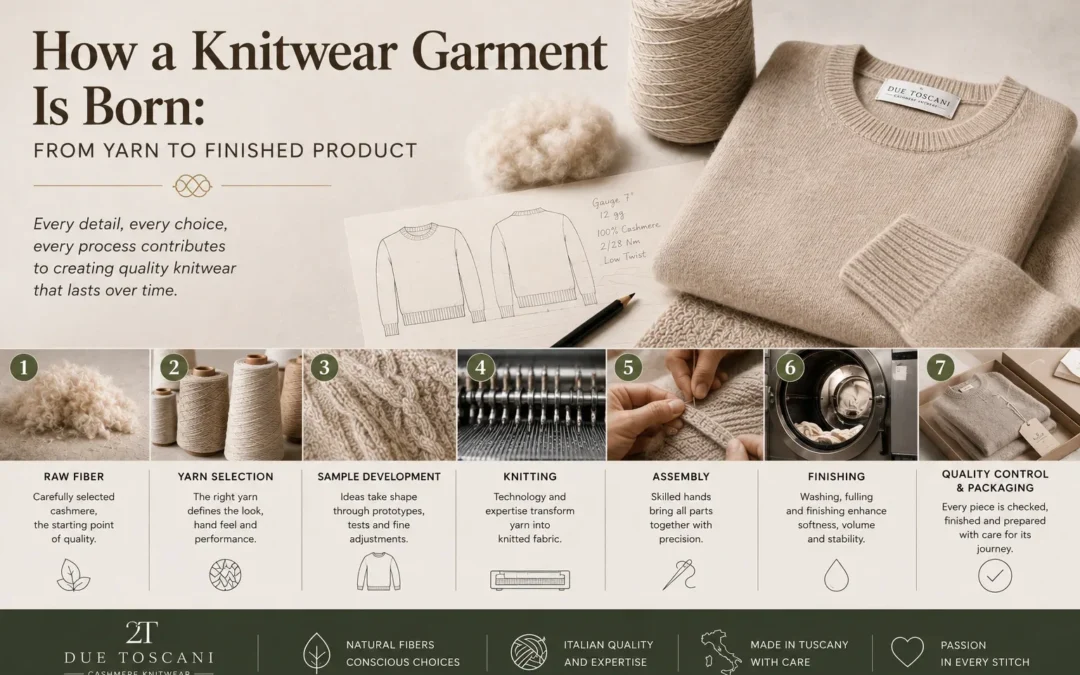
When a customer enters a store and picks up a cashmere sweater, they see the end result of a process that often seems simple. A soft, warm, elegant garment, ready to be worn. What they don't see is the long journey that transforms a fiber into a finished product, a journey of technical choices, manufacturing expertise, continuous checks, and hundreds of details that determine the final quality.
In the world of high-end knitwear, every garment tells a story that begins long before the knitting machine. It begins with the yarn. This is where the foundation of the product is laid. The choice of yarn is not just about color or composition, but also involves parameters such as count, twist, number of plies, fiber length, and processing behavior. Two seemingly similar yarns can produce completely different results once transformed into a garment.
Choosing the right yarn
At Due Toscani, every project begins with an analysis of the desired product. A sweater destined for a luxury boutique in Scandinavia will have different needs than a collection for a concept store in Southern Europe. The season, the final target, the selling price, and the brand's positioning influence all subsequent choices.
Sample development
Once the most suitable yarn has been identified, the sample development phase begins. This is where ideas take shape. The model, fit, construction, and stitch are defined. Each stitch creates a different result. A plain stitch conveys elegance and cleanliness, a rib stitch communicates structure and comfort, while more complex stitches can add character and volume to the product.
Sample development is a phase that requires experience and numerous tests. The initial processes are performed to verify how the yarn reacts to the machine, how the chosen stitch behaves, and what the final effect will be after subsequent treatments. Often, the first sample is not the final one. Small changes in measurements, tension, or workmanship can make a huge difference in the final result.
Knitting and production
Once the sample is approved, the knitting machines are programmed. Today, technology allows for extraordinary levels of precision, but the machine alone is not enough. Behind every program is the work of specialized technicians who understand the behavior of the yarn and know how to achieve the best possible result.
The actual production process is a fascinating phase. Thousands of meters of yarn flow through needles and electronic systems that transform a simple thread into panels, sleeves, collars, and details. Each machine operates according to extremely precise parameters. An incorrect tension or even the slightest variation can affect the entire garment.
Finishing
Once the process is complete, the product enters the manufacturing phase. In traditional garments, the different parts are joined by specialized personnel who assemble the sweater with millimeter precision. In more advanced systems, certain processes allow for almost completely seamless garments, improving comfort and fit.
At this point, the garment is not yet ready. In fact, it is likely at the most delicate stage of its transformation. This is where the finishing comes into play, a series of processes that determine much of the quality perceived by the end customer.
Washing, fulling, drying, and stabilization profoundly alter the product. It is during these stages that cashmere develops much of its softness, volume, and characteristic feel. A properly executed treatment enhances the yarn. An incorrect treatment can jeopardize weeks of work.
Quality control
After finishing, quality control begins. Each garment is inspected for measurements, stitch regularity, any defects, and compliance with the approved sample. This is often an invisible step, but it is essential to ensure continuity and reliability over time.
Only after passing all these checks is the garment ironed, labeled, packaged, and prepared for shipping. What arrives in the store is the result of a process involving diverse skills, advanced technologies, and a deep knowledge of the raw material.
For a buyer, understanding how a knitwear garment is created means understanding the true value of the product. Behind a cashmere sweater is more than just a yarn transformed into a garment, but a sequence of technical and production decisions that influence quality, comfort, durability, and the perceived value.
At Due Toscani, we believe that quality doesn't come from a single element, but from the balance between raw materials, experience, technology, and attention to detail. It's this balance that transforms a simple yarn into a garment designed to last and represent the best of Tuscan manufacturing tradition.