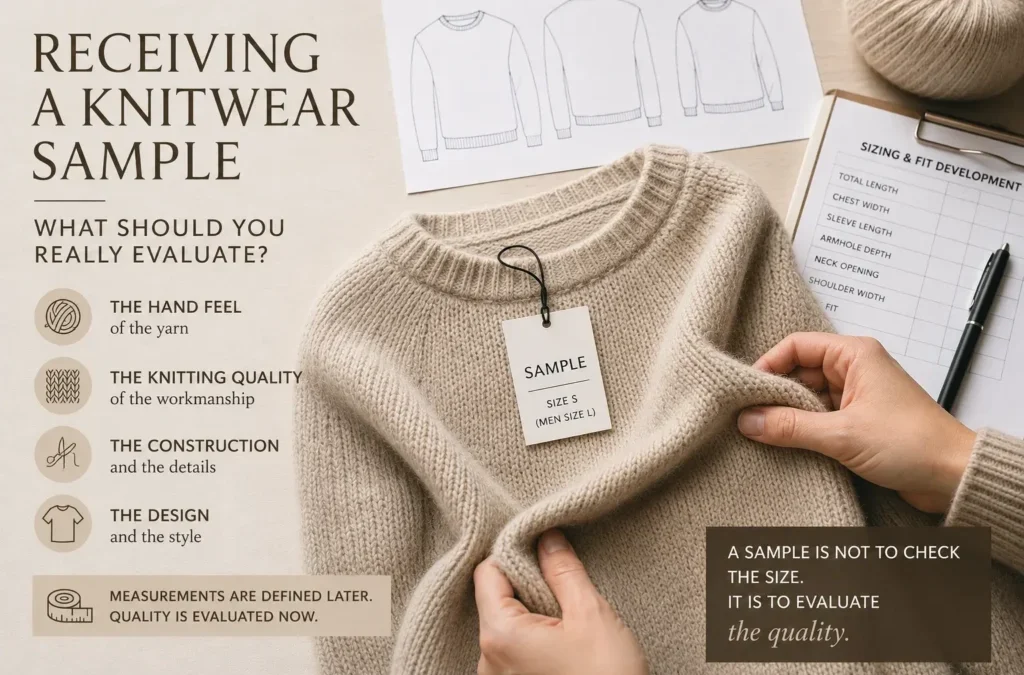
It is one of the questions we receive most frequently.
Many people imagine that producing a sample simply means loading yarn onto a knitting machine and waiting for a sweater to come out.
The reality is very different.
When developing a new knitwear style, the garment does not yet exist.
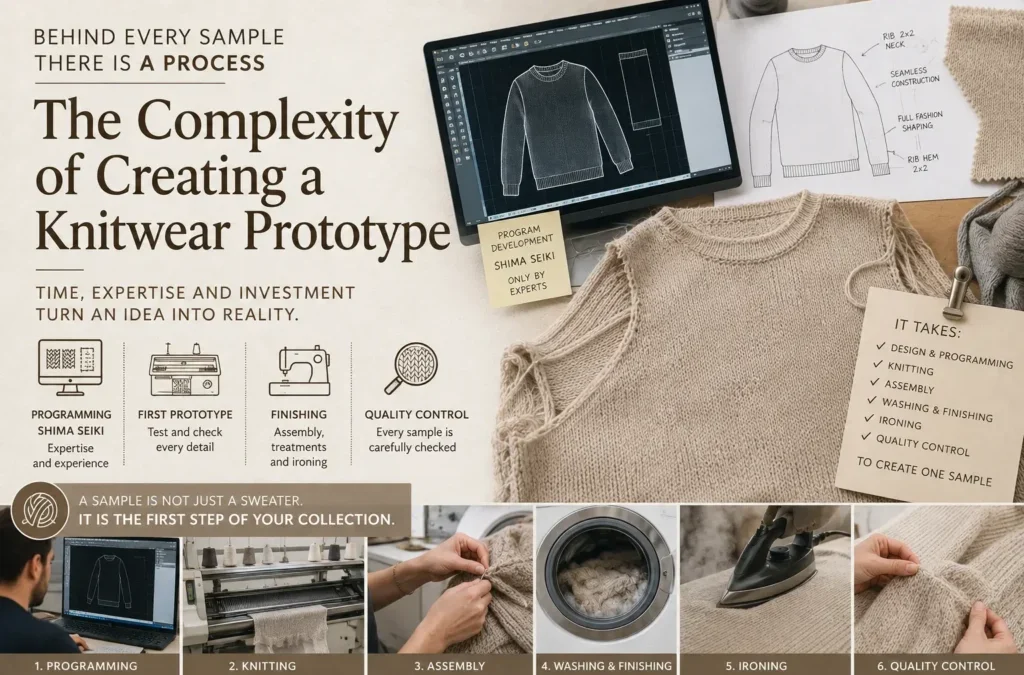
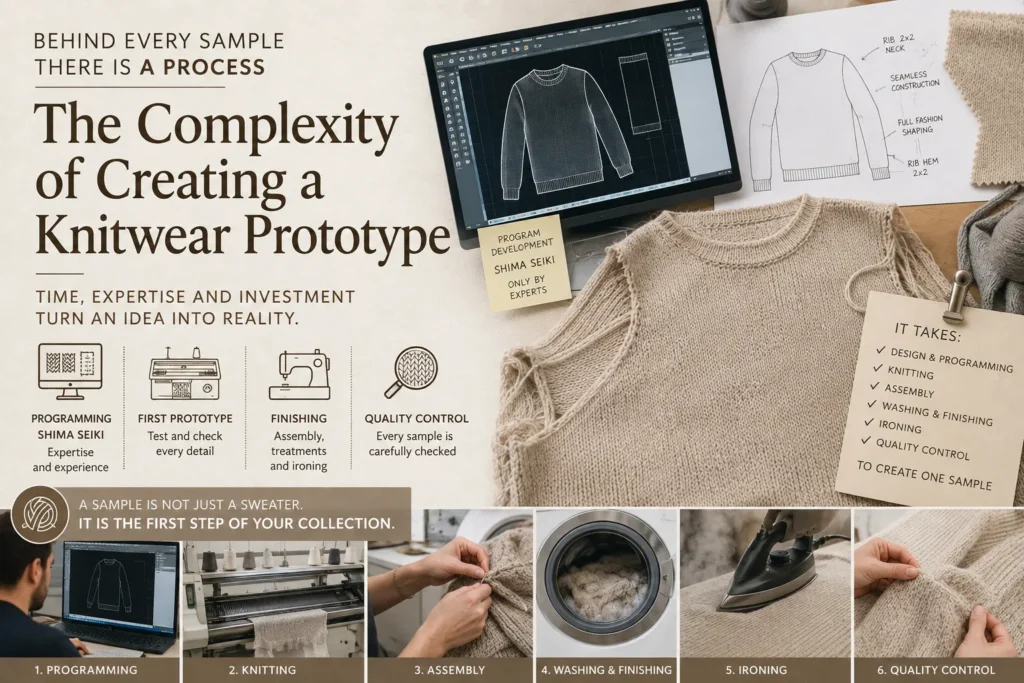
It has to be designed, programmed, tested, refined and perfected before it can go into production.
A sample is not just a sweater.
It is the beginning of an entirely new product.
Every Sample Starts with an Idea
A new knitwear sample can begin in many different ways.
A customer may provide:
a photograph;
a fashion sketch;
a technical specification sheet (tech pack);
an existing garment;
or simply an idea to develop.
Regardless of the starting point, that is where our work begins.
The Machine Program Doesn't Exist Yet
A Shima Seiki computerized knitting machine cannot automatically produce a new style.
Every garment requires its own dedicated knitting program.
This program contains all the instructions the machine needs to produce the garment correctly, including:
garment shape;
stitch structure;
increases and decreases;
rib constructions;
neckline;
sleeves;
shoulders;
knitting tensions;
yarn feeders;
and the complete knitting sequence.
In other words, it is the digital blueprint of the garment.
Creating the Program Requires Years of Experience
The knitting program is not generated automatically.
It is developed by a highly skilled Shima Seiki programmer.
Becoming a professional knitwear programmer requires specialized training, dedicated Shima Seiki courses and years of practical experience.
It is one of the most specialized professions in the knitwear industry.
Every stitch, every shaping detail and every technical element must be carefully planned and programmed.
How Long Does It Take?
The answer depends entirely on the complexity of the design.
A simple plain-knit crewneck requires far less development than a garment featuring:
cable patterns;
textured stitches;
jacquard knitting;
intarsia;
plated constructions;
seamless (WholeGarment®) technology;
or complex shaping details.
Some programs can be completed within a few hours.
Others may require several days of development.
The First Sample Is Rarely Perfect
Once the knitting program has been completed, the machine produces the first prototype.
However, this is only the beginning of the development process.
The first sample is usually created to verify that every aspect of the garment works correctly.
During this stage it is common to adjust:
knitting tension;
shaping;
measurements;
neckline construction;
shoulder balance;
rib details;
or simply improve the overall fit.
For this reason, the first sample should always be considered a prototype rather than a finished product.
A Test Yarn Is Often Used
When the final yarn is particularly valuable, it is common practice to produce the first prototype using a less expensive test yarn.
This allows us to verify:
the knitting program;
the garment construction;
the measurements;
and any technical issues that may need correction.
Only after the program has been fully approved is the sample produced using the final yarn.
In the case of cashmere, this approach helps avoid unnecessary material waste.
The Work Doesn't End When the Machine Stops
Once the knitting machine has finished, the garment is still far from complete.
Several additional production stages are required, including:
removing the garment from the machine;
checking every knitted panel;
linking or fully assembling the garment;
trimming loose yarns;
washing or fulling when required;
drying;
pressing;
and carrying out a final quality inspection.
Only then is the sample ready for evaluation.
How Much Does Sample Development Cost?
This is another question we hear very often.
The answer is simple.
You are not paying only for a sweater.
You are investing in the entire product development process.
The cost includes:
design analysis;
Shima Seiki programming;
the programmer's work;
machine time;
yarn consumption;
garment assembly;
washing and finishing;
pressing;
quality control;
and, when necessary, additional testing and program revisions.
In many cases, the programming alone may cost between €100 and €300, depending on the complexity of the style, before considering machine time, materials and all subsequent production processes.
Why We Charge for Sample Development
Some customers are surprised that developing a prototype involves a separate charge.
In reality, the fee covers only part of the investment required.
Creating a knitwear sample involves hours of highly specialized work and the collaboration of several skilled professionals.
For this reason, we are always happy to develop samples for customers who are genuinely interested in moving forward with production.
A sample is not simply a garment to purchase.
It is the first investment in your future collection.
Behind Every Sample Is a Team
Many people are surprised to discover how many professionals contribute to the development of a single knitwear sample.
Depending on the project, a prototype may involve:
the customer or fashion designer;
the Shima Seiki programmer;
the knitwear technician;
the knitting machine operator;
the linking and assembly specialist;
the washing and finishing department;
the pressing specialist;
the quality control inspector;
the production manager who oversees the entire process.
When you realize that up to nine skilled professionals may contribute to a single prototype, it becomes much easier to understand why developing a sample cannot cost only a few euros.
It is a genuine research and development process.
A Great Sample Is an Investment, Not an Expense
Every successful knitwear collection begins with a well-developed sample.
The more care, expertise and attention invested during this stage, the smoother and more efficient production will be later.
That is why we consider sample development to be one of the most important phases of the entire project.
Because this is the moment when an idea stops being just a sketch and becomes a real knitwear garment.
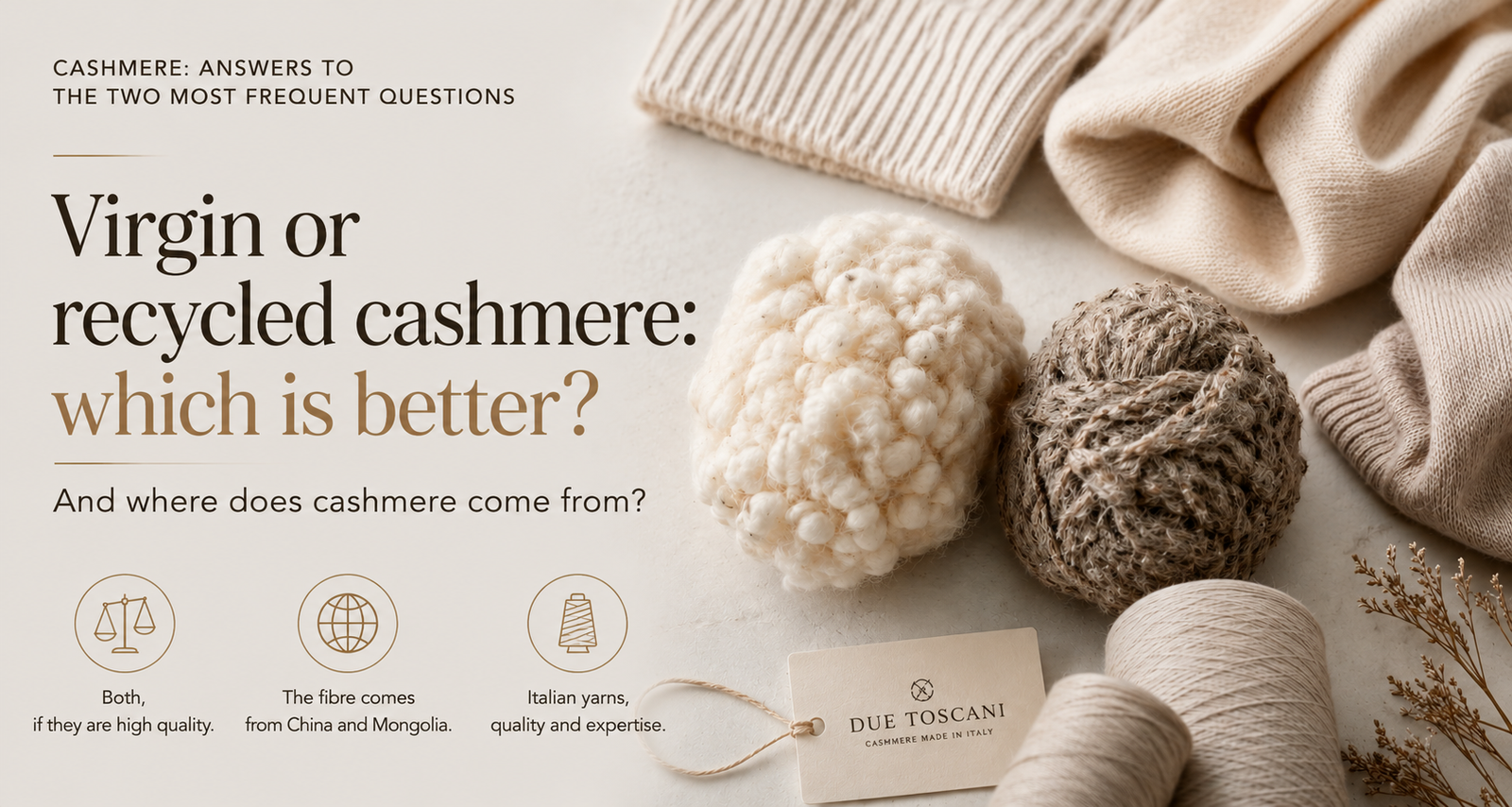
There are two questions we have been receiving very frequently lately from customers, buyers, retailers and brands contacting us to develop their own collections:
1. Which is better: virgin cashmere or recycled cashmere?
2. Where does cashmere come from?
These are two very interesting questions because they give us the opportunity to clarify some aspects of cashmere that are still often misunderstood.
Let’s start with the first one.
Which Is Better: Virgin or Recycled Cashmere?
Our answer is simple:
Both.
High-quality virgin cashmere and high-quality recycled cashmere are both excellent materials.
They are different.
They have different origins, are obtained through different processes and can have different characteristics, both to the touch and in the finished garment.
But different does not mean better or worse.
The real distinction should not simply be between virgin cashmere and recycled cashmere.
It should be between high-quality cashmere and poor-quality cashmere.
Not All Virgin Cashmere Is the Same
Virgin cashmere is produced from the fibre obtained from the undercoat of cashmere goats.
It is an extraordinarily fine, soft and insulating fibre which, when it is of good quality and properly processed, can be used to create exceptional yarns and knitwear.
But there is one very important thing to remember:
the words “100% cashmere” indicate the composition, not the quality.
Two sweaters can both have “100% cashmere” written on their labels and yet be completely different.
The quality of the fibre depends on several factors, including fineness, length, uniformity and the selection of the raw material.
And then there is everything that happens afterwards.
The quality of the spinning, dyeing, yarn count, number of plies, machine gauge, knit construction and finishing process all contribute to the final result.
This is why there are exceptionally high-quality virgin cashmeres as well as much more commercial-quality virgin cashmeres.
Simply saying “it is virgin cashmere” is not enough to determine the quality of a garment.
What About Recycled Cashmere?
The same principle applies to recycled cashmere.
Once again, everything starts with the quality of the raw material and how carefully it is selected.
Recycled cashmere is obtained by recovering cashmere-containing materials, carefully sorting them and processing them back into fibre.
That fibre can then be used to produce a new yarn and, subsequently, a new garment.
The quality of the final result depends on the quality of the original material, the sorting process, the knowledge of the fibres and the way in which the entire recycling and spinning process is carried out.
High-quality recycled cashmere can be extremely soft, warm, pleasant to the touch and beautiful to wear.
It will have different characteristics from virgin cashmere, but that does not automatically make it inferior.
It is simply another way of using cashmere.
Recycled Cashmere Is Not “Second-Class Cashmere”
This is probably one of the points we care about most.
Automatically considering recycled cashmere to be a cheaper or lower-quality version of virgin cashmere is an oversimplification.
There is excellent recycled cashmere, just as there is mediocre virgin cashmere.
Once again, everything depends on the raw material and how it is processed.
Recycled cashmere also introduces another important element: the ability to recover a precious fibre and give it a new life.
And when we talk about recovering textile fibres, we inevitably talk about Prato.
In Prato, Textile Recycling Is Not a Recent Trend
Today, there is a great deal of discussion about the circular economy, raw material recovery and sustainability.
In the textile district of Prato, these practices have existed for generations.
The sorting of garments and textile waste, separation by composition and colour, fibre recovery and transformation into new raw material are all part of the industrial history of our area.
Behind these processes are skills that cannot simply be acquired by purchasing a machine.
They require experience, knowledge of fibres and the ability to recognise and correctly select different materials.
For this reason, recycled cashmere is not simply an alternative to virgin cashmere for us.
It also represents part of the textile culture we come from.
So, Virgin or Recycled Cashmere?
Both.
We use both and we believe in both.
We may choose virgin cashmere when we are looking for certain characteristics and recycled cashmere when we are looking for others.
We may prefer the feel of one or the other.
We may choose according to the garment, the project, the price point, the positioning of the collection or the philosophy of the brand.
But there is no rule saying that virgin automatically means “better” and recycled automatically means “worse”.
For us, the fundamental question remains:
Is it good cashmere?
Second Question: Where Does Cashmere Come From?
This is another question we are asked very frequently.
And here we need to distinguish between at least three things:
the origin of the fibre, where the yarn is produced, and where the garment is manufactured.
These are three different things.
Where Does Cashmere Fibre Come From?
Cashmere fibre comes from the undercoat of cashmere goats.
These animals live mainly in areas of Asia characterised by particularly harsh climatic conditions.
The main cashmere-producing regions are located in China and Mongolia, as well as other areas of Central Asia.
To protect themselves from extremely cold winters, cashmere goats develop a very fine, soft and insulating undercoat beneath their longer, coarser outer hair.
It is this exceptionally fine fibre that we are interested in.
After collection, the raw material must be sorted, cleaned and separated from the coarser hairs. Only part of the material collected will therefore become the cashmere fibre used to produce yarn.
So Does Italian Cashmere Exist?
It depends on what we mean by the expression.
If we are talking about the origin of the fibre, the cashmere used by the Italian textile industry comes mainly from Asia.
But this certainly does not mean that there cannot be cashmere yarn produced in Italy or, of course, cashmere knitwear Made in Italy.
And this is where confusion often arises.
The origin of the raw material is one thing.
Where and how that raw material is transformed is another.
From Asian Fibre to Italian Yarn
Cashmere fibre originating from Mongolia or China can be purchased, selected and subsequently transformed in Italy by an Italian spinning mill.
Spinning is a fundamental part of the process.
Having access to good fibre is not enough to automatically produce an exceptional yarn.
It requires knowledge of the raw material, experience, technology, selection expertise, preparation, blending, spinning, dyeing and quality control.
Italy is home to some of the world’s most prestigious and specialised cashmere spinning mills.
And these are the companies we rely on for our virgin cashmere production.
The Virgin Cashmere Yarns We Use
For our virgin cashmere knitwear, we use yarns produced in Italy by some of the finest Italian spinning mills.
The yarn is selected according to the garment we need to produce.
There is no single yarn that is ideal for everything.
A substantial sweater knitted on a particular gauge, an extremely lightweight garment produced on a high-gauge machine, a scarf, a shawl or a seamless garment may all require yarns with different characteristics.
For us, choosing the yarn therefore means starting with the result we want to achieve.
And What About Our Recycled Cashmere?
In the case of recycled cashmere, our involvement with the yarn is even more direct.
The recycled cashmere yarn we use is produced by us in collaboration with a specialised partner in the Prato textile district.
This allows us to be directly involved in the selection of the raw material and in the production of the yarn that will subsequently be used in our collections and in the garments we manufacture for our customers.
And it is significant that this takes place in Prato.
Because here, fibre regeneration is not simply a manufacturing technique.
It is part of our industrial history.
And Finally, There Is the Knitwear
At this point, we have the fibre and we have the yarn.
But one fundamental step is still missing: transforming that yarn into a knitted garment.
This is where our work begins.
The choice of machine gauge, programming, stitch construction, tensions, knitting, linking and assembly where required, finishing, washing, fulling, pressing and final quality control can all have a profound effect on the final result.
The same yarn, worked in two different ways, can produce two garments with completely different looks and handles.
This is why the quality of a cashmere sweater cannot be explained simply by reading the composition on its label.
Behind a good garment lies an entire supply chain.
Fibre, Yarn and Knitwear: Three Different Origins
We can therefore summarise the journey very simply.
Cashmere fibre originates mainly in Asia.
The virgin cashmere yarns we use are produced in Italy by some of the finest Italian spinning mills.
Our recycled cashmere yarn is produced by us in collaboration with a specialised partner in Prato.
Our knitwear is manufactured in Italy.
These are different stages of the same story.
And it is important to understand them because when we purchase or develop a cashmere product, we are not simply purchasing a fibre.
We are purchasing the result of a long chain of skills and expertise.
So, in the End, Which Cashmere Is Better?
Let’s return to the question we started with.
Virgin cashmere or recycled cashmere?
Both.
As long as the raw material is good.
As long as the yarn is well made.
As long as the right manufacturing process is chosen.
And as long as the people transforming that yarn into knitwear really know what they are doing.
Because the quality of cashmere does not come from a single word written on a label.
It comes from the raw material, knowledge and experience of all the people who transform it.
Carded cashmere is like a very soft wool blanket: it envelops, traps air, and transmits warmth and softness. Combed cashmere is like a heavy silk fabric: fluid, clean, elegant, with a perfectly smooth surface.
When people think about cashmere knitwear, they often assume that one cashmere sweater is much like another. In reality, nothing could be further from the truth.
There are two main families of cashmere yarns used in knitwear: carded cashmere and combed cashmere.
Both can be made from the finest quality cashmere fibers, both can be entirely Made in Italy, and both can represent true luxury. Yet the final garment offers a completely different experience.
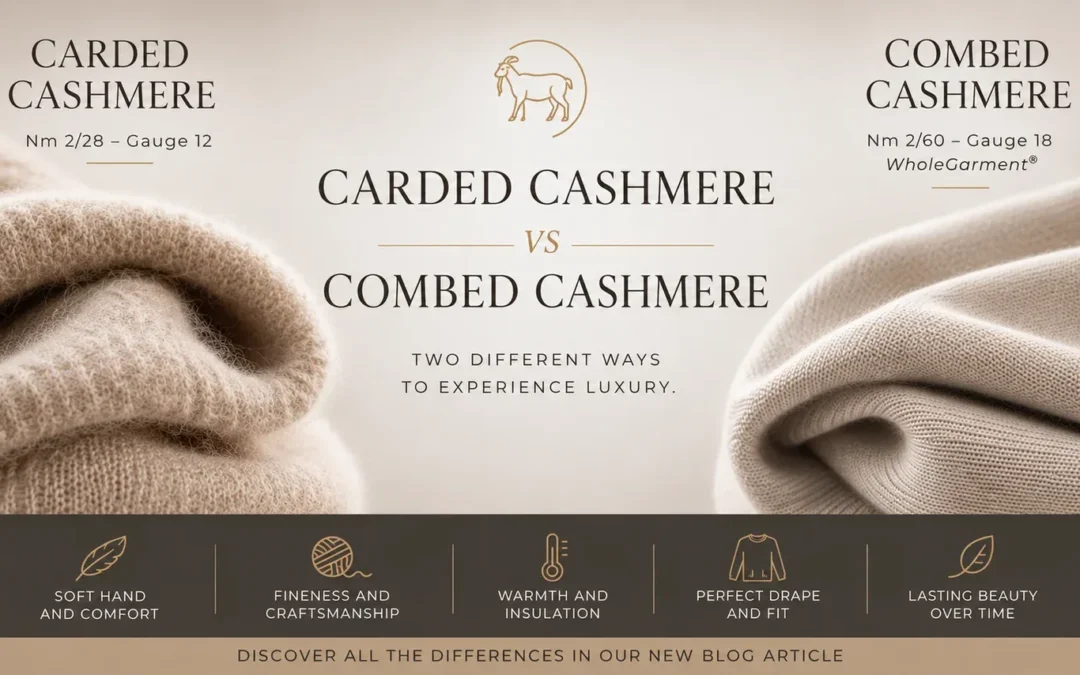
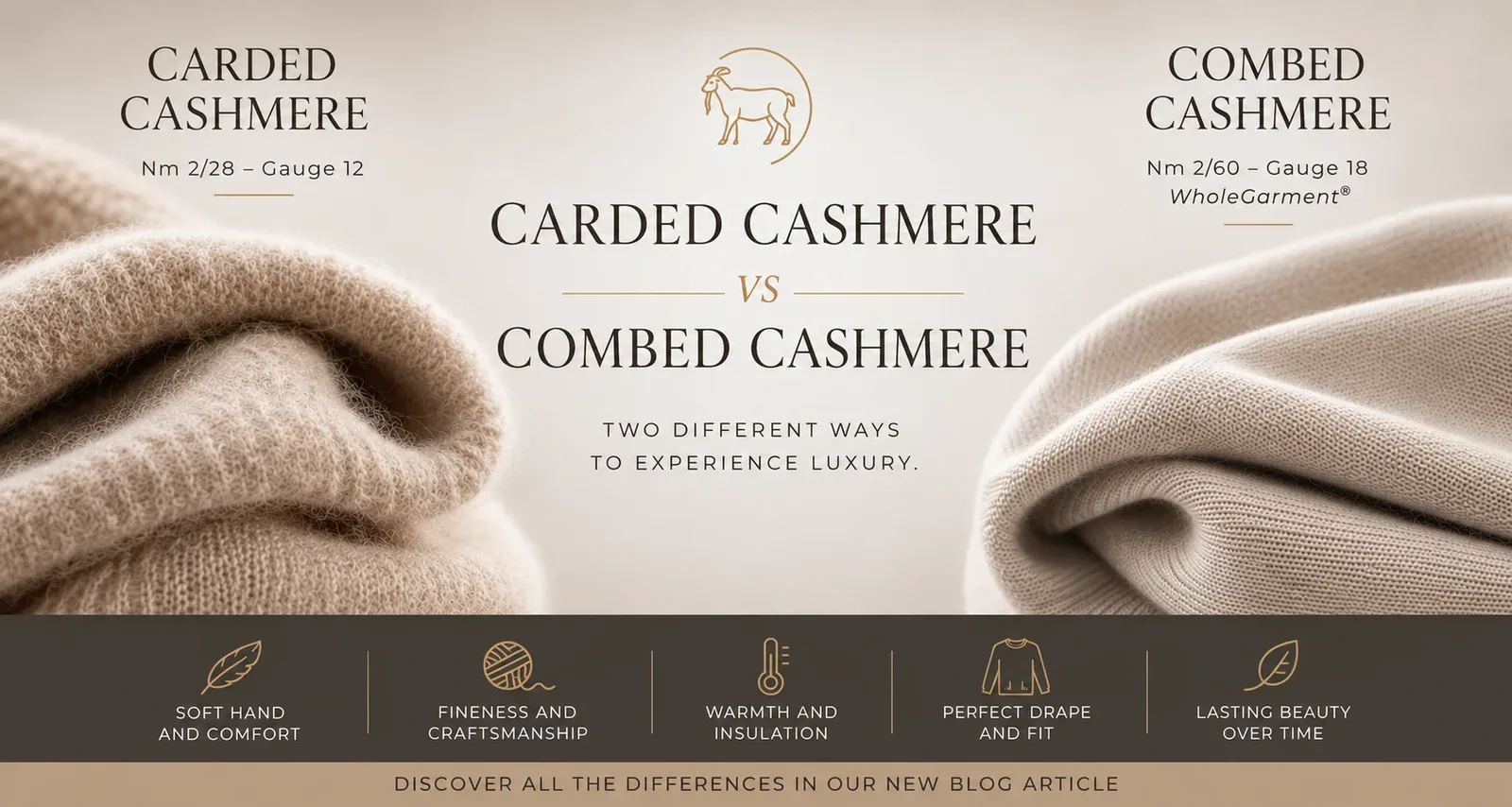
To better understand the difference, let's compare two women's sweaters produced by Due Toscani:
a sweater knitted in 100% carded cashmere Nm 2/28 on a 12-gauge knitting machine;
a sweater knitted in 100% combed cashmere Nm 2/60 on an 18-gauge Shima Seiki WholeGarment® machine, produced seamlessly.
Both are made from pure cashmere.
Both are manufactured in Italy.
Yet they almost seem to belong to two different worlds.
Carded Cashmere: Softness, Warmth and Volume
The very first sensation you experience when touching a sweater made from carded cashmere is softness.
During the carding process, the fibers are opened and arranged in a less uniform way than in combed yarns, allowing part of the fibers to naturally rise to the surface.
The result is a garment that feels:
softer;
fuller;
slightly fuzzy;
warmer to the touch.
Its surface is not perfectly smooth.
And that is precisely its beauty.
The delicate halo surrounding the yarn creates the comforting softness that most people instinctively associate with premium cashmere.
Carded yarn also traps a larger amount of air between the fibers.
Since air is nature's best thermal insulator, this structure allows the garment to retain heat extremely well.
That is why a carded cashmere sweater immediately feels warm and cozy, even when it is surprisingly lightweight.
Combed Cashmere: Precision, Elegance and Refinement
Combed cashmere follows a completely different philosophy.
Before spinning, the fibers are carefully combed and aligned in the same direction.
This produces a much more regular, compact and uniform yarn.
A sweater knitted in Nm 2/60 cashmere on an 18-gauge machine has characteristics that are immediately recognizable:
perfectly smooth surface;
silky, dry hand feel;
elegant drape;
exceptionally well-defined stitch structure;
uniform weight distribution.
It doesn't feel like a soft cloud.
Instead, it feels like an exceptionally refined textile.
Many customers describe it as wearing a "second skin."
The Way the Garment Drapes Is Completely Different
This is perhaps the biggest difference—although it is difficult to appreciate in photographs.
A carded cashmere sweater has more body.
It maintains its structure and shape more naturally.
A combed cashmere sweater, on the other hand, follows the body's movements effortlessly.
It drapes gracefully over the shoulders and adapts naturally to the silhouette.
For this reason, combed cashmere is widely used in contemporary luxury collections where elegance, fluidity and refined tailoring are essential.
Gauge Makes a Huge Difference
A 12-gauge knitting machine produces a richer, fuller knit with a more visible stitch structure.
The fabric feels substantial and textured, making it ideal for autumn and winter garments.
An 18-gauge machine, by contrast, creates an exceptionally fine knit.
The stitches become almost invisible.
The surface appears smooth, continuous and incredibly elegant.
When this construction is combined with WholeGarment® seamless technology, comfort reaches another level.
Without side seams or linking, the garment adapts naturally to the body and offers an almost imperceptible wearing experience.
Which One Feels Softer?
This is probably the question we hear most often.
The answer depends on what we mean by "soft."
Carded cashmere feels softer the moment you touch it.
Its loft immediately creates a sensation of warmth and comfort.
Combed cashmere, instead, initially feels smoother and drier.
But once worn, it surprises with its extraordinary delicacy against the skin.
They are simply two different kinds of softness.
One is cloud-like softness.
The other is silky softness.
Which One Is Warmer?
For garments of comparable weight, carded cashmere generally provides greater thermal insulation because its loft traps more air between the fibers.
Combed cashmere, on the other hand, focuses on lightness, elegance and year-round comfort.
It performs exceptionally well indoors, under jackets and in environments where refined layering is preferred.
Neither is objectively better.
They simply offer two different interpretations of luxury.
If we had to describe these two types of cashmere in just a few words, we would say this.
Carded Cashmere
✔ You immediately want to wrap yourself in it.
✔ It feels warm from the very first touch.
✔ It offers instant softness.
✔ It has a rich, natural and textured appearance.
✔ It creates an immediate sense of comfort.
Combed Cashmere
✔ It truly reveals itself once you wear it.
✔ It glides effortlessly over the body.
✔ It is exceptionally elegant.
✔ Its surface is perfectly smooth.
✔ It is so comfortable that you almost forget you're wearing it.
An Easy Way to Understand the Difference
A simple comparison often explains it better than any technical description.
Carded cashmere is like a luxurious blanket.
It wraps around you.
It keeps you warm.
It gives you an immediate feeling of comfort.
Combed cashmere is like a bespoke shirt made from the world's finest fiber.
It is lightweight.
It drapes beautifully.
It is effortlessly elegant.
A Matter of Personal Preference
Another important difference concerns how the garment evolves over time.
Because carded cashmere naturally has more free fibers on its surface, it may develop a light pilling during the first period of use. This is perfectly normal for high-quality carded yarns and usually stabilizes after the first wears and proper washing.
Combed cashmere, thanks to its longer, parallel fibers, generally has a smoother and more stable surface, with a lower tendency to pill and a more uniform appearance over time.
Neither characteristic should be considered a defect.
They are simply the natural result of two different spinning technologies.
Two Interpretations of the Same Extraordinary Fiber
Carded cashmere represents the warmest, softest and most enveloping expression of this extraordinary natural fiber.
Combed cashmere expresses its most refined, technical and elegant side.
At Due Toscani, we choose both because they meet different expectations.
Some customers seek the comforting embrace of a warm winter sweater.
Others are looking for an exceptionally refined knit that feels light, elegant and perfectly tailored.
In both cases, the true protagonist remains the same:
high-quality cashmere, expertly crafted in Italy through a combination of traditional craftsmanship and state-of-the-art knitting technology.
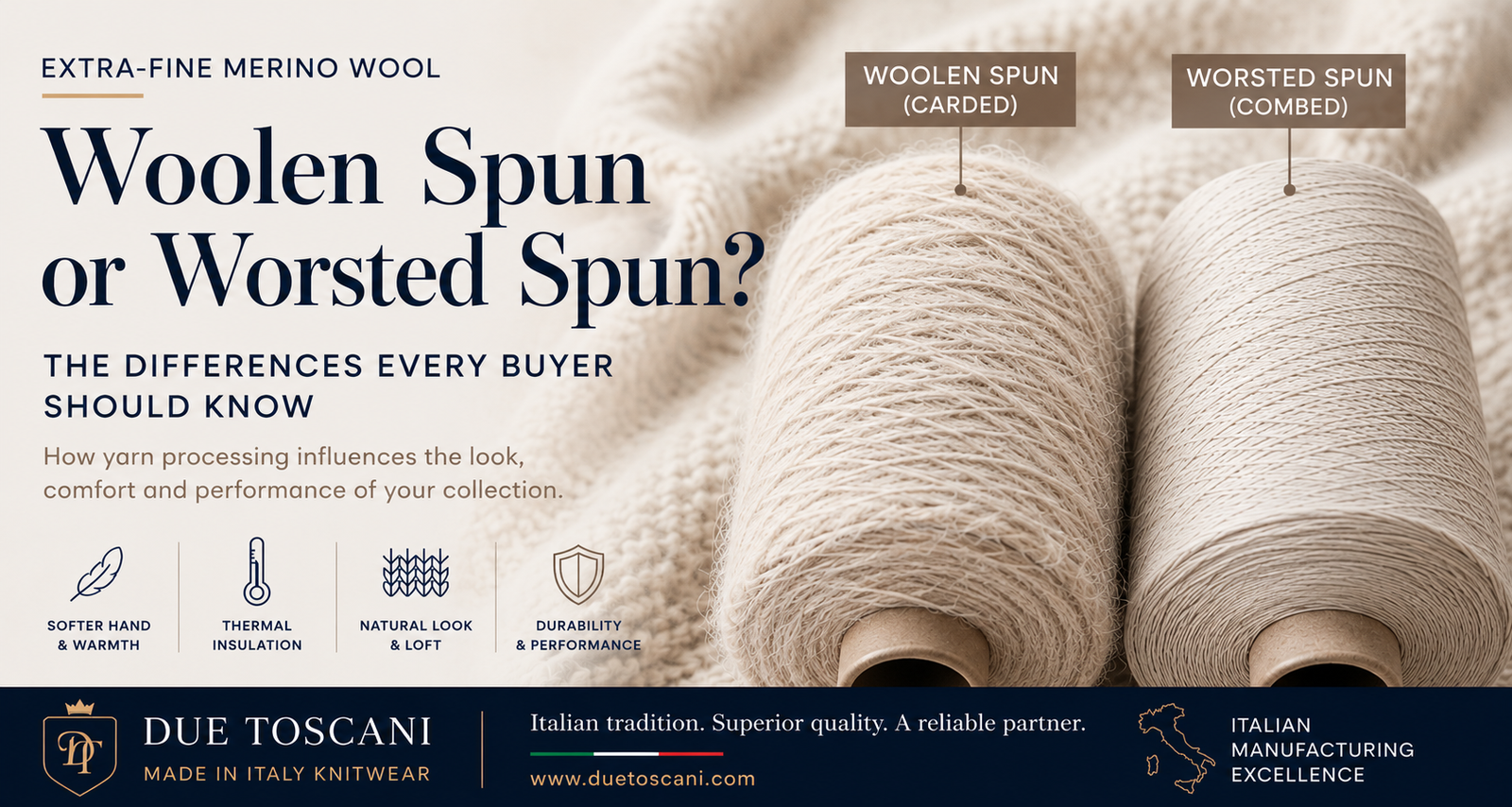
When it comes to premium knitwear, extra-fine Merino wool is one of the most appreciated fibres in the world. Soft, breathable, naturally elastic and incredibly versatile, it is used to create garments ranging from premium everyday knitwear to luxury fashion collections.
However, there is one essential distinction that is often overlooked: not all Merino yarns are the same.
One of the most important differences lies in the spinning process, which produces either woolen spun yarns or worsted spun yarns.
Understanding this difference helps designers, buyers and fashion brands choose the most suitable yarn for their collections, influencing the appearance, comfort, performance and commercial positioning of the final garment.
What is Extra-Fine Merino?
Extra-fine Merino wool comes from carefully selected Merino sheep known for producing exceptionally fine fibres.
The finest qualities measure below 19 microns, making them extremely soft against the skin and comfortable even for people who usually find wool itchy.
Thanks to its natural properties, extra-fine Merino offers:
excellent thermal insulation;
outstanding breathability;
natural moisture management;
excellent elasticity;
exceptional comfort throughout the year.
But fibre quality is only the starting point.
The way these fibres are processed into yarn dramatically changes the characteristics of the finished garment.
What is Woolen Spun Merino?
Woolen spinning is the traditional method of producing soft, lofty yarns.
During this process, the fibres are opened, cleaned and blended, but they remain arranged in a relatively random orientation.
Shorter fibres are intentionally retained within the yarn, creating a structure that traps more air.
The result is a yarn with distinctive characteristics:
softer hand feel;
greater loft;
fuller appearance;
slightly fuzzy surface;
superior warmth.
Because woolen spun yarn contains more air between the fibres, it provides excellent thermal insulation while remaining surprisingly lightweight.
This is why woolen spun Merino is particularly appreciated for Autumn/Winter collections.
The Visual Characteristics of Woolen Spun Knitwear
Garments knitted with woolen spun yarn typically feature:
a softer appearance;
a naturally fuzzy surface;
a warm, comfortable look;
rich texture and depth.
These qualities are especially appreciated in collections designed to communicate comfort, authenticity and timeless elegance.
What is Worsted Spun Merino?
After the initial preparation, fibres intended for worsted spinning undergo an additional combing process.
This removes most of the shorter fibres while aligning the longer fibres in the same direction.
The result is an extremely regular fibre ribbon from which a smoother and more compact yarn is produced.
Compared with woolen spun yarn, worsted spun yarn offers:
greater compactness;
smoother surface;
exceptional uniformity;
sharper stitch definition;
increased durability.
Visually, it creates a cleaner and more refined fabric.
The Appearance of Worsted Knitwear
Knitwear produced from worsted spun yarn generally features:
clearly defined stitches;
smooth surface;
minimal fuzziness;
elegant appearance;
excellent drape.
These characteristics make worsted Merino particularly popular in modern, minimalist collections.
Woolen or Worsted: Which One Should You Choose?
There is no universally better choice.
The right yarn depends entirely on the desired result.
Woolen spun Merino is ideal when looking for:
maximum softness;
superior warmth;
a fuller hand;
a classic, natural appearance.
Worsted spun Merino is preferable when seeking:
a cleaner look;
lighter garments;
refined elegance;
perfectly defined knit structures.
Both yarn types can be produced from premium-quality extra-fine Merino.
The difference lies not in the quality of the wool itself, but in the way the fibres are processed and in the performance and aesthetics of the finished garment.
Knitting Gauge Makes a Difference
The knitting machine gauge also plays an important role in determining the final result.
At Due Toscani we manufacture garments using both woolen and worsted extra-fine Merino.
Woolen Spun Extra-Fine Merino
Typically knitted on:
Gauge 5
Gauge 7
Gauge 12
These gauges create softer, warmer and fuller garments that are ideal for sweaters, cardigans, turtlenecks and premium casual knitwear.
Worsted Spun Extra-Fine Merino
Typically knitted on:
Gauge 18
Gauge 18 produces lightweight, elegant garments with exceptional stitch definition.
It is particularly suitable for:
lightweight crew neck sweaters;
knitted polo shirts;
mock necks and turtlenecks;
fine cardigans;
year-round knitwear collections.
Choosing the Right Yarn for Your Market
The target market should always influence the yarn selection.
Luxury boutiques often appreciate the warm, authentic character of woolen spun Merino.
Contemporary fashion brands, on the other hand, frequently prefer worsted yarns because of their cleaner appearance and modern elegance.
Before developing a new knitwear collection, it is therefore important to consider:
your target customer;
desired retail price;
garment weight;
seasonality;
brand positioning.
Choosing the right yarn at the beginning of the project often makes the difference between a good garment and an exceptional one.
The Due Toscani Approach
At Due Toscani, we work closely with every customer to identify the most suitable yarn for each project.
We manufacture premium Made in Italy knitwear using both woolen spun and worsted spun extra-fine Merino, selecting the best solution according to the desired style, fit, gauge and market positioning.
Whether you choose one of our Due Toscani collections or develop your own private label project, our goal remains the same: transforming your ideas into high-quality knitwear made with the finest Italian manufacturing expertise.
Why International Brands Choose Italian Cashmere Production
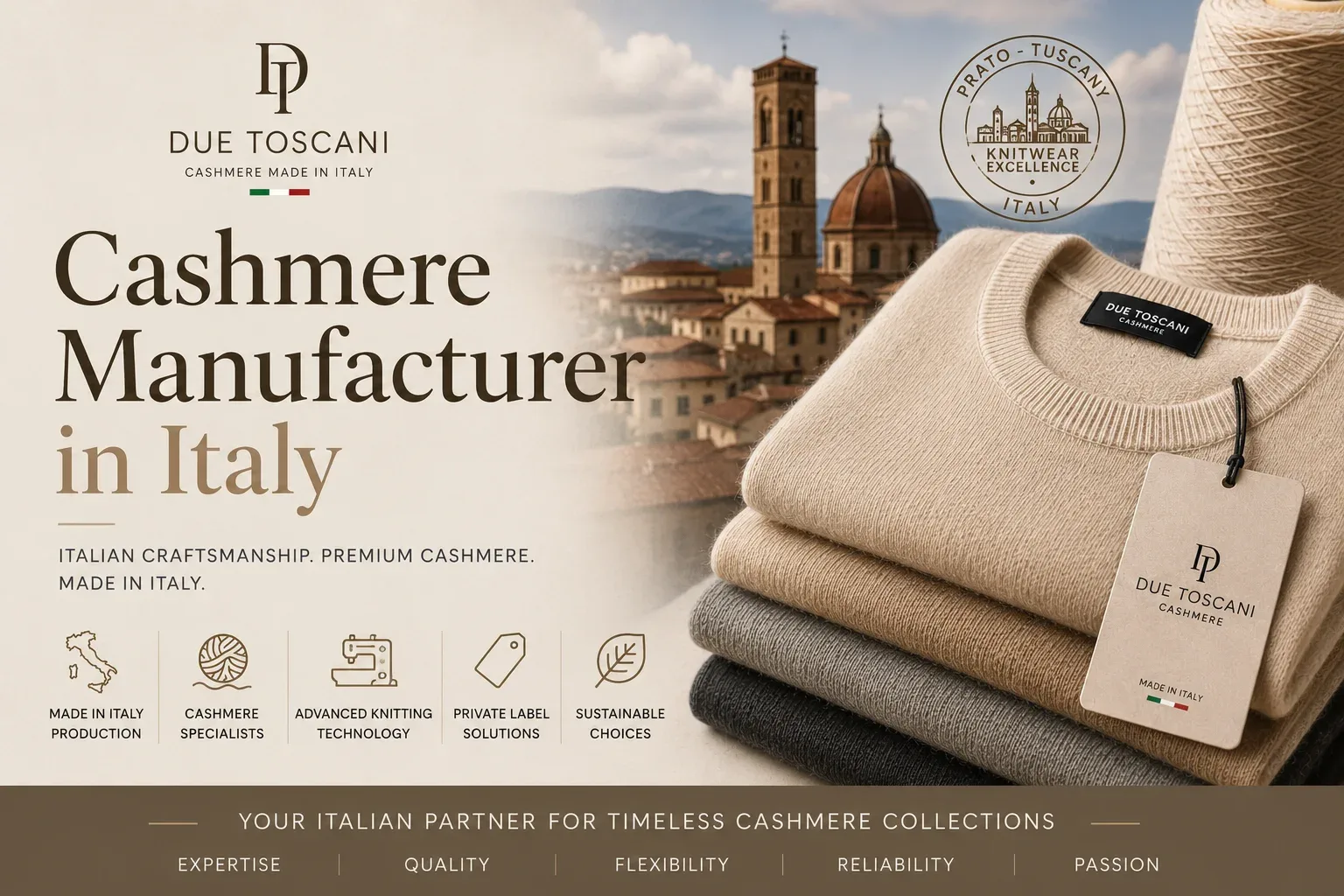
When fashion brands, boutiques, and concept stores search for a cashmere manufacturer in Italy, they are looking for much more than a supplier. They are looking for expertise, reliability, craftsmanship, flexibility, and the prestige that only authentic Made in Italy manufacturing can provide.
Italy has been recognized worldwide for excellence in textile production for generations, and within Italy, the textile district of Prato represents one of the most important centers for premium knitwear manufacturing.
At Due Toscani, we proudly continue this tradition by designing and producing high-quality cashmere knitwear entirely in Italy for international retailers and private label brands.
Why Choose an Italian Cashmere Manufacturer?
Choosing an Italian manufacturer means investing in quality, consistency, and long-term value.
Unlike mass production, Italian knitwear manufacturing focuses on:
Premium raw materials
Skilled craftsmanship
Advanced knitting technology
Attention to every production detail
Strict quality control
Sustainable manufacturing practices
The result is a product designed to last, both in quality and style.
Authentic Made in Italy Production
Today, the expression Made in Italy is often overused.
For us, it represents a complete production philosophy.
Every Due Toscani garment is developed and manufactured in the Prato textile district, where every production stage is carefully supervised:
Product development
Yarn sourcing
Knitting programming
Production
Linking and assembly
Washing and finishing
Quality inspection
Final packaging
This direct control ensures consistent quality and reliable production standards.
Specialists in Cashmere Knitwear
Unlike manufacturers producing multiple apparel categories, Due Toscani specializes exclusively in knitwear.
Our collections include:
Crew neck sweaters
V-neck sweaters
Turtlenecks
Cardigans
Polo sweaters
Hoodies
Ponchos
Scarves
Beanies
Gloves
Shawls
Coordinated accessories
Our expertise allows us to recommend the most suitable yarns, knitting gauges, constructions, and finishing techniques for every project.
Virgin Cashmere and Recycled Cashmere
One of our strengths is offering both luxury and sustainable solutions.
We manufacture collections using:
Virgin Cashmere
Premium-quality yarns for luxury collections with exceptional softness, warmth, and durability.
Recycled Cashmere
Sustainably produced Italian recycled cashmere that combines environmental responsibility with premium quality.
This allows brands to offer products for different market segments while working with a single trusted manufacturer.
Private Label Cashmere Manufacturing
Many of our customers want to create their own brand rather than sell existing labels.
Due Toscani offers complete Private Label manufacturing, including:
Custom designs
Exclusive colors
Personalized labels
Hang tags
Packaging
Size specifications
Brand identity customization
We transform your ideas into finished products while maintaining the highest manufacturing standards.
Advanced Italian Knitting Technology
Traditional craftsmanship alone is no longer enough.
Modern luxury knitwear combines artisanal expertise with cutting-edge technology.
Our production utilizes advanced Shima Seiki knitting technology to ensure:
Superior consistency
Precision knitting
Excellent fit
Efficient production
High-quality finishing
Technology supports craftsmanship—it never replaces it.
Flexible Manufacturing for Fashion Brands
Every customer has different needs.
Some require seasonal collections.
Others need ongoing production or regular replenishment.
We support:
Seasonal collections
Capsule collections
Wholesale production
Scheduled manufacturing
Repeat orders
Private Label programs
Our production model adapts to your business rather than forcing you into rigid manufacturing processes.
Working Directly with the Manufacturer
One of the biggest advantages of choosing Due Toscani is direct communication.
There are no unnecessary intermediaries between your brand and the production team.
This means:
Faster communication
Better technical support
Greater transparency
Shorter decision-making times
More efficient product development
Our customers work directly with the people responsible for manufacturing their collections.
More Than a Supplier
We don't simply manufacture garments.
We help brands develop successful collections.
Our team provides support in:
Yarn selection
Knit structures
Color development
Technical solutions
Production planning
Manufacturing optimization
We believe long-term partnerships create the best results for everyone.
Why International Brands Choose Due Toscani
Our customers choose us because they value:
Authentic Made in Italy production
Italian textile expertise
Cashmere specialization
Virgin and recycled cashmere collections
Private Label manufacturing
Flexible production
Direct communication
Reliable lead times
Premium quality standards
Long-term partnerships
The Value of Manufacturing in Prato
Prato is one of Europe's most important textile districts.
For decades it has been synonymous with:
Luxury fibers
Premium knitwear
Textile innovation
Sustainable manufacturing
Skilled craftsmanship
Manufacturing in Prato means becoming part of one of the world's most respected textile traditions.
Finding the right cashmere manufacturer in Italy means choosing more than production capacity.
It means selecting a partner capable of combining craftsmanship, technology, flexibility, and reliability.
At Due Toscani, we proudly manufacture premium Italian cashmere knitwear for boutiques, retailers, and fashion brands worldwide.
Whether you are launching your own label or expanding an established collection, we are ready to help transform your ideas into authentic Made in Italy products.
Utilizziamo i cookie per essere sicuri che tu possa avere la migliore esperienza sul nostro sito. Se continui ad utilizzare questo sito, assumiamo che tu sia d'accordo.
We use cookies to ensure you a better experience on our website. If you continue to use this site, we assume you are ok with it.