Recycled cashmere has become an increasingly interesting raw material for brands, boutiques, and fashion companies looking to combine the quality of cashmere with an approach focused on recovering and giving new value to existing resources.
But sourcing recycled cashmere is not simply a matter of asking a supplier: “Do you offer recycled cashmere?”
A professional buyer should be asking many more questions.
Where does the fibre come from? How is it recovered? Where is it turned into yarn? What is the actual percentage of cashmere? Is the yarn certified? What does GRS certification really mean? Does the certification apply only to the yarn or also to the finished garment? What are the minimum order quantities?
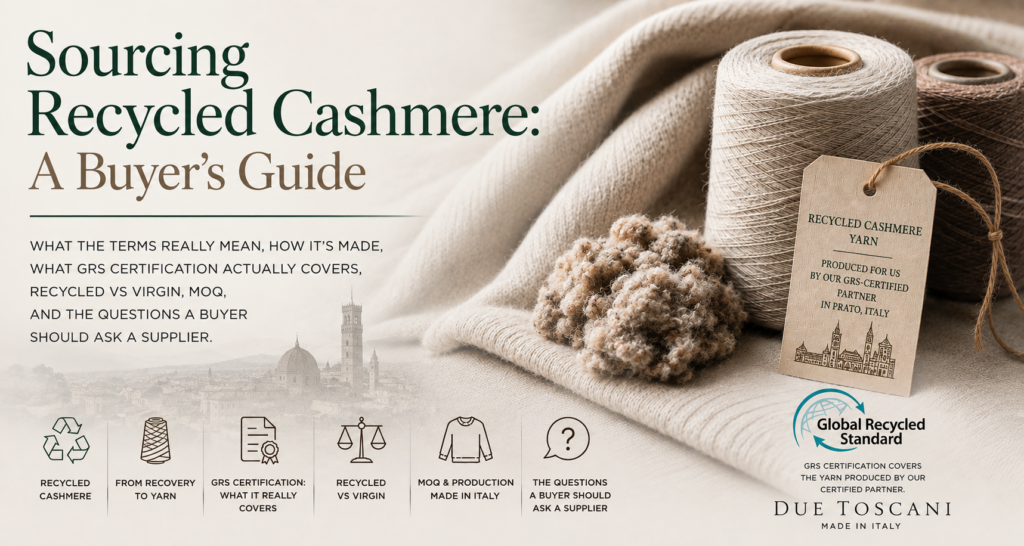
In the Prato textile district, textile fibre recovery has been part of the local industrial culture for generations. Due Toscani operates within this district and manufactures Made in Italy knitwear and accessories using, among other materials, recycled cashmere yarn that we have produced by a specialised GRS-certified partner in Prato.
However, it is important to clarify one fundamental point from the outset: the GRS certification applies to the recycled cashmere yarn that we have produced by our GRS-certified partner. Due Toscani and the subsequent knitwear production supply chain are not GRS certified. Consequently, we do not present or market our finished knitwear and accessories as GRS-certified products.
This distinction is important not only to describe our products correctly, but also to understand what a buyer should actually verify when a supplier talks about certified recycled cashmere.
What Does “Recycled Cashmere” Really Mean?
The first point to clarify is the meaning of the word recycled.
In the textile industry, buyers frequently encounter terms such as:
recycled cashmere;
regenerated cashmere;
reclaimed cashmere;
pre-consumer recycled;
post-consumer recycled.
These terms are not necessarily perfect synonyms.
Recovered material can come from different waste streams. Pre-consumer material is recovered before a product reaches the consumer, while post-consumer material comes from products that have already been used and are subsequently collected for recycling.
For this reason, the simple description “recycled cashmere” does not tell the whole story of the material.
A buyer should understand not only whether the cashmere is recycled, but also how it is recovered, processed, traced, and spun into yarn again.
How Is Recycled Cashmere Yarn Made?
Producing high-quality recycled cashmere yarn is considerably more complex than it may appear.
The process begins with the selection of the material to be recovered. This is a crucial stage because the quality of the incoming material will inevitably influence the quality of the finished yarn.
The selected material is prepared and mechanically processed to return it to a fibrous state. Fabrics and knitted garments are progressively opened and pulled apart until usable fibres can be recovered.
This process, however, has an important technical consequence: recovered fibres tend to be shorter than virgin fibres.
This is one of the main characteristics that differentiates recycled cashmere from virgin cashmere.
Producing a quality yarn therefore requires experience in raw-material selection, a deep understanding of fibres, and the ability to correctly manage spinning, yarn count, twist, and the subsequent knitting process.
This is also one of the reasons why Prato is historically one of the world's most important textile recycling districts. For generations, the area has developed an industrial supply chain specialised in sorting, recovering, and regenerating textile fibres.
Due Toscani's Recycled Cashmere
For Due Toscani, recycled cashmere is not simply a yarn selected from a supplier's catalogue.
We have our recycled cashmere yarn produced by a specialised GRS-certified partner in the Prato textile district.
This is an important distinction.
Our direct relationship with the company producing the yarn allows us to have a much closer understanding of the material we subsequently use to manufacture knitwear and accessories for both our own collections and our private-label customers.
We therefore understand not only the finished product, but also how the yarn behaves during production. This is particularly important with recycled cashmere, where the characteristics of the recovered fibre require experience and appropriate manufacturing parameters.
The garments are subsequently manufactured entirely in Italy through our production network, and we directly follow the different stages, from yarn selection and development through to the finished garment.
For a brand, this means working with a manufacturer that understands both the raw material and the processes required to transform it into knitwear.
What Does GRS Certification Really Mean?
One common mistake is to consider GRS – Global Recycled Standard as a generic certification stating that a product is simply “eco-friendly” or “sustainable”.
The concept is much more specific.
GRS is a voluntary international standard that includes verification of recycled content and its traceability throughout the supply chain, together with specific requirements established by the standard relating to social, environmental, and chemical practices.
One of its fundamental concepts is the chain of custody.
This means that simply using a certified raw material does not automatically allow every product manufactured from that material to be declared GRS certified.
And this brings us to one of the most important distinctions a buyer needs to understand.
A GRS-Certified Yarn Does Not Automatically Make a Sweater GRS Certified
Suppose a manufacturer uses a GRS-certified recycled cashmere yarn.
That yarn can be covered by the documentation provided within the yarn manufacturer's certified supply chain.
The yarn must then be transformed into a finished knitted garment.
Depending on the style, this process can involve numerous stages:
programming, knitting, linking or assembly, washing and finishing treatments, drying, pressing, quality control, and final finishing.
In order to maintain certification and the corresponding traceability through to the finished product, the relevant organisations and stages within the chain of custody must fall within the certification system required by the standard.
Therefore, the certification of the raw material cannot simply be transferred to the finished sweater.
There is a substantial difference between saying:
“This garment is made using GRS-certified recycled cashmere yarn.”
and saying:
“This garment is GRS certified.”
These are two very different statements, and a buyer should always ask the supplier which one actually applies.
The Due Toscani Case: Certified Yarn, Non-Certified Finished Garment
Due Toscani provides a practical example of this distinction.
We have our recycled cashmere yarn produced by a specialised GRS-certified partner in Prato, and the certification applies to the yarn manufactured by our partner within its certified supply chain.
The subsequent transformation of the yarn into knitwear and accessories takes place through Due Toscani's production network.
Due Toscani is not currently GRS certified, and some of the companies performing subsequent manufacturing processes within our production supply chain are not GRS certified.
For this reason, we do not declare or market our knitwear and accessories as GRS-certified finished products.
We believe it is important to communicate this distinction to our customers with complete transparency.
For Due Toscani, at least for the time being, obtaining certification for our company alone would have limited practical value if all the relevant external manufacturing stages required to produce the finished garment could not also be included within the certified chain.
Our approach is therefore straightforward:
we highlight the GRS certification of the recycled cashmere yarn that we have produced by our certified partner, but we do not extend that certification claim to the finished knitwear and accessories.
One Essential Question to Ask Any Supplier
When a manufacturer claims to use certified recycled cashmere, a buyer should ask one very precise question:
“Is the yarn you use GRS certified, or is the finished product you are selling me also GRS certified?”
The difference is fundamental.
If the supplier claims that the finished garment is also certified, the buyer should ask which certification applies and what documentation can be provided to support that claim.
The presence of a certified raw material within a production process should not be confused with certification of the entire finished product.
A serious supplier should be able to clearly explain to the buyer where the certified supply chain begins and where it ends.
GRS Does Not Automatically Mean “100% Recycled”
Another common misunderstanding concerns the percentage of recycled material.
The presence of GRS certification does not necessarily mean that a material consists of 100% recycled fibre.
For this reason, when purchasing yarn or finished garments, do not simply ask:
“Is it GRS certified?”
Also ask:
“What is the exact fibre composition of the yarn?”
A yarn may contain recycled cashmere together with other fibres. Buyers should therefore know precisely the composition and percentage of each component.
This is important regardless of certification.
What GRS Certification Does NOT Mean
GRS should not be interpreted as a universal certification covering every possible environmental characteristic of a product.
A serious certification system is primarily a tool for verification, control, and traceability according to defined requirements, rather than a marketing slogan.
Terms such as:
GRS certified, recycled, sustainable, responsible, or circular
should therefore be used accurately.
For a B2B buyer, it is important to look beyond the marketing claim and ask:
What exactly is certified? Who holds the certification? How far through the supply chain does the certification extend? Is the finished product actually certified?
Recycled Cashmere or Virgin Cashmere: Which Is Better?
Due Toscani's answer is very simple:
both.
They are two different materials, and we do not believe that one should automatically be considered superior to the other.
Virgin cashmere starts with new and generally longer fibres. It can offer exceptional softness, consistency, strength, and lightness and remains a fundamental raw material for high-end knitwear.
Recycled cashmere, on the other hand, starts with existing cashmere that is recovered and given a new life.
After the recovery process, the fibre has different characteristics and requires specific processing. The result can be an extremely pleasant, soft, high-quality garment, but it does not necessarily need to imitate a garment made from virgin cashmere in every respect.
They are two products with different characteristics and different stories.
For Due Toscani, therefore, the right question is not:
“Which one is better?”
but:
“Which material is best suited to the product, price point, and market positioning we want to achieve?”
The Price of Recycled Cashmere
There is another common misconception:
recycled means inexpensive.
Not necessarily.
Producing a quality recycled yarn requires collection, sorting, processing, fibre recovery, spinning, and quality control.
When a certified supply chain is involved, procedures, controls, documentation, and certification-related costs must also be considered.
The quality of the recovered raw material, fibre composition, yarn count, colour, quantities, and type of processing all influence the final cost.
For this reason, comparing two offers simply on the basis of the yarn price per kilogram — or the final price of a sweater — can be misleading.
First, a buyer needs to understand what is actually being compared.
MOQ: How Much Do You Need to Order?
MOQ – Minimum Order Quantity is one of the most important issues for small brands and new collections.
However, it is important to distinguish between at least two different levels:
yarn MOQ and finished garment production MOQ.
Producing a custom yarn colour may require different minimum quantities compared with using an existing colour.
Similarly, developing a completely new style involves different costs and production requirements compared with selecting a style that has already been developed.
For this reason, a buyer should provide the manufacturer with the following information from the beginning:
expected quantity;
number of styles;
number of colours;
size range;
desired fibre composition;
target price range;
destination market;
any certification requirements;
need for custom colours.
At Due Toscani, we work both with our own collections and with private-label production, including the development of styles supplied or designed directly by our customers.
Understanding the project before discussing MOQ alone often makes it possible to identify a much more efficient production solution.
Questions a Buyer Should Ask a Recycled Cashmere Supplier
Before choosing a recycled cashmere knitwear manufacturer, we recommend asking at least the following questions:
What is the exact fibre composition of the yarn?
What percentage is actually recycled cashmere?
Is the recycled material pre-consumer, post-consumer, or a combination of both?
Where is the raw material recovered and processed?
Where is the yarn produced?
Is the yarn GRS certified?
Who actually holds the GRS certification?
Does the certification apply to the yarn or also to the finished product?
How far through the supply chain is the certification maintained?
Can you provide the relevant documentation for the supply?
Which yarn counts and knitting gauges are available?
Which colours are already available?
Can custom colours be developed, and what is the MOQ?
What is the MOQ per style and colour for knitwear production?
Does the manufacturer have specific experience working with recycled cashmere?
Where are knitting, assembly, washing/finishing, and pressing carried out?
Can a prototype be developed before production?
What are the sampling and production lead times?
Can you provide private-label production with the customer's own labels and packaging?
What documentation will accompany the finished product?
The answers to these questions tell a buyer far more than price alone.
Traceability Before Marketing
Recycled cashmere represents an important opportunity for the fashion industry, but the increasing attention given to sustainability and recycling also makes accuracy in product claims more important than ever.
Terms such as recycled, sustainable, circular, and responsible should not be used simply as marketing tools.
For a B2B buyer, the priority should be understanding the actual supply chain behind the product.
Who produced the yarn? Where was it produced? What material was used? What is its composition? Who holds the certification? Which part of the supply chain is certified? Does the certification extend to the finished product, or does it stop at the raw material or yarn stage?
These questions are far more important than any slogan.
This is also why Due Toscani prefers to state exactly what we can document:
we have our recycled cashmere yarn produced by a GRS-certified partner in Prato, but we do not claim that our knitwear and accessories are GRS certified because Due Toscani and the subsequent production supply chain are not entirely GRS certified.
For us, transparency towards the buyer comes before the marketing claim.
Due Toscani: Recycled Cashmere and Knitwear Manufacturing in Prato, Italy
For Due Toscani, working with recycled cashmere means combining a tradition deeply rooted in the Prato textile district with the requirements of today's international fashion brands.
We have our recycled cashmere yarn produced by a specialised GRS-certified partner in Prato and use this yarn to manufacture Made in Italy knitwear and accessories.
We can work with styles from our own collections or develop private-label productions, starting from an existing garment, a technical specification, a photograph, a physical sample, or a customer's original design.
This gives buyers access to a manufacturing partner that understands both the finished product and the behaviour of the raw material used to create it.
Most importantly, it allows the buyer to understand precisely what is certified and what is not.
Because sourcing recycled cashmere should not simply mean purchasing a yarn or a sweater.
It means understanding the raw material, the manufacturing process, and the supply chain behind the product.
And in Prato, the recovery and transformation of textile fibres is not a recent trend: it is part of a manufacturing culture built over generations.
The recycled cashmere yarn is produced by a GRS-certified partner in Prato. Due Toscani's finished knitwear is not GRS-certified, so we do not market the garments as GRS-certified products.
Does a GRS-certified yarn make the finished sweater GRS-certified?
No. Certification follows a chain of custody. A certified yarn does not automatically make the finished garment certified unless every manufacturing stage is within the certified system.
Does GRS certification mean 100% recycled?
No. GRS verifies recycled content and traceability, but the material is not necessarily 100% recycled. Always ask for the exact fibre composition.
What should a buyer ask a recycled cashmere supplier?
Ask for the exact fibre composition, the recycled percentage, where the yarn is produced, who holds the GRS certificate, and whether it covers only the yarn or also the finished product.
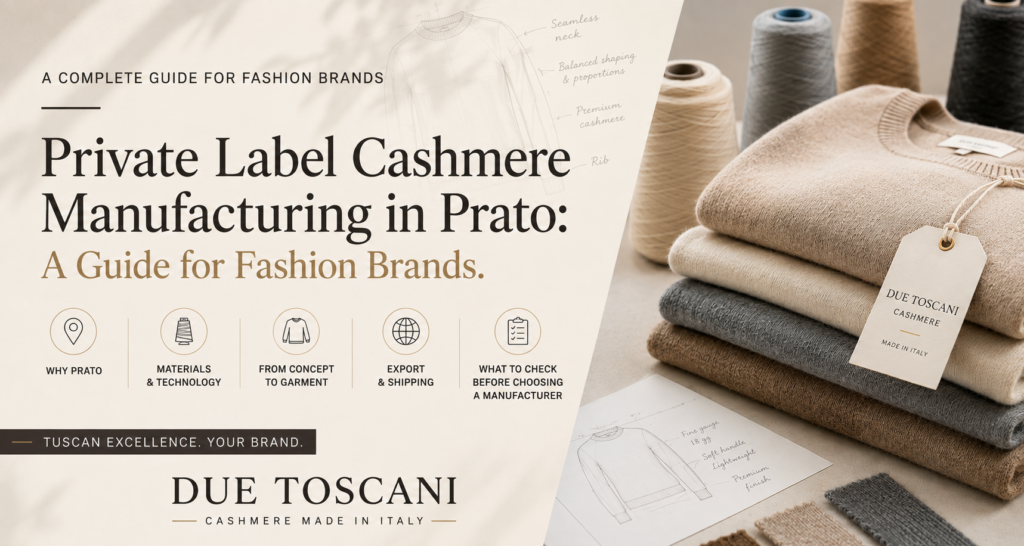
For a fashion brand looking to develop its own cashmere knitwear collection, choosing the right manufacturer is one of the most important decisions to make. It is not simply about finding someone capable of producing a sweater: it means finding a partner who can transform an idea, sketch, technical specification or existing sample into a product that can be manufactured consistently, while keeping quality, fit, costs and lead times under control.
Prato has been one of Italy’s leading textile and manufacturing districts for decades and offers an ecosystem particularly well suited to private label knitwear production.
Due Toscani, a company specialising in the production of cashmere knitwear and accessories, operates within this manufacturing district and provides a useful example of how Made in Italy private label production works in practice.
Why Manufacture Cashmere in Prato?
When people think of Prato, they often think primarily of fabrics and textiles. In reality, the district includes an extremely extensive network of specialised companies: spinning mills, knitwear manufacturers, programmers, dye houses, finishing and washing facilities, ironing specialists, garment makers, embroidery companies, label manufacturers, packaging suppliers and many other specialised businesses.
This means that many of the skills required to transform yarn into a finished garment are concentrated within the same geographical area.
For a fashion brand, this represents an important advantage.
Producing a knitted garment is not simply a matter of knitting yarn on a machine. Behind an apparently simple sweater there may be programming, tension tests, prototyping, garment assembly, washing, fulling, drying, pressing, label application and quality control.
Due Toscani works within the Tuscan textile district, coordinating these different areas of expertise, with the aim of providing customers with a single point of contact for the development and production of their collections.
What Does a Private Label Manufacturer Actually Do?
Private label does not simply mean attaching a customer's label to an existing product.
There are, of course, different levels of customisation. A brand may start with a style already developed by the manufacturer and modify its colour, yarn, measurements or details. Alternatively, it may want to develop an entirely new garment.
At Due Toscani, for example, customers can work either from styles already available in the company's collections or develop completely customised products.
The starting point can be:
a technical specification or tech pack;
a sketch;
a photograph;
a rendering;
a physical sample;
an existing garment to be reinterpreted;
or simply an idea accompanied by measurements and style indications.
The more accurate the initial information, the easier it will be to transform the project into a successful prototype.
From an Idea to a Sweater: The Production Process
One of the aspects that often surprises brands approaching knitwear production for the first time is the complexity involved in prototyping.
A new garment must first be interpreted from a technical point of view.
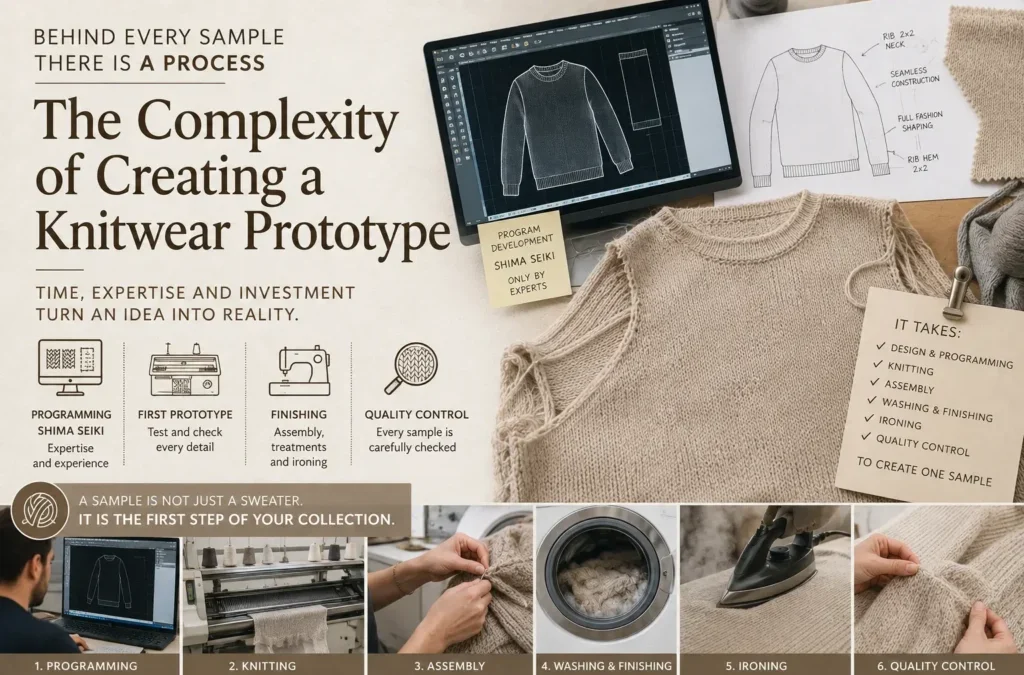
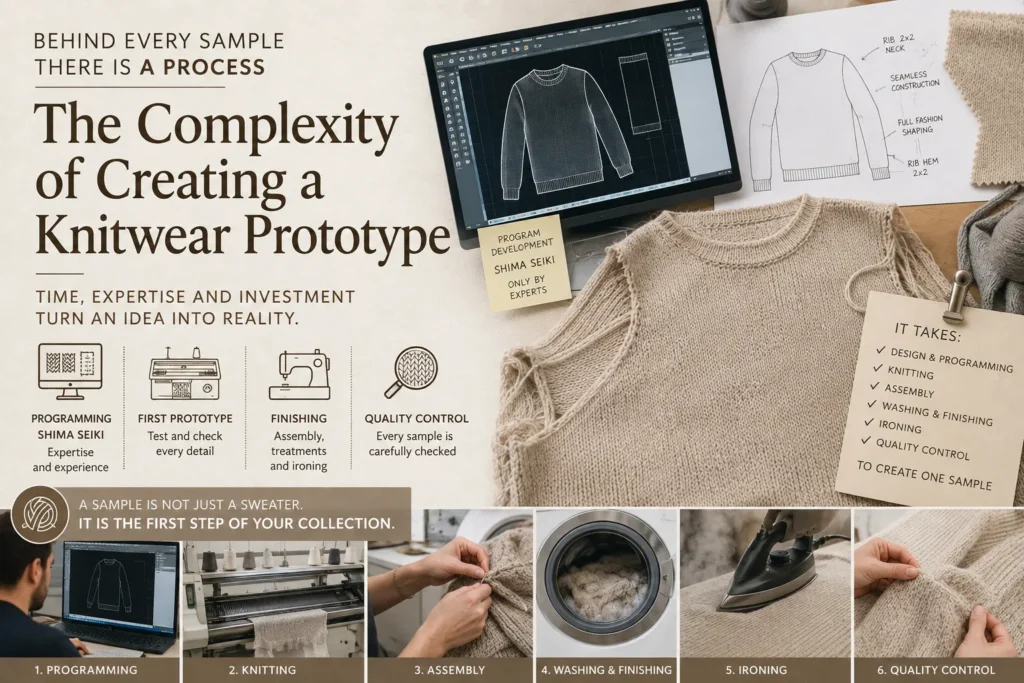
With electronic knitting machines, a specific machine programme must be created. This is not simply a graphic file: the programme determines the garment construction, decreases, increases, knitting structures, stitches, tensions and many other parameters.
Due Toscani uses Shima Seiki technology, both for traditional knitwear production and for integral/seamless knitting. Programming therefore requires skilled technicians with specific experience and training on these machines.
Once the programme has been created, the first garment is knitted. In some cases, it can be advisable to produce an initial test using a less expensive trial yarn, allowing the construction and programme to be checked before using a more valuable cashmere yarn.
The prototype then goes through the other required stages: assembly when necessary, finishing, washing or fulling, drying, pressing and quality control.
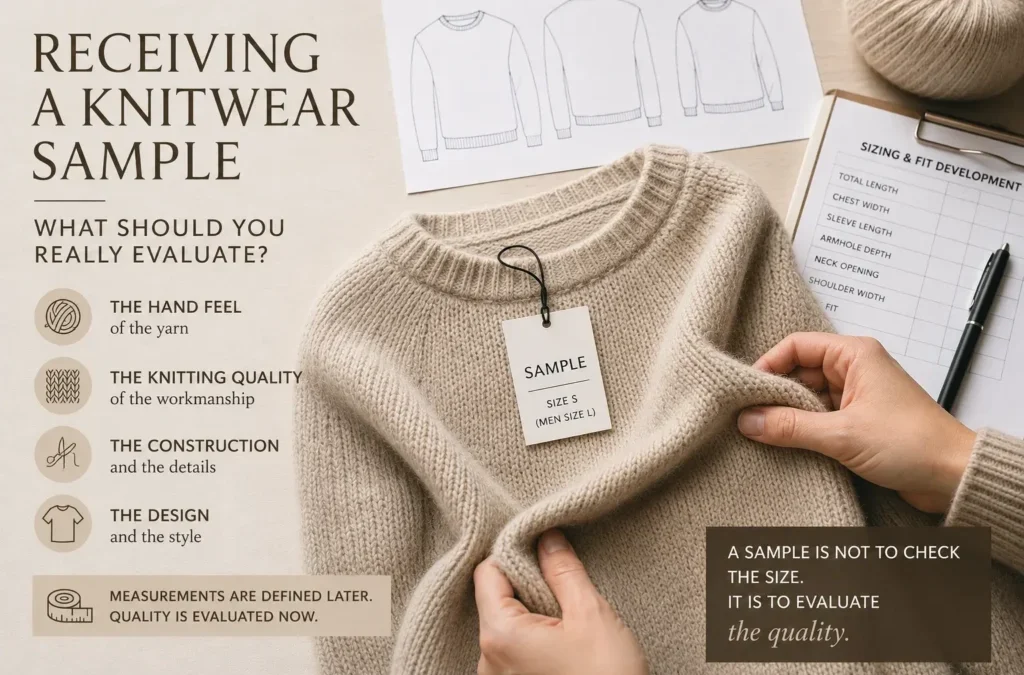
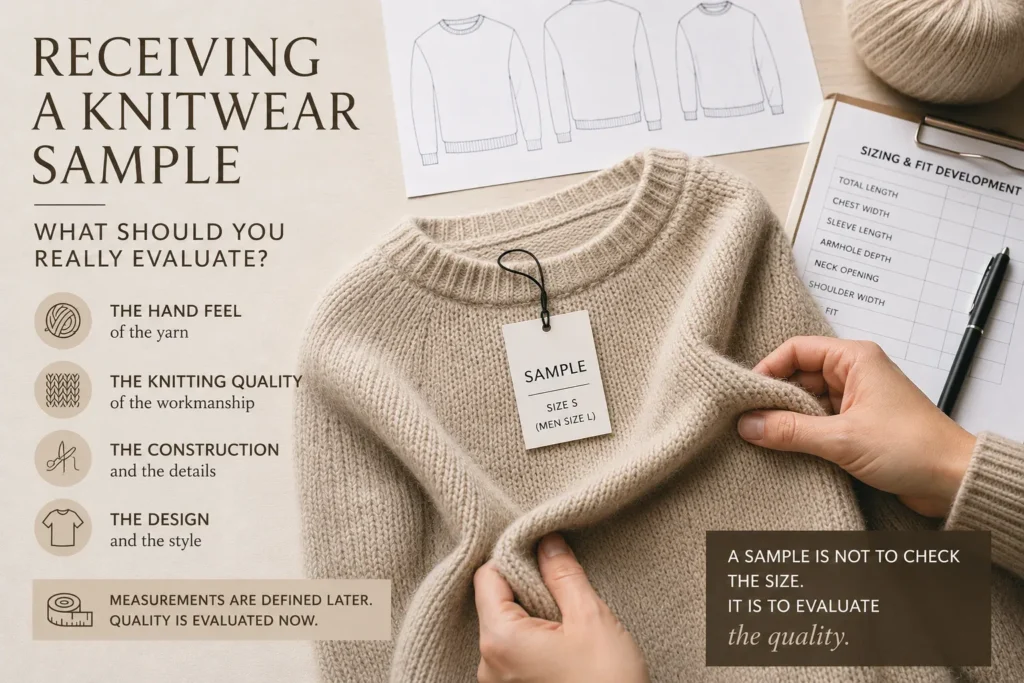
Only after these stages can the result be properly evaluated.
The sample may require adjustments to the fit, measurements, length, proportions or construction. Once the final prototype has been approved, the style can move into production.
A Sample Is Not Yet Production
This is an important concept, especially for new fashion brands.
A prototype is a product development tool.
Its purpose is to create the final product that can subsequently be replicated in production. For this reason, producing a single sample can have an apparently high cost compared with the unit price of the same garment during a production run.
Development costs include programming, machine preparation, yarn, machine time, garment assembly, finishing, pressing and quality control, as well as any modifications that may be necessary.
Due Toscani therefore considers sampling to be a genuine product development phase, rather than simply the production of a single sweater.
MOQ: How Many Pieces Do You Need to Produce?
MOQ – Minimum Order Quantity – is the minimum production quantity required by a manufacturer to make a production run economically sustainable.
In Italian knitwear manufacturing, the MOQ depends on several factors, including the style, yarn, colours, complexity of the knitting process and production organisation.
Due Toscani also works with relatively small brands and businesses and, for private label production, the usual reference MOQ is 50 pieces, although this should always be evaluated according to the specific project.
It is important to discuss MOQ from the very beginning because developing many different styles with only a few pieces per style can make the economics of a collection very different from a production concentrated on fewer styles and larger quantities.
For a new fashion brand, it can therefore be much more effective to begin with a carefully designed capsule collection rather than immediately developing a very large range.
Which Materials Should You Choose?
Cashmere does not necessarily mean one single type of yarn.
One of the first decisions concerns the choice between virgin cashmere and recycled cashmere. There is not necessarily one material that is universally “better” than the other: they are two different products with different characteristics, aesthetics, costs and market positioning.
Due Toscani manufactures garments in both high-quality virgin cashmere and recycled cashmere, as well as extra-fine merino wool and premium blends such as merino/silk.
Another fundamental distinction is between woollen-spun and worsted-spun yarns.
Woollen-spun cashmere can provide a softer, fuller, warmer and more traditional hand, while worsted-spun yarn can be used to create garments that are generally finer, lighter and cleaner in appearance.
Machine gauge also has a major impact on the final result.
Due Toscani works with different gauges and can develop both fuller, heavier knitwear and extremely fine garments, including worsted knitwear produced on 18-gauge WholeGarment machines, particularly suitable for premium and luxury collections.
The choice should therefore begin with the result the brand wants to achieve, rather than simply with the name of the fibre.
Seamless Knitwear and WholeGarment Technology
Another option for brands looking to develop particularly refined products is integral garment construction.
With Shima Seiki WholeGarment technology, certain types of garments can be knitted without traditional side seams.
The result can provide greater comfort, cleaner construction and a distinctive fit.
Due Toscani also uses this technology for private label production, particularly for projects where lightness, comfort and construction quality are important elements of the product's positioning.
Labels, Customisation and Packaging
A private label production should reach the customer ready to be marketed.
For this reason, even elements that may initially appear secondary should be defined from the beginning: brand labels, composition and care labels, size labels, hangtags, packaging and packing requirements.
Due Toscani can manage productions intended to be sold directly under the customer's own brand, coordinating the agreed customisation during the development process.
The brand should, however, provide logos, artwork, company information and all other details required for label production in good time.
Export and Shipping
Working with an Italian manufacturer does not mean that the customer has to be based in Italy.
Due Toscani works with international B2B customers and can manufacture collections intended for both European and non-EU markets.
Before placing an order, it is important to clarify:
delivery address and destination country;
shipping method;
transport costs;
required documentation;
customer's VAT status;
any customs procedures;
import duties and charges in the destination country.
For non-EU shipments in particular, the brand should check the regulations applicable in its own market in advance.
The manufacturer can prepare the commercial documentation required for shipment, while customs duties, local taxes and import procedures depend on the destination country and the commercial terms agreed between the parties.
How to Prepare a Good Brief for Your Manufacturer
A well-prepared brief can significantly reduce development time, misunderstandings and costs.
Before contacting Due Toscani – or any other knitwear manufacturer – it is useful to prepare at least the following information:
Product type – crew neck, cardigan, turtleneck, polo, dress, scarf, beanie, etc.
Men's, women's or unisex.
Preferred material – virgin cashmere, recycled cashmere, merino wool, merino/silk, etc.
Desired weight and hand feel – lightweight, medium, heavy, soft, compact, dry, etc.
Measurements or size chart.
Expected quantities.
Number of colours.
Target market and product price positioning.
Photographs, sketches, tech packs or reference samples.
Approximate date by which the production should be available.
It is not essential for the customer to know the machine gauge or exact yarn count.
That is part of the manufacturer's expertise.
For example, a customer might simply tell Due Toscani: “We would like a very lightweight women's crew neck, clean and soft, seamless and with a luxury feel.”
The manufacturer can then evaluate the most appropriate yarn, yarn count, machine gauge and construction.
What Should You Check Before Choosing a Cashmere Manufacturer?
Price is important, but it should not be the only criterion.
Before entrusting a collection to a manufacturer, it is advisable to understand where the garments are actually produced, which technologies are used and who is responsible for product development.
It is also useful to check:
specific experience in knitwear manufacturing;
ability to develop new styles from scratch;
availability of specialised programmers;
types of knitting machines used;
origin and quality of the yarns;
sampling capabilities;
MOQ requirements;
production lead times;
quality control procedures;
private label capabilities;
export experience;
clarity and reliability of communication.
Another fundamental question is: who will be my point of contact throughout the project?
For a small or medium-sized brand, having direct communication with someone who genuinely understands production can be far more important than it may initially seem.
This is one of the principles behind Due Toscani's B2B service: a direct relationship between the fashion brand and the manufacturer, without turning the development of a collection into a long chain of intermediaries.
Visiting the Manufacturer Can Make a Difference
Whenever possible, it can be extremely useful to visit the manufacturer in person, particularly for an important project.
Seeing the machines, yarns, samples and production processes makes it much easier to understand what can actually be achieved.
For brands that cannot immediately travel to Italy, an initial video call with Due Toscani can be enough to discuss the project, review references, talk about materials, quantities and objectives, and determine whether the right conditions exist to move forward with development.
Due Toscani: Private Label Knitwear Manufacturing in the Prato Textile District
Choosing Prato means working within a region that has built its identity around textiles and manufacturing.
Due Toscani produces Made in Italy knitwear and accessories in virgin cashmere, recycled cashmere, extra-fine merino wool and other premium fibres, developing both its own collections and private label productions for boutiques, retailers and fashion brands.
Thanks to Shima Seiki technology, the ability to work with different machine gauges and collaboration with a network of specialised companies within the local textile district, projects can be followed from yarn selection through to the finished garment.
For a fashion brand that already has a tech pack, a physical sample or simply a few reference images, the first step does not necessarily have to be an order.
It can simply be a conversation.
Reviewing the style, material, expected quantities and brand positioning together makes it possible to understand how the garment can be produced, which technology and yarn are most appropriate, and what the approximate costs will be.
And that is where good private label manufacturing should begin: not with the knitting machine, but with a clear understanding of the product the brand wants to create.
It means a manufacturer develops and produces cashmere knitwear that you sell under your own brand — from a tech pack, sketch, photo or existing sample through to the finished garment.
What is the minimum order quantity (MOQ)?
For private-label production the usual reference MOQ is 50 pieces per style, always evaluated according to the specific project.
Which materials can Due Toscani work with?
Virgin cashmere, recycled cashmere, extra-fine merino wool and premium blends such as merino/silk, in different gauges including 18-gauge WholeGarment for premium collections.
Do you produce for international brands?
Yes. Due Toscani works with international B2B customers and can manufacture collections for both EU and non-EU markets.
It is one of the questions we receive most frequently.
Many people imagine that producing a sample simply means loading yarn onto a knitting machine and waiting for a sweater to come out.
The reality is very different.
When developing a new knitwear style, the garment does not yet exist.
It has to be designed, programmed, tested, refined and perfected before it can go into production.
A sample is not just a sweater.
It is the beginning of an entirely new product.
Every Sample Starts with an Idea
A new knitwear sample can begin in many different ways.
A customer may provide:
a photograph;
a fashion sketch;
a technical specification sheet (tech pack);
an existing garment;
or simply an idea to develop.
Regardless of the starting point, that is where our work begins.
The Machine Program Doesn't Exist Yet
A Shima Seiki computerized knitting machine cannot automatically produce a new style.
Every garment requires its own dedicated knitting program.
This program contains all the instructions the machine needs to produce the garment correctly, including:
garment shape;
stitch structure;
increases and decreases;
rib constructions;
neckline;
sleeves;
shoulders;
knitting tensions;
yarn feeders;
and the complete knitting sequence.
In other words, it is the digital blueprint of the garment.
Creating the Program Requires Years of Experience
The knitting program is not generated automatically.
It is developed by a highly skilled Shima Seiki programmer.
Becoming a professional knitwear programmer requires specialized training, dedicated Shima Seiki courses and years of practical experience.
It is one of the most specialized professions in the knitwear industry.
Every stitch, every shaping detail and every technical element must be carefully planned and programmed.
How Long Does It Take?
The answer depends entirely on the complexity of the design.
A simple plain-knit crewneck requires far less development than a garment featuring:
cable patterns;
textured stitches;
jacquard knitting;
intarsia;
plated constructions;
seamless (WholeGarment®) technology;
or complex shaping details.
Some programs can be completed within a few hours.
Others may require several days of development.
The First Sample Is Rarely Perfect
Once the knitting program has been completed, the machine produces the first prototype.
However, this is only the beginning of the development process.
The first sample is usually created to verify that every aspect of the garment works correctly.
During this stage it is common to adjust:
knitting tension;
shaping;
measurements;
neckline construction;
shoulder balance;
rib details;
or simply improve the overall fit.
For this reason, the first sample should always be considered a prototype rather than a finished product.
A Test Yarn Is Often Used
When the final yarn is particularly valuable, it is common practice to produce the first prototype using a less expensive test yarn.
This allows us to verify:
the knitting program;
the garment construction;
the measurements;
and any technical issues that may need correction.
Only after the program has been fully approved is the sample produced using the final yarn.
In the case of cashmere, this approach helps avoid unnecessary material waste.
The Work Doesn't End When the Machine Stops
Once the knitting machine has finished, the garment is still far from complete.
Several additional production stages are required, including:
removing the garment from the machine;
checking every knitted panel;
linking or fully assembling the garment;
trimming loose yarns;
washing or fulling when required;
drying;
pressing;
and carrying out a final quality inspection.
Only then is the sample ready for evaluation.
How Much Does Sample Development Cost?
This is another question we hear very often.
The answer is simple.
You are not paying only for a sweater.
You are investing in the entire product development process.
The cost includes:
design analysis;
Shima Seiki programming;
the programmer's work;
machine time;
yarn consumption;
garment assembly;
washing and finishing;
pressing;
quality control;
and, when necessary, additional testing and program revisions.
In many cases, the programming alone may cost between €100 and €300, depending on the complexity of the style, before considering machine time, materials and all subsequent production processes.
Why We Charge for Sample Development
Some customers are surprised that developing a prototype involves a separate charge.
In reality, the fee covers only part of the investment required.
Creating a knitwear sample involves hours of highly specialized work and the collaboration of several skilled professionals.
For this reason, we are always happy to develop samples for customers who are genuinely interested in moving forward with production.
A sample is not simply a garment to purchase.
It is the first investment in your future collection.
Behind Every Sample Is a Team
Many people are surprised to discover how many professionals contribute to the development of a single knitwear sample.
Depending on the project, a prototype may involve:
the customer or fashion designer;
the Shima Seiki programmer;
the knitwear technician;
the knitting machine operator;
the linking and assembly specialist;
the washing and finishing department;
the pressing specialist;
the quality control inspector;
the production manager who oversees the entire process.
When you realize that up to nine skilled professionals may contribute to a single prototype, it becomes much easier to understand why developing a sample cannot cost only a few euros.
It is a genuine research and development process.
A Great Sample Is an Investment, Not an Expense
Every successful knitwear collection begins with a well-developed sample.
The more care, expertise and attention invested during this stage, the smoother and more efficient production will be later.
That is why we consider sample development to be one of the most important phases of the entire project.
Because this is the moment when an idea stops being just a sketch and becomes a real knitwear garment.
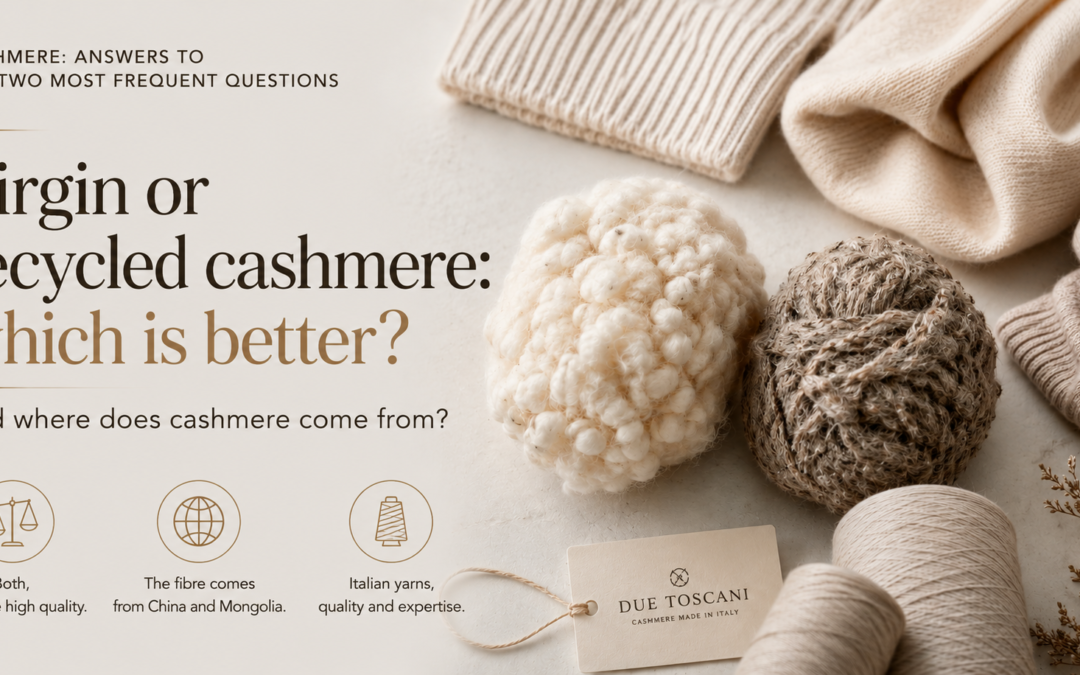
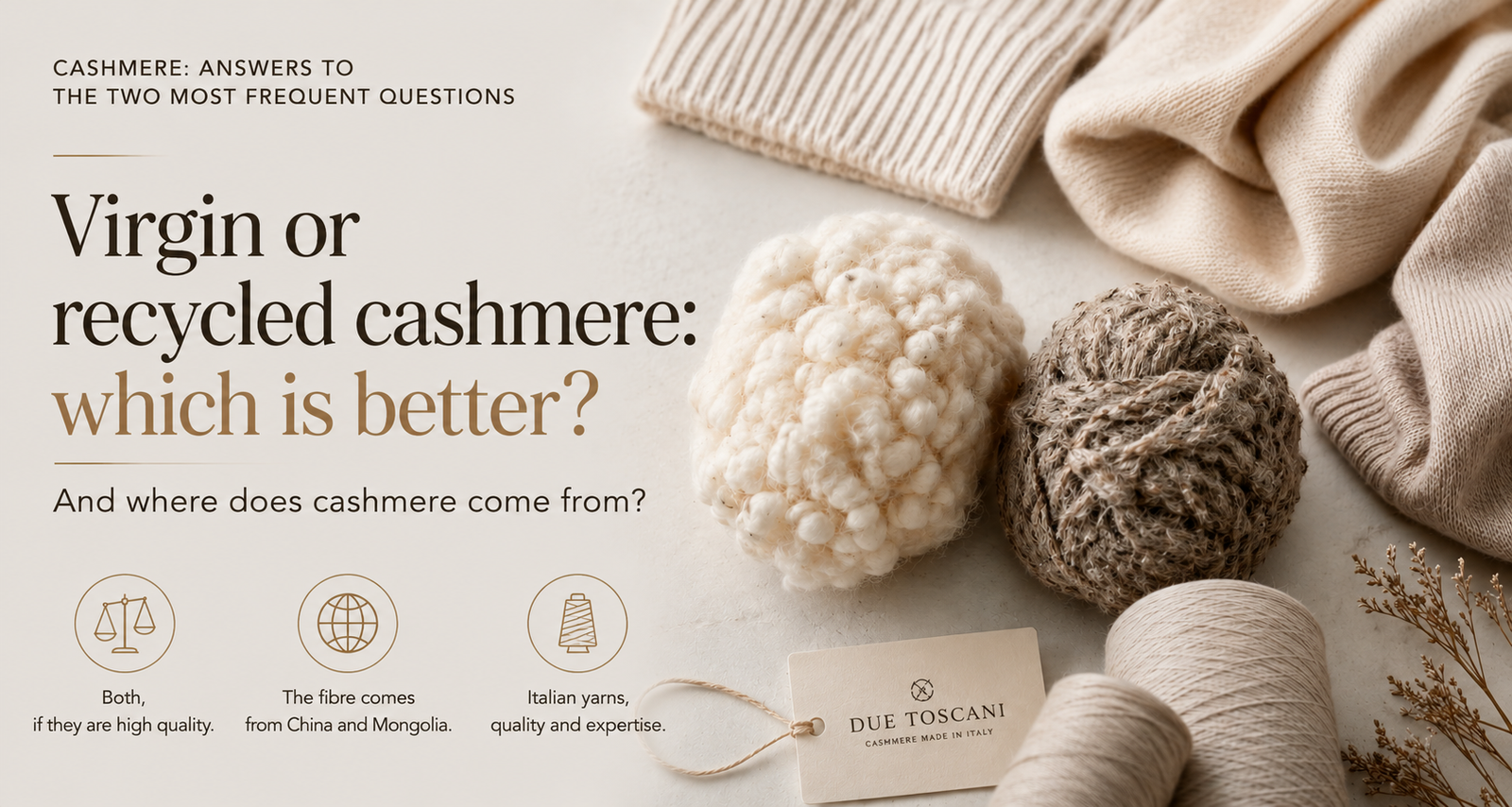
There are two questions we have been receiving very frequently lately from customers, buyers, retailers and brands contacting us to develop their own collections:
1. Which is better: virgin cashmere or recycled cashmere?
2. Where does cashmere come from?
These are two very interesting questions because they give us the opportunity to clarify some aspects of cashmere that are still often misunderstood.
Let’s start with the first one.
Which Is Better: Virgin or Recycled Cashmere?
Our answer is simple:
Both.
High-quality virgin cashmere and high-quality recycled cashmere are both excellent materials.
They are different.
They have different origins, are obtained through different processes and can have different characteristics, both to the touch and in the finished garment.
But different does not mean better or worse.
The real distinction should not simply be between virgin cashmere and recycled cashmere.
It should be between high-quality cashmere and poor-quality cashmere.
Not All Virgin Cashmere Is the Same
Virgin cashmere is produced from the fibre obtained from the undercoat of cashmere goats.
It is an extraordinarily fine, soft and insulating fibre which, when it is of good quality and properly processed, can be used to create exceptional yarns and knitwear.
But there is one very important thing to remember:
the words “100% cashmere” indicate the composition, not the quality.
Two sweaters can both have “100% cashmere” written on their labels and yet be completely different.
The quality of the fibre depends on several factors, including fineness, length, uniformity and the selection of the raw material.
And then there is everything that happens afterwards.
The quality of the spinning, dyeing, yarn count, number of plies, machine gauge, knit construction and finishing process all contribute to the final result.
This is why there are exceptionally high-quality virgin cashmeres as well as much more commercial-quality virgin cashmeres.
Simply saying “it is virgin cashmere” is not enough to determine the quality of a garment.
What About Recycled Cashmere?
The same principle applies to recycled cashmere.
Once again, everything starts with the quality of the raw material and how carefully it is selected.
Recycled cashmere is obtained by recovering cashmere-containing materials, carefully sorting them and processing them back into fibre.
That fibre can then be used to produce a new yarn and, subsequently, a new garment.
The quality of the final result depends on the quality of the original material, the sorting process, the knowledge of the fibres and the way in which the entire recycling and spinning process is carried out.
High-quality recycled cashmere can be extremely soft, warm, pleasant to the touch and beautiful to wear.
It will have different characteristics from virgin cashmere, but that does not automatically make it inferior.
It is simply another way of using cashmere.
Recycled Cashmere Is Not “Second-Class Cashmere”
This is probably one of the points we care about most.
Automatically considering recycled cashmere to be a cheaper or lower-quality version of virgin cashmere is an oversimplification.
There is excellent recycled cashmere, just as there is mediocre virgin cashmere.
Once again, everything depends on the raw material and how it is processed.
Recycled cashmere also introduces another important element: the ability to recover a precious fibre and give it a new life.
And when we talk about recovering textile fibres, we inevitably talk about Prato.
In Prato, Textile Recycling Is Not a Recent Trend
Today, there is a great deal of discussion about the circular economy, raw material recovery and sustainability.
In the textile district of Prato, these practices have existed for generations.
The sorting of garments and textile waste, separation by composition and colour, fibre recovery and transformation into new raw material are all part of the industrial history of our area.
Behind these processes are skills that cannot simply be acquired by purchasing a machine.
They require experience, knowledge of fibres and the ability to recognise and correctly select different materials.
For this reason, recycled cashmere is not simply an alternative to virgin cashmere for us.
It also represents part of the textile culture we come from.
So, Virgin or Recycled Cashmere?
Both.
We use both and we believe in both.
We may choose virgin cashmere when we are looking for certain characteristics and recycled cashmere when we are looking for others.
We may prefer the feel of one or the other.
We may choose according to the garment, the project, the price point, the positioning of the collection or the philosophy of the brand.
But there is no rule saying that virgin automatically means “better” and recycled automatically means “worse”.
For us, the fundamental question remains:
Is it good cashmere?
Second Question: Where Does Cashmere Come From?
This is another question we are asked very frequently.
And here we need to distinguish between at least three things:
the origin of the fibre, where the yarn is produced, and where the garment is manufactured.
These are three different things.
Where Does Cashmere Fibre Come From?
Cashmere fibre comes from the undercoat of cashmere goats.
These animals live mainly in areas of Asia characterised by particularly harsh climatic conditions.
The main cashmere-producing regions are located in China and Mongolia, as well as other areas of Central Asia.
To protect themselves from extremely cold winters, cashmere goats develop a very fine, soft and insulating undercoat beneath their longer, coarser outer hair.
It is this exceptionally fine fibre that we are interested in.
After collection, the raw material must be sorted, cleaned and separated from the coarser hairs. Only part of the material collected will therefore become the cashmere fibre used to produce yarn.
So Does Italian Cashmere Exist?
It depends on what we mean by the expression.
If we are talking about the origin of the fibre, the cashmere used by the Italian textile industry comes mainly from Asia.
But this certainly does not mean that there cannot be cashmere yarn produced in Italy or, of course, cashmere knitwear Made in Italy.
And this is where confusion often arises.
The origin of the raw material is one thing.
Where and how that raw material is transformed is another.
From Asian Fibre to Italian Yarn
Cashmere fibre originating from Mongolia or China can be purchased, selected and subsequently transformed in Italy by an Italian spinning mill.
Spinning is a fundamental part of the process.
Having access to good fibre is not enough to automatically produce an exceptional yarn.
It requires knowledge of the raw material, experience, technology, selection expertise, preparation, blending, spinning, dyeing and quality control.
Italy is home to some of the world’s most prestigious and specialised cashmere spinning mills.
And these are the companies we rely on for our virgin cashmere production.
The Virgin Cashmere Yarns We Use
For our virgin cashmere knitwear, we use yarns produced in Italy by some of the finest Italian spinning mills.
The yarn is selected according to the garment we need to produce.
There is no single yarn that is ideal for everything.
A substantial sweater knitted on a particular gauge, an extremely lightweight garment produced on a high-gauge machine, a scarf, a shawl or a seamless garment may all require yarns with different characteristics.
For us, choosing the yarn therefore means starting with the result we want to achieve.
And What About Our Recycled Cashmere?
In the case of recycled cashmere, our involvement with the yarn is even more direct.
The recycled cashmere yarn we use is produced by us in collaboration with a specialised partner in the Prato textile district.
This allows us to be directly involved in the selection of the raw material and in the production of the yarn that will subsequently be used in our collections and in the garments we manufacture for our customers.
And it is significant that this takes place in Prato.
Because here, fibre regeneration is not simply a manufacturing technique.
It is part of our industrial history.
And Finally, There Is the Knitwear
At this point, we have the fibre and we have the yarn.
But one fundamental step is still missing: transforming that yarn into a knitted garment.
This is where our work begins.
The choice of machine gauge, programming, stitch construction, tensions, knitting, linking and assembly where required, finishing, washing, fulling, pressing and final quality control can all have a profound effect on the final result.
The same yarn, worked in two different ways, can produce two garments with completely different looks and handles.
This is why the quality of a cashmere sweater cannot be explained simply by reading the composition on its label.
Behind a good garment lies an entire supply chain.
Fibre, Yarn and Knitwear: Three Different Origins
We can therefore summarise the journey very simply.
Cashmere fibre originates mainly in Asia.
The virgin cashmere yarns we use are produced in Italy by some of the finest Italian spinning mills.
Our recycled cashmere yarn is produced by us in collaboration with a specialised partner in Prato.
Our knitwear is manufactured in Italy.
These are different stages of the same story.
And it is important to understand them because when we purchase or develop a cashmere product, we are not simply purchasing a fibre.
We are purchasing the result of a long chain of skills and expertise.
So, in the End, Which Cashmere Is Better?
Let’s return to the question we started with.
Virgin cashmere or recycled cashmere?
Both.
As long as the raw material is good.
As long as the yarn is well made.
As long as the right manufacturing process is chosen.
And as long as the people transforming that yarn into knitwear really know what they are doing.
Because the quality of cashmere does not come from a single word written on a label.
It comes from the raw material, knowledge and experience of all the people who transform it.
Utilizziamo i cookie per essere sicuri che tu possa avere la migliore esperienza sul nostro sito. Se continui ad utilizzare questo sito, assumiamo che tu sia d'accordo.
We use cookies to ensure you a better experience on our website. If you continue to use this site, we assume you are ok with it.